Postponement of Fukuoka Plant Construction
Pressure from Low-Cost Chinese Products and Declining Profits
Will Toyota Fall Behind in the EV Driving Range Competition?
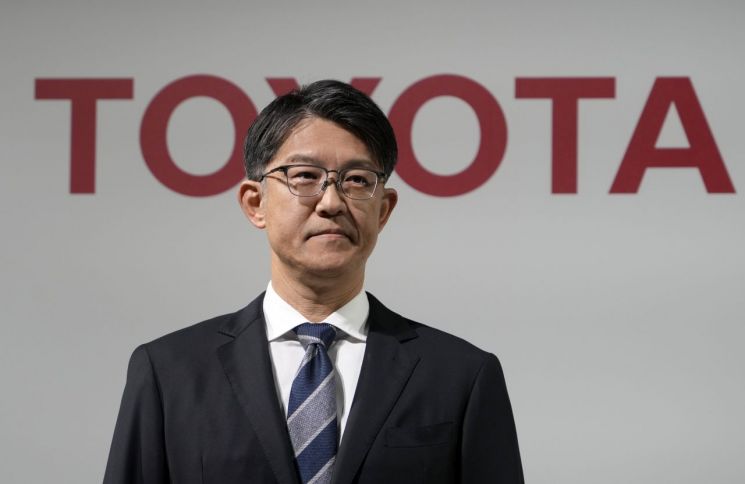 Koji Sato, President of Toyota Motor Corporation Japan, is holding a press conference in Tokyo, Japan, on February 13 last year. / Photo by EPA and Yonhap News
Toyota Motor has decided to postpone the construction of its next-generation battery factory planned in Fukuoka Prefecture, Japan, the Asahi Shimbun reported on the 24th. The decision is believed to be influenced by the slower-than-expected growth in the electric vehicle (EV) market and the burden of decreased operating profits due to the aggressive competition from low-cost Chinese products.
Toyota Battery, a battery production subsidiary, was responsible for the construction and operation of the factory, with plans to start production in 2028. The next-generation batteries produced at the new factory were intended to be installed in Lexus’s next-generation EV models, Toyota’s luxury car brand. The goal was to double the driving range per charge to about 1000 km, twice that of current EVs, and reduce production costs by 20%. Koji Sato, CEO of Toyota Japan, is expected to visit the Fukuoka Prefectural Office soon to report the decision to delay construction, according to the Asahi Shimbun.
This decision is presumed to reflect concerns over the global EV demand being weaker than expected, coupled with the rising competition from low-cost Chinese EV companies such as BYD. Additionally, inflation in Japan, including rising material and labor costs, is also believed to have had an impact. Global EV sales in 2023 were recorded at 14 million units, a 35% increase from the previous year. In 2024, sales are projected to reach 17 million units, a 20% increase from the previous year. Although the upward trend continues, there are indications that the growth rate is slowing.
Expansion of battery investments has also been cited as one of the reasons behind Toyota’s recent decline in profitability. Costs related to investments in electric vehicles (EVs), hybrid vehicles (HVs), and automotive batteries have contributed to the decrease in profits. In fact, for the first to third quarters of fiscal year 2025 (April 1, 2024 ? December 31, 2024), Toyota’s sales increased by 4.9% year-on-year, while operating profit decreased by 13.2%.
Meanwhile, Toyota had previously set targets of selling 1.5 million EVs worldwide by 2026 and 3.5 million by 2030. However, as of February this year, the company announced that it would not withdraw these targets.
© The Asia Business Daily(www.asiae.co.kr). All rights reserved.
![Clutching a Stolen Dior Bag, Saying "I Hate Being Poor but Real"... The Grotesque Con of a "Human Knockoff" [Slate]](https://cwcontent.asiae.co.kr/asiaresize/183/2026021902243444107_1771435474.jpg)
















