The Ministry of National Defense's Remains Recovery and Identification Unit announced on the 24th that it will conduct remains excavation to find United Nations forces who participated in the Korean War on Gopado Island, Palbong-myeon, Seosan-si, Chungnam, until April 11. The unit estimates that the remains to be excavated belong to a fighter pilot of the South African Air Force.
This excavation began when the unit, during an investigation of remains locations around Boryeong-si and Seosan-si, Chungnam, in May last year, heard from a resident who had lived on Gopado Island in the past about a story related to a U.S. military aircraft crash.
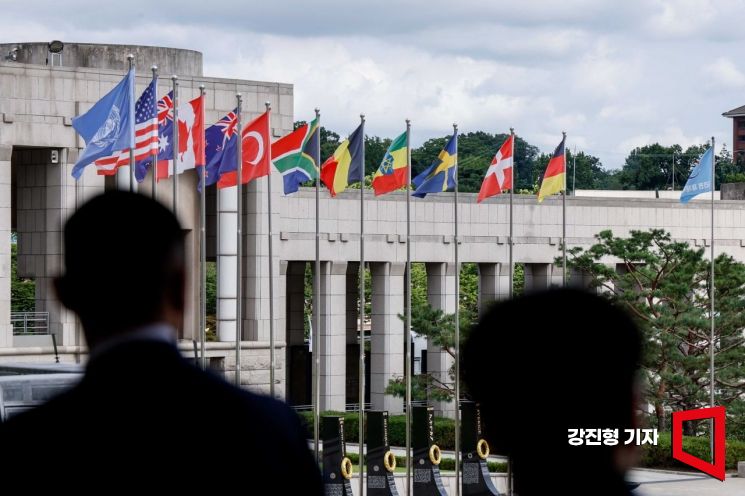 On the 25th, two days before the 70th anniversary of the signing of the Korean War armistice agreement and United Nations Forces Participation Day, flags of the United Nations participating countries were displayed at the War Memorial in Yongsan-gu, Seoul. Photo by Jinhyung Kang aymsdream@
Subsequently, in October of the same year, an on-site investigation was conducted on Gopado Island, and testimonies were collected from multiple residents, including “I witnessed metal fragments resembling aircraft debris while working on fish farm cultivation,” “I heard stories about a U.S. military aircraft crash,” “In the 1970s, I found a parachute at the beach and made a blanket from it,” “I saw leg bones,” and “I heard that remains were buried around the sandy beach area.”
The unit requested related materials from the U.S. Department of Defense's Defense POW/MIA Accounting Agency (DPAA) to further verify the credibility of the remains' location, and it was finally estimated that the residents' testimonies are related to the disappearance of a UN pilot who participated in the Korean War.
The remains to be excavated this time are presumed to be those of a South African Air Force fighter pilot.
On August 28, 1953, a pilot of the 2nd Fighter Squadron (assigned to the U.S. 18th Fighter-Bomber Wing) was conducting training aboard a North American F-86 Sabre. At that time, problems occurred with the aircraft's backup and emergency system gauges, and the pilot attempted to eject with a parachute at an altitude of 18,000 feet (approximately 5,500 meters) near Naeri, Iwon-myeon, Taean-gun, Chungnam. His parachute was spotted about 3.2 km away over the sea, but despite intensive searches over two days, he was not found and was officially declared missing.
Based on the DPAA data and local residents' inquiries, the unit determined the expected site where the remains are presumed to be located. The aircraft crashed between Iwon-myeon, Taean-gun, Chungnam, and Gopado Island. Due to ocean currents, wind effects, and geographical factors such as sand dunes along Gopado's coastline, the unit estimates that the aircraft debris, parachute, and pilot's body drifted and settled on the sandy beach of Gopado Island.
Based on this, the unit decided to excavate three locations: the sandy beach where residents testified to witnessing remains, the back slope of the sandy beach, and a nearby hill.
Meanwhile, among the 24 missing South African pilots, only nine have had family genetic samples secured.
Lee Geun-won, head of the unit, said, “It is our mission to find the remains of heroes who came to protect a country they did not know, with different races, languages, and cultures, and could not return to their homeland,” adding, “We hope to successfully complete the excavation and repay the past grace.”
© The Asia Business Daily(www.asiae.co.kr). All rights reserved.
![Clutching a Stolen Dior Bag, Saying "I Hate Being Poor but Real"... The Grotesque Con of a "Human Knockoff" [Slate]](https://cwcontent.asiae.co.kr/asiaresize/183/2026021902243444107_1771435474.jpg)
















