Tariff Uncertainty Spreads... Dollar and S&P Down 4% This Year
Is the Era of 'American Exceptionalism' Over?
Some on Wall Street Claim "Trump Wants a Deliberate Recession"
As uncertainty over U.S. President Donald Trump's tariff policies shakes the 'American exceptionalism' that allowed the U.S. economy to run alone, both the value of the U.S. dollar and the stock market are falling together. Amid fears of stagflation (rising prices amid economic slowdown) and R (recession), some on Wall Street even claim that President Trump is deliberately fostering a mild economic downturn.
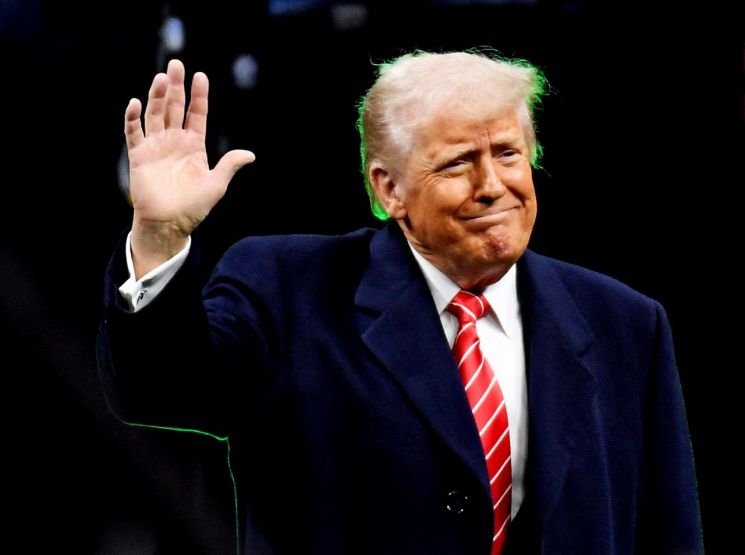
According to the global foreign exchange market on the 23rd (local time), the dollar index, which measures the value of the U.S. dollar against six major currencies, has fallen 4.4% so far this year through the 21st. The S&P 500, a representative U.S. stock market index, dropped 3.6% during the same period.
U.S. investment bank (IB) Goldman Sachs analyzed that it has been rare for the U.S. dollar and stock market to decline simultaneously since the 2000s. Based on Goldman Sachs' analysis, the British economic daily Financial Times (FT) reported that there have been six major simultaneous declines of the dollar and stock market over the past 25 years, with the current decline occurring after the dollar value and the S&P 500 index fell by 1% and 1.7%, respectively, in June-July 2011.
Goldman Sachs stated, "In recent weeks, as doubts about the sustainability of American exceptionalism have grown, the U.S. stock market has experienced its fastest correction since the early 1970s," adding that it is rare for dollar selling to occur simultaneously with a rapid stock market revaluation, and that the dollar has entered a full-scale bear market for the first time in four years.
The main cause of the recent simultaneous decline in the U.S. dollar and the New York stock market is attributed to the tariff war initiated by Trump. In recent weeks, concerns about an economic recession due to tariff hikes have rapidly spread on Wall Street. The U.S. Federal Reserve (Fed) also partially revealed stagflation concerns by lowering growth forecasts and raising inflation outlooks at the Federal Open Market Committee (FOMC) meeting on the 19th, mentioning the impact of tariffs. President Trump announced on January 20th that he would impose 25% tariffs on Canada and Mexico, and two rounds of 10% tariffs on China, totaling an additional 20%, and on February 2nd, he announced plans to impose reciprocal tariffs on countries worldwide. The 'Trump trade'?investments in the U.S. stock market and dollar made after Trump's election in early November last year?has been overshadowed by the 'recession trade' following the start of the Trump administration's second term.
Bob Michele, Global Head of Fixed Income at JP Morgan Asset Management, said, "Market participants are turning their eyes away from the dollar and beginning to diversify dollar-denominated assets into other markets and currencies," diagnosing that "the market overall is saying that dollar exceptionalism has reached its peak."
As concerns about a U.S. economic recession spread and bets on American exceptionalism disappear from the market, some on Wall Street argue that President Trump desires and even intends a shallow recession.
Charlie McElligott, strategist at Nomura Securities, said, "President Trump and his administration need a deliberately induced economic downturn that can cause slower growth and disinflation (a decline in inflation rate)," adding, "This could lead to Fed rate cuts and a significant weakening of the U.S. dollar to carry out his next economic agenda."
The analysis suggests that if the economy slows, it could lead to a decline in inflation rates, Fed rate cuts, and a weaker dollar. Nomura Securities believes that the Fed lowering rates and the government supporting with large-scale tax cuts and deregulation policies could allow the economy to sail smoothly. In a situation where the Fed maintains a cautious monetary easing policy due to inflation concerns caused by tariffs, if the economy falls into a mild recession, it could lead to an early rate cut. Also, a recession occurring in the first year of a term can be blamed on the previous Biden administration.
Earlier, President Trump did not deny the possibility of a recession this year. U.S. Treasury Secretary Scott Bezent said he is not worried about short-term stock market volatility and mentioned that their goal is a "smooth transition."
© The Asia Business Daily(www.asiae.co.kr). All rights reserved.
![Clutching a Stolen Dior Bag, Saying "I Hate Being Poor but Real"... The Grotesque Con of a "Human Knockoff" [Slate]](https://cwcontent.asiae.co.kr/asiaresize/183/2026021902243444107_1771435474.jpg)
















