Traffic Impact as Key Negotiation Agenda
Notification Procedure Possible for Minor Changes
Full-scale Negotiations to Begin at End of This Month
Hyundai Motor Group's proposal to change the number of floors in the Global Business Center (GBC) design has brought the issue of whether to re-evaluate the traffic impact assessment back into focus. The city is of the view that since the design plan has changed, it needs to be reviewed again. If a re-evaluation takes place, the project schedule, which was already delayed due to Hyundai Motor Group changing the design from a single 105-floor tower to three buildings each with 54 floors, is expected to be further postponed. However, since last year Seoul Mayor Oh Se-hoon has called for deregulation of traffic and environmental impact assessments, attention is focused on the negotiations between both sides scheduled for the end of this month.
According to Seoul City on the 24th, the city has raised the discussion of re-evaluating the traffic impact assessment as a key agenda item in additional negotiations related to Hyundai Motor Group's submitted GBC development plan change proposal. A Seoul city official stated, "It has not been decided whether the traffic impact assessment needs to be redone," adding, "The traffic impact resulting from the design change will be one of the important topics in this negotiation."
Will GBC Undergo Traffic Impact Assessment Re-evaluation?
If Seoul City determines that Hyundai Motor's newly submitted design plan constitutes a minor change, the process could be replaced by a 'notification' procedure instead of a re-evaluation. Under current law, if the building structure or other design elements change significantly beyond just the building height, a new traffic impact assessment must be conducted. Projects subject to traffic impact assessment that increase in scale by 30% or more compared to the original permit due to changes in the project plan, or increase beyond the scale of the assessment target even if less than 30%, can be considered for re-evaluation. Additionally, if changes to the building plan exceed the allowable range for modifications to traffic improvement measures, re-evaluation is required.
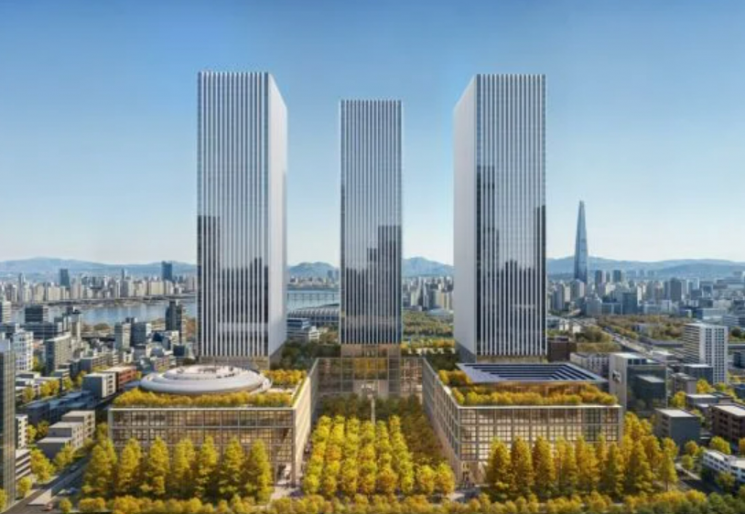 A design rendering of the GBC to be developed in the Samseong-dong area of Gangnam-gu, Seoul. Provided by Hyundai Motor Group
If re-evaluation is decided after discussions between both parties, the project schedule will be pushed back. The project timeline has already been delayed due to a tense tug-of-war over Hyundai Motor's proposal to change the number of floors. Hyundai Motor purchased the site in 2014, passed the traffic impact assessment in 2018, and began construction in 2020. However, as discussions between the two sides dragged on, the progress rate as of the fourth quarter business report was only 6.1% for Hyundai Construction and 5.7% for Hyundai Engineering.
Mayor Oh Se-hoon's Emphasis on Construction Regulation Deregulation
However, since Mayor Oh Se-hoon has shown strong determination to ease construction regulations since last year, re-evaluation may not take place. In December last year, Mayor Oh held an emergency economic meeting on economic regulations and ordered the city to ease regulations on traffic and environmental impact assessments. At that time, Mayor Oh emphasized, "Traffic impact assessments and similar regulations act as huge constraints from a corporate perspective," and urged, "Please make sure to change these representative regulations first."
Experts believe that whether re-evaluation is required will depend on whether Hyundai Motor's submitted revised design plan qualifies as a minor change. Professor Koo Ja-hoon of Hanyang University Graduate School of Urban Studies explained, "It is necessary to examine whether the floor area by use and the total floor area fall within the scope of minor changes under the Urban Traffic Improvement Promotion Act," adding, "If the traffic volume generated by each use is calculated and it is judged that there is no significant change from the existing design plan, it can be considered a minor change."
Seoul City and Hyundai Motor will begin full-scale negotiations from the end of this month. Seoul City plans to form a negotiation coordination committee consisting of about 10 members from the private sector, public sector, and experts to conduct negotiations on public contributions. Following this, based on the negotiation results, the city will proceed with the district unit plan change decision procedure.
© The Asia Business Daily(www.asiae.co.kr). All rights reserved.

















