Abe Assassin Cites "Mother's Large Donations," Sparking Controversy
If Dissolution Order Is Finalized, It Will Be the Third Case in History
A Japanese court is expected to rule as early as the 25th on whether to issue a dissolution order against the Family Federation for World Peace and Unification (formerly the Unification Church, hereinafter Family Federation), which has been embroiled in controversy over receiving large donations.
According to the Yomiuri Shimbun and others on the 23rd, the Tokyo District Court requested the attendance of both the Ministry of Education, Culture, Sports, Science and Technology, which filed the dissolution order, and the Family Federation on the 25th. The Japanese government filed for a dissolution order with the court after an investigation, following the revelation that the assassin of former Prime Minister Shinzo Abe in July 2022 stated the motive was that "his mother made large donations to the Unification Church, which ruined the family," raising concerns about the Family Federation's large donations.
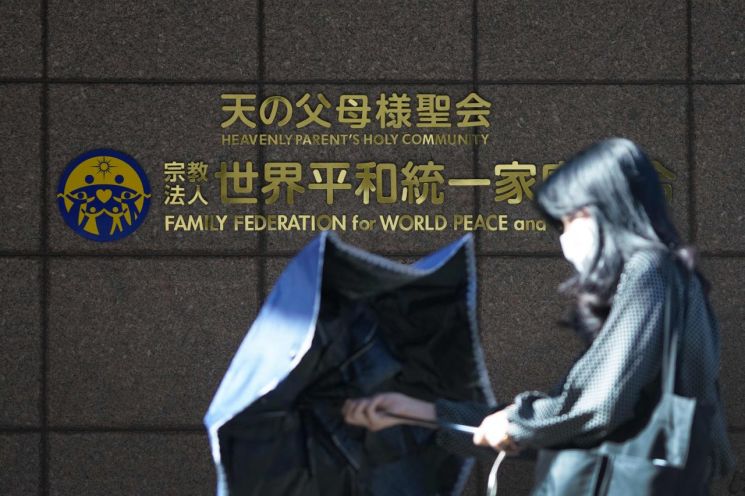 The Family Federation for World Peace and Unification (formerly the Unification Church), embroiled in controversy over receiving large donations. AFP Yonhap News
During a closed hearing lasting about one year and three months until January of this year, the Ministry of Education, Culture, Sports, Science and Technology argued that the large donations constituted illegal acts under civil law, but the Family Federation countered that there were no organized illegal acts and thus the conditions for a dissolution order were not met. The court also heard from Family Federation believers about the circumstances of the donations.
Japan's Religious Corporations Act stipulates that if an act is recognized as significantly harming public welfare by violating laws or significantly deviating from the purpose of the religious organization, the court may issue a dissolution order.
In the past, two religious corporations were ordered dissolved due to legal violations: Aum Shinrikyo, which carried out the sarin gas attack on the Tokyo subway in March 1995, and another group. However, since the leaders of these groups were involved in criminal cases, attention is now focused on whether illegal acts under civil law alone can serve as grounds for a dissolution order for the first time.
Earlier this month, the Supreme Court of Japan, equivalent to the Supreme Court, imposed a fine on the Family Federation for refusing to answer some questions during the Japanese government's investigation based on the Religious Corporations Act, ruling that illegal acts under civil law are also included in grounds for a dissolution order. If the dissolution order is finalized, the religious corporation will lose tax benefits. However, religious acts will not be prohibited, and the organization can continue as a voluntary religious group. The Yomiuri reported that regardless of the Tokyo District Court's ruling, both the government and the Family Federation can immediately appeal.
© The Asia Business Daily(www.asiae.co.kr). All rights reserved.

















