Simultaneous Outbreaks Nationwide
Difficult to Contain Due to Dry Weather and Strong Winds
Government Declares Disaster Situation
On the 22nd, wildfires broke out simultaneously across the country. It is analyzed that the 'high pressure in the south and low pressure in the north' weather system, combined with dry and windy conditions, likely contributed to the spread of the wildfires. The government declared a disaster situation in Gyeongsangnam-do, Gyeongsangbuk-do, and Ulsan Metropolitan City to mobilize an all-out response at the intergovernmental level.
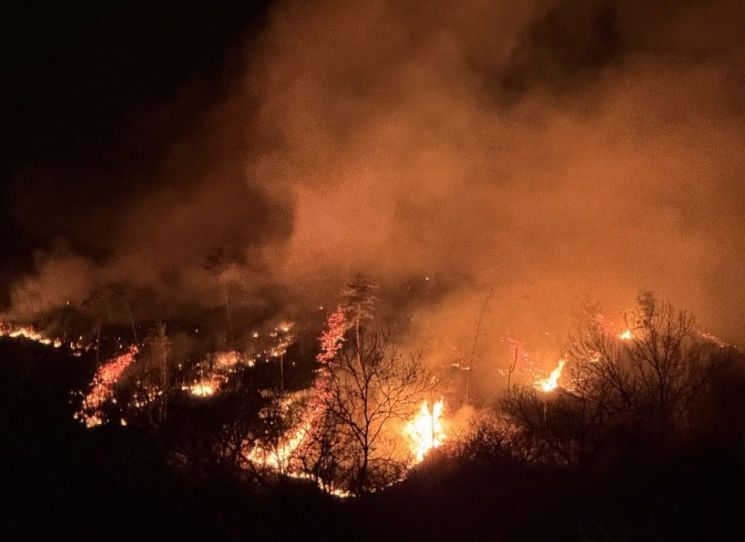
According to the Korea Forest Service's real-time wildfire information, the wildfire that started on the 21st in Sancheong, Gyeongsangnam-do, remains unextinguished, and 30 new wildfires occurred on the same day. As of 8 p.m., five wildfires are currently being extinguished.
In Sancheong, Gyeongsangnam-do, where a large wildfire continued for two days, two firefighting personnel from Changnyeong County who were deployed on site died, and one firefighter and one government official are missing. Additionally, six firefighters and residents were injured, and 263 people were displaced.
Wildfires also occurred consecutively in Gyeongsangbuk-do. Around 11:24 a.m., a large wildfire broke out at the summit of a mountain in Gwaesan-ri, Anpyeong-myeon, Uiseong-gun, Gyeongsangbuk-do. This wildfire spread eastward about 8 km toward Uiseong-eup, driven by strong winds. So far, the area damaged by the wildfire has been estimated at 130 hectares, and 392 nearby residents evacuated to facilities such as the comprehensive sports gymnasium. Due to the large wildfire in Uiseong-gun, train operations on some sections of the Jungang Line were suspended.
Also, around 2 p.m., a fire broke out on a mountain in Ganmae-ri, Gangcheon-myeon, Yeoju-si, Gyeonggi-do, and at 5:27 p.m., a wildfire occurred in Susang-dong, Andong-si, Gyeongsangbuk-do.
The vast majority of wildfires are caused by human factors, so weather cannot be pointed to as the main cause of wildfires. However, it is true that weather conditions have a considerable impact on wildfires. This weekend was expected to have a particularly high risk of wildfire occurrence. This is because the Korean Peninsula was under the influence of a pressure system with high pressure in the south and low pressure in the north, resulting in clear skies and westerly winds. Accordingly, dry weather advisories were issued in various parts of the East Coast and Yeongnam inland areas, and strong wind advisories were issued in Gangwon Yeongdong and northeastern Gyeongsangbuk-do.
When westerly winds blow into Korea, temperatures rise significantly on the east side of the Baekdudaegan mountain range, and the atmosphere becomes dry. This is due to the 'foehn effect,' where air cools and dries as it rises over the mountains, then warms again as it descends, causing hot and dry winds to blow in the areas below the mountains.
Especially this weekend, a situation was created where warm air covered the mountains like a lid, and very strong hot and dry winds were expected to blow east of the Baekdudaegan. As of 5 p.m., humidity was below 25% in most regions nationwide except for the west coast.
In Sancheong, where a large wildfire occurred the previous day, the effective humidity dropped to the mid-20% range around 5 p.m. the day before. Effective humidity is calculated based on relative humidity over the past five days and indicates how dry trees and vegetation are; generally, below 50% is considered a condition prone to large fires.
In the eastern regions, temperatures reached record highs that day. Ulsan and Pohang, Gyeongsangbuk-do, recorded daytime maximum temperatures of 25.6°C and 26.3°C respectively, the highest late-March temperatures since weather observations began in those areas. Record highs for late March daytime maximum temperatures were also set in Gyeongju, Gyeongsangbuk-do (26.5°C), and Uiryeong (26.8°C) and Gimhae (25.6°C) in Gyeongsangnam-do.
Meanwhile, the Korea Forest Service raised the national crisis alert for wildfire disasters in the Chungcheong, Honam, and Yeongnam regions to the 'Severe' level at 3:30 p.m. that day. The crisis alert for Seoul, Incheon, Gyeonggi, and Gangwon regions was also raised from 'Caution' to 'Warning.'
Yongkwon, the Forest Disaster Control Officer, said, "Due to the hot and dry weather, wildfires are occurring nationwide, and the strong winds pose a high risk of spreading into large wildfires."
© The Asia Business Daily(www.asiae.co.kr). All rights reserved.
![Clutching a Stolen Dior Bag, Saying "I Hate Being Poor but Real"... The Grotesque Con of a "Human Knockoff" [Slate]](https://cwcontent.asiae.co.kr/asiaresize/183/2026021902243444107_1771435474.jpg)
















