"If Korea Does Not Change Its Structure, Society Itself Could Collapse"
Warnings Over the Spread of Non-Marriage Ceremonies and Declining Birth Rate
As the culture of holding 'non-marriage ceremonies' to choose not to marry spreads domestically, foreign media are also paying attention to this phenomenon.

Recently, Hong Kong's South China Morning Post (SCMP) reported that 'non-marriage ceremonies' are beginning among single Korean women who oppose marriage, focusing on the background behind this trend.
SCMP introduced the case of Kang Mo (30), who took photos wearing a wedding dress at a photo studio in Seoul, posing with her pet dog instead of a groom. Kang said, "Wearing a dress was a childhood dream," but added, "However, I decided not to become anyone's wife or mother. I will be happy for myself."
The story of office worker Jung Mo (32), who held a 'non-marriage ceremony' for herself by inviting 40 guests, was also shared. Wearing a gray suit, she declared in front of the guests, "I vow to love myself for life." She said she wanted the celebratory atmosphere of a wedding but did not want the marriage itself.
Jung pointed to Korea's family-centered culture as the background for non-marriage. She criticized the reality where women face career interruptions and responsibilities for childcare and housework immediately after marriage, likening marriage to "a package tour with too many unwanted options."
According to Statistics Korea, as of November 2023, 51% of people in their 30s in Korea are unmarried. This is about four times higher compared to 2000. Especially in Seoul, more than 60% of people in their 30s are unmarried.
The most frequently cited reason for non-marriage among non-marriage advocates is economic burden. In Korea, it is common to prepare a newlywed home upon marriage, but due to rising housing prices, many newlyweds start married life with debt. SCMP also reported that the average cost required to get married in Korea reaches 300 million won.
As young people hesitate to marry, the birth rate is also sharply declining. Korea's total fertility rate was 0.72 in 2023 and 0.75 in 2024, ranking among the lowest in the world. Korea is the only OECD member country with a fertility rate below 1. The number of newborns was 230,000, down 7.7% from the previous year, and about half compared to ten years ago.
SCMP also noted that some companies are establishing a 'non-marriage allowance' instead of the traditional wedding congratulatory money given only to married employees. However, despite these changes, social pressure and scrutiny toward unmarried women remain. SCMP warned, "If Korea does not change its current structure, society itself could collapse."
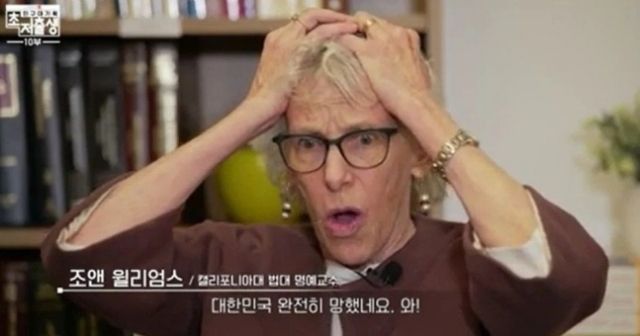 Joan Williams, Professor Emerita at the University of California. Screenshot from EBS documentary 'Population Project: Ultra-Low Birthrate'
Meanwhile, Joanne Williams, Professor Emerita at California State University College of Law, who has devoted her life to researching women, labor, and class issues, said in an interview with JTBC last year about Korea's situation, "I have never seen such a low birth rate without a major epidemic or war," adding, "The numbers are signaling a national emergency." She criticized, "Workplace culture designed for ideal workers and family systems that require adults to care for children cannot coexist. If Korea trains young women and then pushes them out of the labor market after they become mothers, it makes no economic sense. Your career as a non-regular worker ends, and so does the national economy."
© The Asia Business Daily(www.asiae.co.kr). All rights reserved.


















