Simultaneous Outbreaks Nationwide
Difficult to Contain Due to Dry Weather and Strong Winds
On the 22nd, wildfires broke out simultaneously across the country. It is analyzed that the 'high pressure in the south and low pressure in the north' atmospheric system, combined with high temperatures, dry conditions, and strong winds, had a considerable impact on the wildfires.
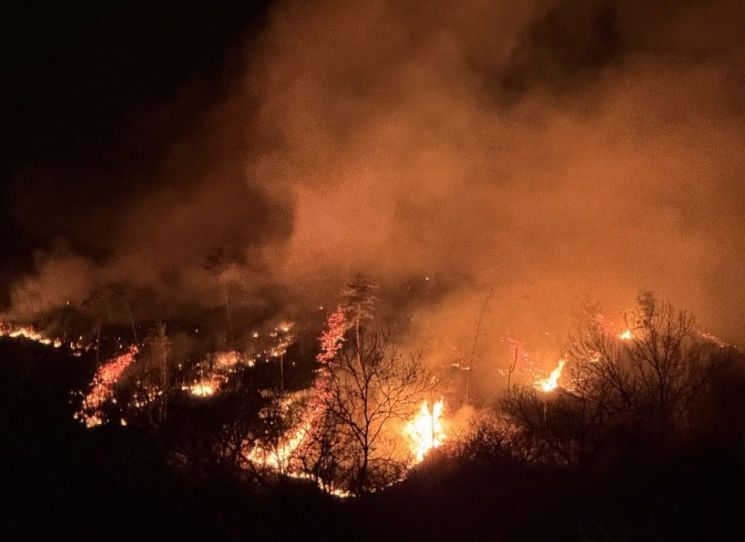
According to the Korea Forest Service, while the wildfire that started on the 21st in Sancheong, Gyeongnam, has not yet been extinguished, 16 new wildfires occurred on the same day. As of 4:30 PM, 14 wildfires are being controlled. At 3:30 PM that day, the national crisis alert for wildfire disasters was raised to the 'Severe' level in Chungcheong, Honam, and Yeongnam regions, and to the 'Warning' level in the Seoul metropolitan area and Gangwon.
The vast majority of wildfires are caused by human factors, so weather cannot be pointed to as the main cause of the fires. However, it is true that meteorological conditions have a significant influence on wildfires. The risk of wildfire occurrence was expected to be particularly high this weekend. This is because the atmospheric system with high pressure in the south and low pressure in the north of Korea was maintained, resulting in clear skies and westerly winds. Consequently, dry weather advisories were issued in various parts of the east coast and inland Yeongnam, and strong wind advisories were issued for Gangwon Yeongdong and northeastern Gyeongbuk.
When westerly winds blow into Korea, temperatures on the east side of the Baekdudaegan mountain range rise significantly, and the atmosphere becomes dry. This is due to the 'Foehn effect,' where air cools and dries as it ascends the mountain and then warms again as it descends, causing hot and dry winds to blow in the areas below the mountains.
Especially this weekend, a situation where warm air covers the mountain like a lid is expected to cause very strong hot and dry winds on the east side of the Baekdudaegan. As of 5 PM, the humidity in most regions nationwide, except for the west coast, was below 25%.
In Sancheong, where a large wildfire occurred the previous day, the effective humidity dropped to the mid-20% range around 5 PM the day before. Effective humidity is calculated based on the relative humidity over the past five days and indicates how dry trees and vegetation are; generally, a level below 50% is considered prone to large fires.
Temperatures in the eastern regions also rose to record highs that day. Ulsan and Pohang, Gyeongbuk, recorded maximum daytime temperatures of 25.6°C and 26.3°C respectively, the highest for late March since meteorological observations began in those areas. Record highs for late March daytime temperatures were also set in Gyeongju, Gyeongbuk (26.5°C), Uiryeong, Gyeongnam (26.8°C), and Gimhae (25.6°C).
Meanwhile, at 3:30 PM that day, the Korea Forest Service raised the national crisis alert for wildfire disasters in Chungcheong, Honam, and Yeongnam regions to the 'Severe' level. The crisis alert for Seoul, Incheon, Gyeonggi, and Gangwon regions was also raised from 'Caution' to 'Warning.'
Yongkwon Lee, the Forest Disaster Control Officer, stated, "Due to the hot and dry weather, wildfires are occurring nationwide, and the strong winds pose a high risk of these fires spreading into large-scale wildfires."
© The Asia Business Daily(www.asiae.co.kr). All rights reserved.

















