Instead of Collecting Usage Fees, Frequency Assignment Cycle Extended
Expansion into IoT-Based Smart Home and Unmanned Store Management
"Are Usage Fees Collected to Fund the Broadcasting and Communications Development Fund?"
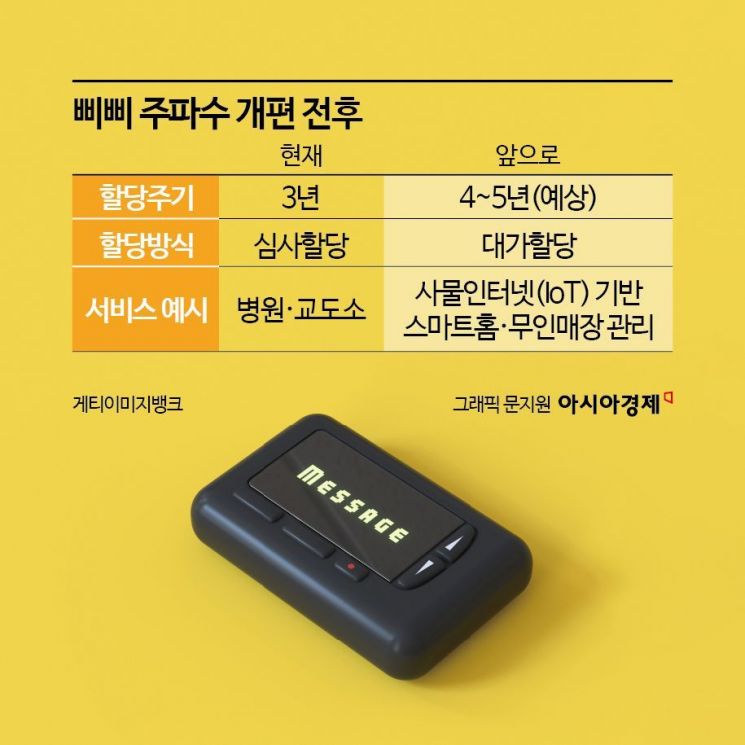
Currently, the pager (wireless calling device) operators mainly used in hospitals or prisons plan to expand into new businesses such as smart home and unmanned store management starting in the second half of this year. As the frequency reassignment cycle, which was previously three years, has been extended to four to five years, allowing for more stable use of frequencies, the wireless calling industry has ventured into new businesses.

On the 24th, a representative from the Ministry of Science and ICT stated, "Until now, the frequency usage period was only three years, so there was significant uncertainty about reassignment, making it difficult for operators to readily invest in new services," adding, "Therefore, we decided to extend the assignment cycle." The likely duration is four or five years. Accordingly, wireless calling operators will be able to use the frequency bands (300·900 MHz) for more than three years. The current term expires in June, and the usage period is expected to be extended from then.
Seoul Mobile Communications, a leading wireless calling operator, is planning new businesses such as IoT-based smart home and unmanned store management. These include enhancing security with access records and intrusion detection functions, and remotely controlling lighting or heating and cooling systems. IoT devices use frequencies to perform wireless communication between various equipment and sensors. Low-frequency bands like those used for wireless calling have high building penetration rates and communication stability. Since January, Seoul Mobile Communications has been collaborating with the voice recognition specialist developer ‘PuzzleAI’ to prepare AI services.
Although the extension of the frequency assignment period benefits operators, frequency usage fees will now be incurred. This is because the Ministry of Science and ICT is changing the wireless calling frequency assignment method from the current 'evaluation assignment' to 'compensation assignment.' While commercial frequencies are generally assigned through auctions (compensation assignment), low-profit frequency bands like wireless calling were exceptions. Until now, the Ministry applied evaluation assignment, distributing frequencies based on companies' business plans. Frequencies were assigned without competitive bidding, so frequency usage fees were free. However, going forward, wireless calling will also be subject to compensation assignment, and frequency usage fees are expected to increase from tens of millions to hundreds of millions of Korean won.
There is also a view that the government made this decision because frequency demand has declined. A telecommunications industry official said, "Mobile carriers already have surplus 5G frequencies allocated, so unlike in the past, they are reluctant to secure more frequencies." He added, "The government, which needs to collect frequency usage fees to fund the Broadcasting and Communications Development Fund, is in a difficult position," and "This seems to be why the frequency used by wireless calling operators was also converted to compensation assignment."
Meanwhile, the Ministry of Science and ICT has completed the institutional preparations for extending the frequency assignment period. On the 12th, it revised the 'Details on the Calculation and Imposition of Frequency Assignment Fees' to include the wireless calling band as a frequency subject to compensation assignment. Reassignment evaluations will begin next month, and the reassignment decision will be made in June.
© The Asia Business Daily(www.asiae.co.kr). All rights reserved.


















