"To Prevent Damage to Good-Faith Investors"
ABSTB Investors with Card Receivables as Collateral Will Also Be Repaid
Homeplus has decided to treat purchase debt securitization as trade receivables to prevent damage to investors of asset-backed securitized short-term bonds (ABSTB) issued based on card payment claims.
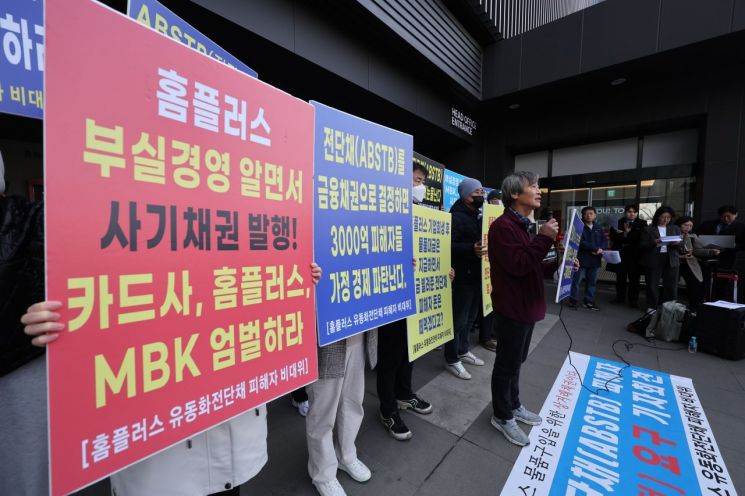 Officials from the Homeplus Liquefied Bond Victims' Committee held a press conference on the 14th in front of the Homeplus headquarters in Gangseo-gu, Seoul, demanding the classification of victims' commercial claims. Photo by Yonhap News
According to Homeplus on the 21st, the company set this policy the day before after meeting with parties involved in purchase debt securitization at the Seoul Rehabilitation Court to prevent damage to good-faith investors.
ABSTB is a short-term bond in which Homeplus, after paying for partner companies' products with purchase cards, transfers the card sales receivables owed to card companies as collateral to securities firms and sells them to investors to secure cash.
When Homeplus suddenly entered corporate rehabilitation proceedings on the 4th, individual investors who had invested about 300 billion KRW in the ABSTB expressed anxiety fearing they would not get their money back. When rehabilitation proceedings begin, trade receivables such as payments for partner companies' deliveries or tenant settlements can be repaid. However, financial claims are deferred for a certain period, and ABSTB has the characteristics of both financial claims and trade receivables.
The emergency response committee formed by the victims claimed, "Homeplus's issuance of short-term bonds was a 'fraudulent act' carried out with prior knowledge of the credit rating downgrade." They also demanded, "Instead of the financial claims deferred by the start of rehabilitation proceedings, please recognize the short-term bonds as trade receivables and prioritize their repayment."
Initially, Kim Kwang-il, co-CEO of Homeplus, showed an attempt to avoid responsibility by saying, "The company cannot judge whether this is a trade receivable or a financial claim, and will accurately explain to the court how this transaction was conducted." However, as investors' concerns grew and the political sphere urged measures, the situation changed.
According to Homeplus, as of the 4th, the balance of purchase debt securitization was 461.8 billion KRW. The company plans to treat the credit card companies' claims related to purchase debt securitization as trade receivables in the rehabilitation plan and reflect this classification in the rehabilitation creditors' classification according to Article 236, Paragraph 3 of the Debtor Rehabilitation and Bankruptcy Act. Accordingly, investors in ABSTB issued based on credit card companies' claims will receive the same effect as the treatment of credit card companies' claims as trade receivables.
A Homeplus official said, "By deciding to treat purchase debt securitization as trade receivables, we plan to reflect full repayment as trade receivables in the rehabilitation plan," adding, "We will ensure that good-faith investors do not suffer damage by repaying the full amount of purchase debt securitization according to the rehabilitation proceedings."
© The Asia Business Daily(www.asiae.co.kr). All rights reserved.

















