Received Approval in Principle from American Bureau of Shipping...
Certified at Highest Level, "Tier 3"
Expected to Reduce Ship Inspection Costs and Time,
and Extend Vessel Lifespan
Hanwha Ocean (CEO Kim Heecheol) has developed a smart ship solution capable of diagnosing the safety status of ships and offshore plants in real time.
This is the most advanced stage among existing safety monitoring systems. It is expected to reduce both the time and cost required for safety inspections.
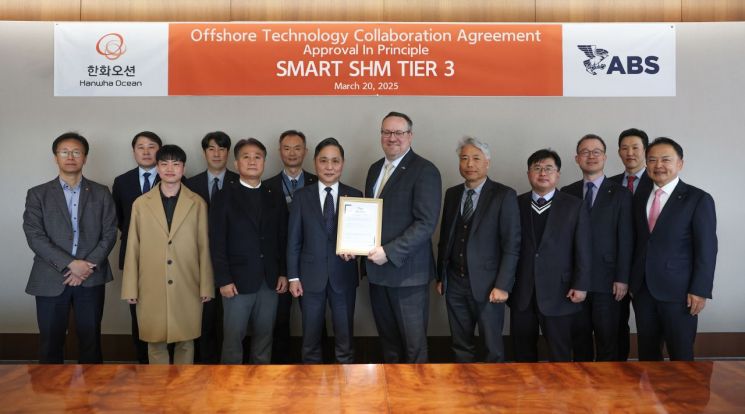 Son Youngchang, Vice President and Head of Product Strategy Technology Institute at Hanwha Ocean (7th from the left), Patrick Ryan, Chief Technology Officer of ABS (6th from the right), and other company officials are posing for a commemorative photo after the concept approval ceremony. Provided by Hanwha Ocean.
Hanwha Ocean has received Approval in Principle (AiP) from the American Bureau of Shipping (ABS) for its "Smart Structural Health Monitoring Tier 3" system.
Approval in Principle means that a ship inspection authority has officially recognized that a new technology is safe and feasible.
In September last year, Hanwha Ocean signed an "Offshore Technology Collaboration Agreement" with ABS and has since been developing technologies in three areas: ▲digitalization and artificial intelligence ▲cybersecurity operations ▲sustainability. The system that received approval this time was developed as part of this technology collaboration agreement.
ABS has certified Hanwha Ocean's hull structural monitoring system as "Tier 3," the highest technical grade. The hull structural monitoring system detects structural damage in ships and offshore plants at an early stage and predicts the optimal timing for maintenance to ensure safety.
ABS classifies hull structural monitoring technologies into three tiers?1, 2, and 3?according to their level of accuracy and reliability.
To achieve "Tier 3" certification, the system must be able to assess the safety of areas without sensors that measure loads on the hull. Hanwha Ocean has secured technology that enables the evaluation of structural health in areas without sensors through data fusion and analysis. This is seen as overcoming the limitations of existing monitoring systems, which could only assess the structural health of sensor-equipped locations.
The newly approved technology monitors the condition of hull structures in real time, helping shipowners establish preventive maintenance strategies. As ships or offshore plants operate over long periods, their structures can weaken due to factors such as waves or cargo weight.
The hull structural monitoring system analyzes operational data collected by sensors to assess and warn about structural strength and stability under extreme conditions. It also predicts the remaining fatigue life of the hull and enables advance scheduling of hull inspections.
Fatigue life refers to the period during which a ship can withstand operation while being exposed to waves and wind.
This is expected to ease the conservative safety evaluation standards that have been applied as regular inspections for ships and offshore plants, saving both time and cost for inspections.
Additionally, timely maintenance will minimize unexpected operational downtime and contribute to extending ship lifespan and ensuring safety.
Currently, Hanwha Ocean is conducting demonstration research to further advance hull structural monitoring technology. The company plans to pursue additional research and development with the goal of installing the system on actual offshore plants around 2026.
Going forward, Hanwha Ocean aims to commercialize this technology and establish a consistent hull structural monitoring system from the design stage through to post-delivery operation. The accumulated real-world measurement data and analysis results will be used to develop various systems for improving ship design and reducing maintenance OPEX (operating expenses).
Son Youngchang, Executive Vice President and Head of Product Strategy & Technology at Hanwha Ocean, said, "Recently, shipowners are increasingly including digital technology as a contract condition, and classification societies are also updating regulations related to digitalization. Based on this Approval in Principle, we will actively respond to the demand for smart and digital technologies in the shipping industry."
© The Asia Business Daily(www.asiae.co.kr). All rights reserved.

















