Soaring Egg Prices Drive U.S. Inflation Concerns
Relatively Affordable Korean Eggs Emerge as an Alternative
Recently, 20 Tons from Geirim Farm in Chungnam Exported to the U.S.

Recently, Korean eggs have been exported to the United States for the first time, and the U.S. government has officially announced its plan to expand imports of Korean eggs. Expectations are growing that the export destinations for domestic laying hens, which had been limited to places like Hong Kong, will diversify.
On the 20th (local time), U.S. news agency Reuters reported that Brooke Rollins, U.S. Secretary of Agriculture (USDA), said during a call with industry groups and reporters that the U.S. will start importing more eggs from Korea. Korea was included among the countries whose imports to the U.S. will be expanded, along with T?rkiye and Brazil.
The U.S. government has been considering increasing import volumes to stabilize soaring egg prices. As part of these efforts, Geirim Farm in Chungnam recently exported 20 tons (10,172 trays, 335,160 eggs) of premium eggs to the state of Georgia in the U.S., marking the first domestic export of its kind. It is known that Geirim Farm’s acquisition of HACCP certification, animal welfare certification, and antibiotic-free certification played a favorable role in the selection.
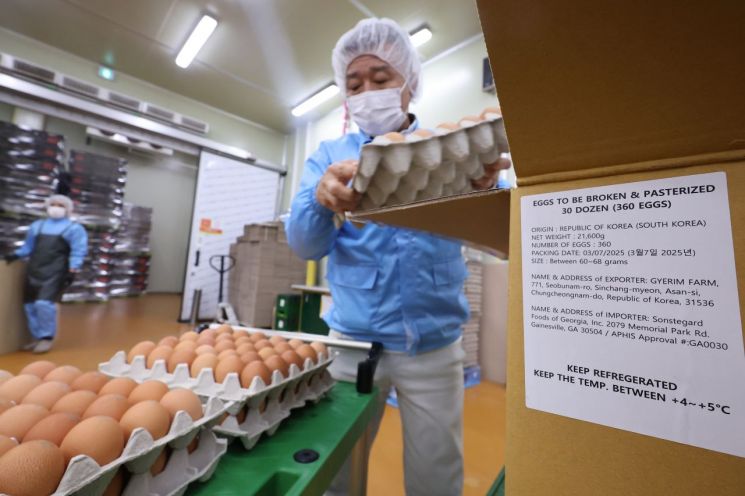 On the 17th, employees at Gyelim Farm in Asan City, Chungcheongnam-do, which exported eggs to the United States for the first time in Korea, are organizing eggs packed in boxes for export to the U.S. Photo by Yonhap News
Korean egg prices are relatively affordable. According to the global price index site Numbeo on the same day, a dozen eggs are sold for $2.93 in Korea, about 30% lower than in the U.S. ($4.13). It is also cheaper than Poland ($3.22), one of the world’s largest egg exporters. However, it is higher than T?rkiye ($1.62) and Brazil ($2.00).
The sharp rise in egg prices in the U.S. is due to highly pathogenic avian influenza (AI). Secretary Rollins previously stated in a Wall Street Journal (WSJ) op-ed that up to $1 billion (about 1.47 trillion KRW) would be allocated to combat AI to stabilize egg prices.
The surge in egg prices and concerns over reciprocal tariffs announced for April 2 have increased inflation worries in the U.S., putting pressure on the Trump administration. Tariffs are taxes imposed on imported products. There have been continuous concerns through foreign media that these costs will ultimately be passed on to consumers. President Trump also acknowledged that economic shocks are inevitable for the time being but made it clear he has no intention of backing down, saying, "April 2 will be a day of liberation."
This is also expected to benefit Korean farms. According to the Korea Agro-Fisheries & Food Trade Corporation (KATI), as of the cumulative total in February this year, fresh egg exports amounted to 208 tons, a 30.7% decrease compared to the same period last year. Hong Kong was almost the only export destination. Extending the period to 2024, a total of 1,380.7 tons were exported by December, marking a 38.9% decrease compared to the previous year.
© The Asia Business Daily(www.asiae.co.kr). All rights reserved.


















