Achieved Cumulative Engine Production of 10,000 Units Over 45 Years
Goal to Develop 6th Generation Fighter and Unmanned Aircraft Engines
Investment to Develop Engines Equivalent to KF-21 Engine
Annual Economic Effect of Tens of Trillions of KRW Expected from Independent Engine Development
Hanwha Aerospace (Hanwha Aero) has begun expanding its engine development workforce. The goal is to capture the aerospace market through a 3.6 trillion KRW capital increase by Hanwha Aerospace, but the domestic technology level and workforce are severely lacking.
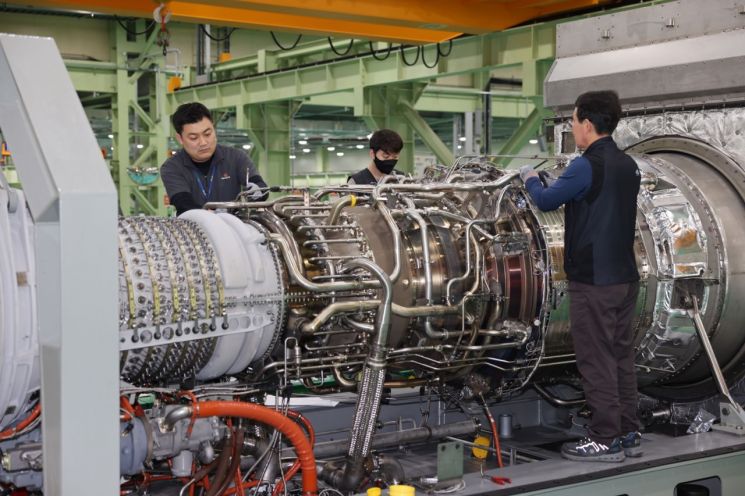
On the 19th, a Hanwha Aerospace official stated, “We plan to use our U.S. and European subsidiaries as research and development (R&D) hubs and increase R&D personnel to 500 by 2028,” adding, “We will start actively recruiting engine-related research personnel from this year.”
Achieved Cumulative Engine Production of 10,000 Units Over 45 Years
Hanwha Aerospace, the only domestic aircraft engine manufacturer, produces engines for South Korea’s Air Force main aircraft such as the 4F-15K fighter jet and T-50 advanced trainer, as well as the domestically produced engine for the Korean helicopter ‘Surion.’ In April last year, it achieved a cumulative engine production of 10,000 units over 45 years. This reflects its unique technology and status in the aircraft engine field. Along with producing engines for the Air Force’s main aircraft, it also performs maintenance, repair, and overhaul (MRO) for a total of 5,700 aircraft, possessing the country’s only integrated capabilities in engine design, production, and MRO.
Goal to Develop 6th Generation Fighter and Unmanned Aircraft Engines
However, developing engines for 6th generation fighter jets and unmanned aircraft requires securing technology and talent. Currently, South Korea’s fighter aircraft development level ranks among the world’s top alongside the U.S., Russia, China, France, Japan, the U.K., Germany, and Sweden, but it still relies on imports for aircraft engines due to the lack of independent technology. The domestically produced supersonic fighter KF-21’s engine is manufactured under license in Korea using U.S. General Electric (GE) technology. U.S. defense companies do not share core technologies such as high-pressure turbines when outsourcing engine production to Korean companies. The industry estimates that domestic technology is about 70% of advanced countries’ level, and material technology is only about 40-50%. According to the Defense Technology Promotion Research Institute’s ‘Defense Science and Technology Survey,’ among 99 major defense-related technology categories, six are insufficient, four of which are in the aerospace field.
There is also a shortage of personnel. According to estimates by the Defense Acquisition Program Administration (DAPA) as of early last year, there are about 250 engine-related personnel in companies and about 220 professors and others in universities. This is about one-tenth of the U.S. level. Countries like the U.S. actively control the transfer of engine-related technology due to concerns over strategic asset technology leakage.
Investment to Develop Engines Equivalent to KF-21 Engine
Hanwha Aero is pushing for advanced engine localization to fully internalize technologies currently dependent on overseas sources. The goal is to independently develop a 15,000-pound thrust class engine equivalent to the KF-21 engine by the mid-to-late 2030s in cooperation with the government. In addition to securing personnel, infrastructure investment is also increasing. A smart engine factory of 16,500㎡ (about 5,000 pyeong) is being expanded at the Changwon plant with an investment of 40 billion KRW. Hanwha Aerospace invested 887.8 billion KRW in R&D last year and plans to continue large-scale investments this year as well.
Annual Economic Effect of Tens of Trillions of KRW Expected from Independent Engine Development
South Korea also plans to independently develop aircraft engines to prepare for the future. Since 2020, the Defense Acquisition Program Administration has been developing a 5,500 lbf thrust class turbofan engine for unmanned aircraft in cooperation with the Ministry of Trade, Industry and Energy, and is conducting research on core components of an 18,000 lbf turbofan engine. The government is also focusing on development in the aircraft engine sector. Earlier this year, it expanded new growth engine technologies, newly designating propulsion system technologies such as gas turbine engines, military satellite system technologies, and manned-unmanned complex system technologies. Based on this, the goal is to establish an ecosystem in the aircraft engine field and secure globally competitive independent aircraft engine technology by the mid-to-late 2030s.
Independent development of aircraft engines is expected to strengthen security as well as bring economic benefits. Fighter jet engines are related to unmanned drones, space rockets, and can be diversified and expanded. The development cost is estimated at 5 to 6 trillion KRW, and the economic effect after completion is estimated to reach tens of trillions of KRW annually, directly and indirectly. The global aircraft engine market is expected to exceed approximately 150 trillion KRW by 2029.
© The Asia Business Daily(www.asiae.co.kr). All rights reserved.

















