Korea Food Industry Association and Korean Intellectual Property Office Form Joint Response Council
Jeonggwanjang Counterfeit Products Discovered at Vietnamese Wholesale Center
Number of Blocked Counterfeit Product Distribution Cases Up 19% from Previous Year
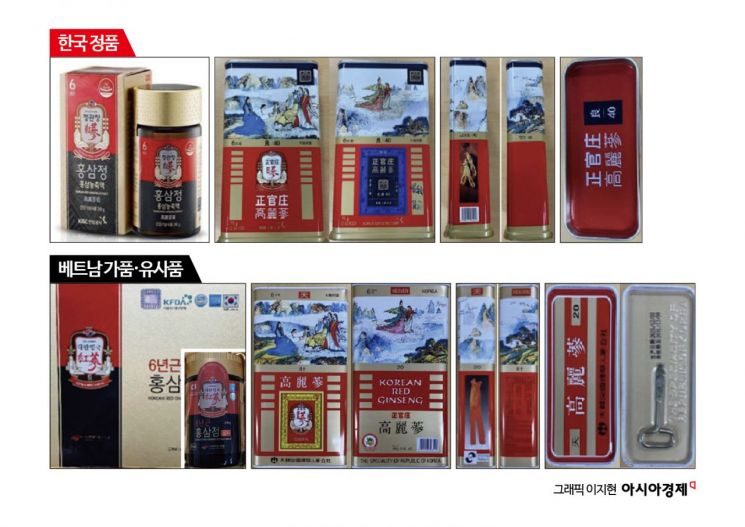
#Last October, six businesses selling counterfeit Jeonggwanjang products were caught at the Halfmedi Center, a pharmaceutical and health food wholesale center in Vietnam. These businesses were found to have been selling low-quality counterfeit products that closely imitated the original products, packaging, and product names. For example, 'Jeonggwanjang Goryeo Sam Yangsam' was disguised as 'Goryeo Sam,' and similar products to 'Hongsamjeong' such as '6-Year-Old Hongsamjeong Gold' were also sold. Vietnamese police confiscated the counterfeit goods and fined the businesses. This was the first administrative crackdown on counterfeit Korean food products in Vietnam and received significant coverage in local media.
Daesang, Samyang Foods, Korea Ginseng Corporation, and others formed the 'K-Food Overseas Intellectual Property (IP) Infringement Joint Response Council' together with the Korea Food Industry Association and the Korean Intellectual Property Office. This council investigated online and offline distribution networks in Vietnam to identify the circulation of fake Korean products and collected evidence. Subsequently, administrative crackdowns were conducted, and some companies issued warning letters to local manufacturers and distributors.
Shim Hyun-soo, team leader at the Korea Food Industry Association, stated, "Unlike China, Vietnam lacked local law firms with the capacity to investigate counterfeit goods, which posed difficulties. However, by building cooperative relationships, we strengthened investigative capabilities and were able to conduct full-scale crackdowns starting in the second half of the year." The council plans to continue focusing on Vietnam as a key country for countermeasures this year to eradicate counterfeit products.
With the rise of the Korean Wave and increasing popularity of K-Food, various counterfeit products have been rampant in China and Southeast Asia. Although the food industry is jointly responding to prevent further damage, concerns over harm caused by the distribution of counterfeit products are growing day by day.
Rapid Increase in Counterfeit Product Distribution, China and Southeast Asia Account for 72%
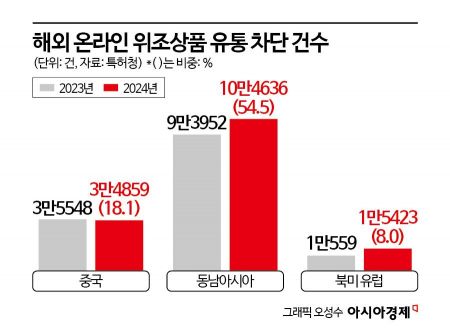
According to the Korean Intellectual Property Office on the 21st, the number of cases blocking overseas online counterfeit product distribution last year was 191,971, a 19% increase from the previous year (161,110 cases). Among these, China and Southeast Asia accounted for 72% of the total, making them major regions for counterfeit product distribution. In Southeast Asia alone, the number of blocked cases increased by 11.3%, from 93,953 to 104,636. China’s cases rose from 30,548 to 34,859, and North America and Europe increased from 10,559 to 15,423.
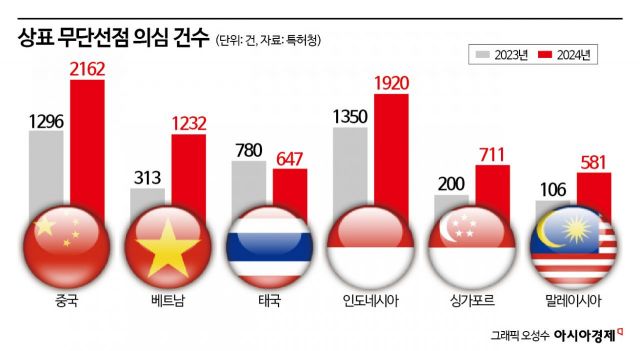
Suspected cases of unauthorized trademark preemption also showed an increasing trend, rising 84% from 5,015 in 2023 to 9,249 last year. In particular, Vietnam saw a sharp increase of 293%, from 313 to 1,232 cases, revealing the rampant presence of fake K-Food products.
Counterfeit products refer to knockoffs, fakes, imitations, and counterfeit goods that infringe on our companies’ intellectual property rights such as trademarks and design rights. This is a serious issue involving infringement of our companies’ IP rights, and consumer damage is increasing due to increasingly sophisticated counterfeit manufacturing technologies.
As the brand awareness of Korean food rises, there is a growing trend of highly sophisticated counterfeit products in China and Southeast Asia that are difficult to distinguish. Last year, exports of major Korean processed foods reached a record high of $2.4 billion (approximately 3.5 trillion KRW), a 21.5% increase compared to the previous year. However, the scale of counterfeit products is believed to be even larger.
According to an analysis by the Organisation for Economic Co-operation and Development (OECD), the scale of counterfeit products infringing on our companies’ intellectual property rights distributed worldwide in 2021 reached 11 trillion KRW. The government reports that this scale is increasing every year.
More Sophisticated Counterfeit Products... Joint Government and Industry Response
The domestic food industry has taken joint action against overseas counterfeit products. Previously, four major domestic food companies?CJ CheilJedang, Samyang Foods, Daesang, and Ottogi?along with the Korea Food Industry Association formed a council and filed IP infringement lawsuits against Taeyangcho Food Co., Ltd. and Jeongdo Food Co., Ltd., which manufactured and distributed fake Korean food products in China. These companies created brands labeled in Hangul as 'Sanai' and sold imitation products. CJ CheilJedang’s 'Baeksul White Sugar' was disguised as 'Korea Import White Sugar,' and 'Beef Dashida' was distributed as 'Beef U-yukbun.'
The council investigated the distribution status of counterfeit products such as ramen and seasonings in major regions including Beijing, Guangzhou, Shandong Province, and Guangdong Province. In 2023, they won the lawsuit. Chinese courts ordered compensation payments ranging from 100,000 to 200,000 yuan (approximately 18 million to 36 million KRW).
SPC Group’s Paris Baguette also faced similar issues. Currently, Paris Baguette operates in China using the Chinese registered trademark 'Bali Beitien (巴黎??).' A Chinese company is operating more than 60 stores using the trademark 'Balitientien (巴黎比?)' and an Eiffel Tower logo, imitating the brand. Paris Baguette has filed a lawsuit seeking damages against this company.
A representative from the Korea Food Industry Association explained, "In the past, counterfeit products were crude and easy to distinguish, but recent advances in printing technology and manufacturing processes have made it difficult to differentiate fakes from genuine products." Especially online, there is an increasing method of posting images of genuine products but delivering counterfeit goods, which is causing greater consumer harm. Accordingly, the government and industry are focusing on establishing international cooperation and strong countermeasures to eradicate counterfeit products.
Food companies and the Korea Food Industry Association plan to actively respond this year to protect brands and strengthen IP in overseas markets. In particular, they will intensify investigations and crackdowns on counterfeit products in Vietnam, China, and other Southeast Asian regions, focusing on enhancing the trustworthiness of K-Food.
© The Asia Business Daily(www.asiae.co.kr). All rights reserved.



















