Existing Home Sales Exceed Expectations at 4.26 Million Units...
Recession Concerns Ease
Last Week's New Unemployment Claims Also Below Forecast
Powell: "Tariff-Induced Inflation Is Temporary"
US Fed Maintains Outlook for Two Rate Cuts This Year
The three major indices of the U.S. New York Stock Exchange were rising in early trading on the 20th (local time). Investor sentiment revived as concerns about a U.S. economic recession eased due to strong existing home sales data.
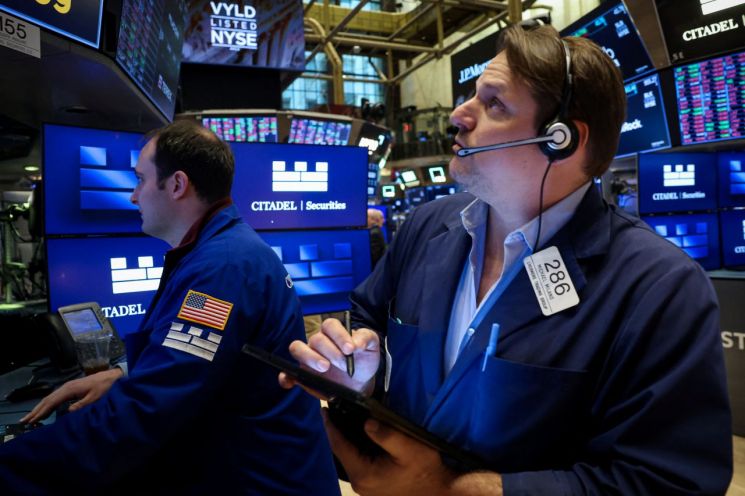
As of 10:46 a.m. in the New York stock market on the day, the Dow Jones Industrial Average (Dow) focused on blue-chip stocks was trading at 42,223.85, up 259.22 points (0.62%) from the previous trading day. The S&P 500, centered on large-cap stocks, rose 34.04 points (0.6%) to 5,709.33, and the Nasdaq, focused on tech stocks, jumped 143.44 points (0.81%) to 17,894.23.
The market started the day lower but reversed to an upward trend as existing home sales unexpectedly increased. According to the National Association of Realtors (NAR), existing home sales in February rose 4.2% month-over-month to 4.26 million units. This figure not only significantly exceeded market expectations (3.95 million units) but also surpassed the previous month's figure (4.09 million units). The strong existing home sales data led to an analysis that recession concerns might have been exaggerated, prompting the market, which had shown weakness early on, to rebound.
Last week, new U.S. unemployment claims also slightly undershot market expectations, indicating a robust recovery in the labor market. According to the U.S. Department of Labor, new unemployment claims for the week of March 9?15 remained low at 223,000 claims, 1,000 fewer than the expert forecast of 224,000 claims.
The U.S. Federal Reserve (Fed) held the benchmark interest rate steady at 4.25?4.5% the previous day and maintained its forecast of two rate cuts this year. The Fed significantly revised its economic outlook toward lower growth and higher inflation control. In the new Summary of Economic Projections (SEP), the Fed adjusted this year’s GDP growth forecast from 2.1% to 1.7%, and the core Personal Consumption Expenditures (PCE) price index inflation rate from 2.5% to 2.8%. This was interpreted as partially signaling the possibility of stagflation (economic slowdown amid rising prices).
However, Fed Chair Jerome Powell focused on reassuring the market by stating that price increases caused by President Donald Trump's tariff policies are "transitory." He also viewed the likelihood of a recession as low. He said, "Our policy is well-positioned to respond to upcoming developments," easing some concerns about a difficult path for future monetary policy amid stagflation worries. Powell’s more dovish-than-expected remarks led the New York stock market to close higher across the board the previous day.
Allison Ausenbaugh, Chief Investment Strategist at JP Morgan, said, "The word 'transitory' has returned," and assessed, "Judging by the market reaction, investors seem to believe that tariffs and other policies will not create sustained inflationary pressures and that the Fed will maintain control."
Matt Mele, Senior Market Strategist at Miller Tabak, analyzed, "The question now is whether the rebound that began late last week signals the bottom of this bear market or is merely a short-term relief from the oversold conditions formed mid-last week."
However, concerns remain that the tariff effects could intensify after President Trump’s announced reciprocal tariffs on the world starting April 2.
By individual stocks, Nvidia is up 1.48%. The previous day, Jensen Huang, Nvidia’s CEO, said in an interview with the Financial Times (FT), "We will procure about $500 billion worth of semiconductors and electronic equipment over the next four years, with several hundred billion dollars’ worth of products produced within the U.S." Apple rose 0.78%, and Alphabet, Google’s parent company, was up 0.32%.
U.S. Treasury yields are falling. The 10-year U.S. Treasury yield, a global bond yield benchmark, dropped 4 basis points (1 bp = 0.01 percentage points) from the previous trading day to 4.21%, while the 2-year Treasury yield, sensitive to monetary policy, fell 2 basis points to 3.95%.
© The Asia Business Daily(www.asiae.co.kr). All rights reserved.
![Clutching a Stolen Dior Bag, Saying "I Hate Being Poor but Real"... The Grotesque Con of a "Human Knockoff" [Slate]](https://cwcontent.asiae.co.kr/asiaresize/183/2026021902243444107_1771435474.jpg)
















