"April 2nd is America's Liberation Day"
Trump Pressures Chair Powell to Match Reciprocal Tariffs
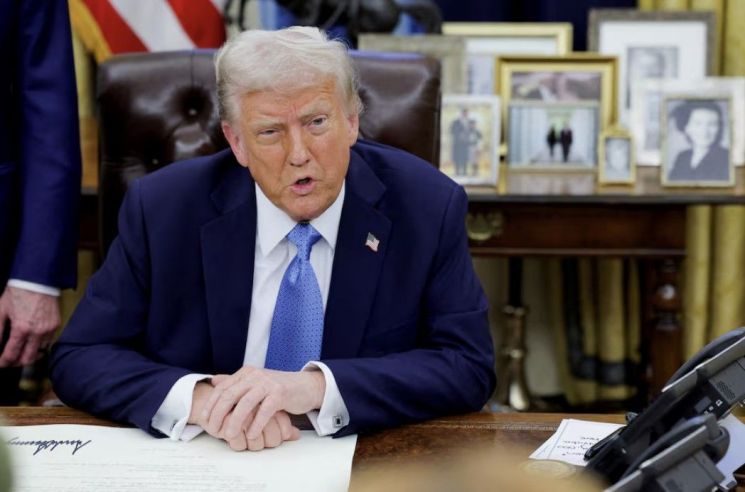 Donald Trump, President of the United States, is signing an executive order in the White House Oval Office.
On the 19th (local time), U.S. President Donald Trump pressured the Federal Reserve (Fed), the central bank, to cut interest rates after it decided to keep the benchmark rate unchanged.
In a post on the social networking service Truth Social that night, President Trump claimed that U.S. tariffs were beginning to produce the desired effects on the economy and argued that "the Fed would be much better off lowering rates." He added, "Do the right thing," and said, "April 2nd is America's liberation day." April 2nd is the date Trump announced for the 'reciprocal tariffs' announcement.
However, the Fed, which actually kept rates steady that day, pointed to Trump's 'tariff war' as a factor increasing economic uncertainty. After concluding the two-day Federal Open Market Committee (FOMC) meeting, the Fed decided to maintain the benchmark interest rate at 4.25?4.50%. For the first time, the Fed included the phrase "uncertainty surrounding the economic outlook has increased" in its policy statement, stating that "the Committee is paying close attention to risks on both sides of its dual mandate of price stability and maximum employment."
Earlier, President Trump had consistently urged rate cuts and publicly pressured the Fed since taking office. When the Fed kept rates unchanged at the January FOMC meeting, the first since his inauguration on January 20, Trump criticized via social media that "Jerome Powell (Fed Chair) and the Fed have failed to stop the problem they created with inflation."
The market is concerned about the inflationary backlash that Trump's reciprocal tariff policy might bring. The British BBC reported, "Economists have long warned that some policies could cause short-term price increases and raise uncertainty for businesses," adding, "Analysts believe these concerns have fueled stock market sell-offs." Indeed, the U.S. S&P 500 index has fallen 10% since February, returning to levels last seen in September of the previous year.
This is a point even President Trump acknowledges. While admitting that his tariff policy may cause "a little disturbance," he made it clear that he has no intention of withdrawing the tariff imposition plan, asserting that it will lead to long-term economic growth.
Meanwhile, on Wall Street, expectations for three rate cuts within the year have risen following Fed Chair Powell's more dovish-than-expected remarks. Powell stated at the post-FOMC press conference that inflation caused by tariffs is "transitory," which is "our baseline scenario." However, some analysts caution that concerns about stagflation (economic slowdown amid rising prices) have been partially confirmed in the Fed's economic outlook, and with the U.S. scheduled to impose reciprocal tariffs next month, vigilance should not be relaxed.
© The Asia Business Daily(www.asiae.co.kr). All rights reserved.
![Clutching a Stolen Dior Bag, Saying "I Hate Being Poor but Real"... The Grotesque Con of a "Human Knockoff" [Slate]](https://cwcontent.asiae.co.kr/asiaresize/183/2026021902243444107_1771435474.jpg)











