Export Industry Business Outlook for the Second Quarter
Below the Baseline for Two Consecutive Quarters: "Cloudy Prospects"
Impact of Mexico Tariffs and Steel/Aluminum Tariffs
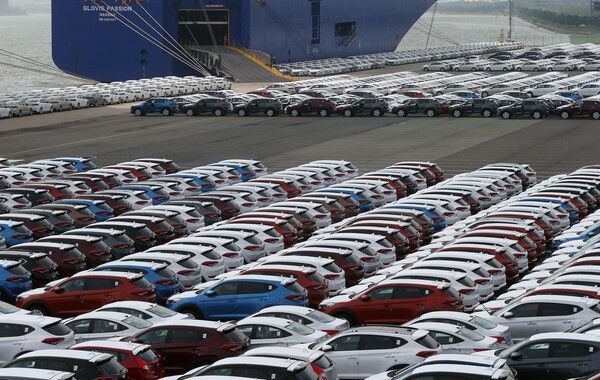
Sharp Decline in Automobile Export Outlook
Following the 25% tariffs on steel and aluminum imposed by the second Trump administration in the United States, and with the announcement of reciprocal tariffs on the entire world scheduled for the 2nd of next month, there is a forecast that the perceived business conditions of our export companies in the second quarter will be significantly contracted.
On the 20th, the Korea International Trade Association's International Trade and Commerce Research Institute revealed this in its '2025 2nd Quarter Export Industry Business Outlook Survey (EBSI)' report.
According to the report, the EBSI for the second quarter stands at 84.1, falling below 100 for the second consecutive quarter, indicating that export business conditions are expected to worsen compared to the previous quarter. The EBSI is an index that surveys and analyzes domestic export companies' outlook on export conditions for the next quarter. A value above 100 indicates an expectation of improvement compared to the previous quarter, while a value below 100 indicates an expectation of deterioration.
By product category, 11 out of the top 15 major export items recorded lower values compared to the first quarter. Automobiles and automobile parts, which have a high dependence on exports to the United States, registered 59.4, marking the largest decline from the previous quarter. The report explained, "It appears that the U.S. tariff measures on Mexico, where many Korean companies have established a presence, along with the 25% tariffs imposed on steel and aluminum derivative products, have had an impact."
Steel, which is directly subject to tariffs, recorded 88.8 and is expected to worsen compared to the previous quarter. However, the report noted that the abolition of volume quotas is interpreted as partially offsetting the decline. On the other hand, semiconductors recorded 112.7, a significant increase compared to 64.4 in the first quarter. This is analyzed as an expected export expansion due to the base effect from the first quarter, increased demand for high-value-added semiconductors driven by artificial intelligence (AI) investment expansion, and expectations of a rebound in prices of general-purpose semiconductors. Ships (140.6) also continued their favorable trend from the previous quarter due to the expansion of exports of high-value-added vessels such as liquefied natural gas (LNG) carriers.
By category, concerns appeared in items targeted or mentioned by President Trump for tariffs, such as semiconductors, automobiles and automobile parts, and steel and non-ferrous metal products. The main export difficulties in the second quarter were identified as 'rising raw material prices (19.2%)' due to increases in prices of non-ferrous metals like copper, 'increased exchange rate volatility (14.2%)', 'economic downturns in export destination countries (13.7%)', and 'import regulations in export destination countries (10.8%)'.
Yang Ji-won, senior researcher at the Korea International Trade Association, stated, "Since the inauguration of the second Trump administration, uncertainties have increased, raising concerns that difficulties for export companies may intensify. In the rapidly changing trade environment, it is necessary to closely monitor changes in trade policies to respond flexibly, review existing production networks, and seek ways to minimize the impact of tariffs."
© The Asia Business Daily(www.asiae.co.kr). All rights reserved.
![Clutching a Stolen Dior Bag, Saying "I Hate Being Poor but Real"... The Grotesque Con of a "Human Knockoff" [Slate]](https://cwcontent.asiae.co.kr/asiaresize/183/2026021902243444107_1771435474.jpg)
















