Port Sales for Kansai Region Shippers,
Vitalizing the Busan-Kyoto Maizuru Port Route
Promoting Busan Port's Transshipment Competitiveness
through Jinhae New Port Mega Port Development
and Smart Logistics Systems
Busan Port Authority (BPA, President Song Sangkeun) held a promotional session to encourage the use of Busan Port for local shippers and logistics companies in Kyoto, Japan, on the 19th.
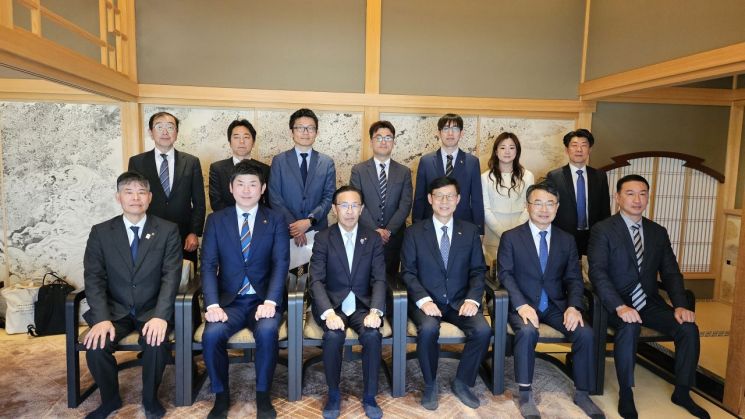 From the right, Byeonggeun Park, Chairman of Busan Port Labor Union; Jeonghaeng Lee, Chairman of Busan Port Logistics Association; Sanggeun Song, President of Busan Port Authority; Takatoshi Nishiwaki, Governor of Kyoto Prefecture; Akitsu Kamota, Mayor of Maizuru; Hideyuki Kanbayashi, President. Provided by Busan Port Authority
This session was organized to promote the competitiveness of Busan Port to shippers in the Kansai region, including Kyoto, and to vitalize the shipping route between Busan Port and Kyoto Maizuru Port. About 200 local shippers, logistics companies, and maritime logistics professionals attended the session, showing high interest in Busan Port.
On this day, BPA introduced the various regular shipping routes and cost-saving benefits of Busan Port, highlighting the merits of transshipment at Busan, and shared plans for infrastructure supply, focusing on enhancing the trust of Japanese shippers in Busan Port's transshipment services.
Generally, Japanese shippers can enjoy cost savings and a wider selection of shipping routes when transshipping via Busan Port. However, as additional loading and unloading time is required during the transshipment process, it is essential to provide smooth transshipment services to encourage Japanese shippers to choose Busan Port.
To this end, BPA reported that it is continuously striving to secure punctuality and reliability demanded by Japanese shippers by developing the Jinhae New Port into a mega port, improving terminal operation efficiency, and introducing smart logistics systems.
In particular, the western coast of Japan, including Kyoto Maizuru Port where the session was held, is geographically close to Busan Port and enjoys the greatest benefits from Busan transshipment. BPA expects that if transshipment conditions improve, it will further strengthen efforts to attract Japanese transshipment cargo to Busan Port, especially from these regions.
Accordingly, BPA plans to continue joint port sales activities centered on port authorities in western Japan, including Maizuru Port, and to actively promote the sustainable growth of feeder routes between Korea and Japan.
At the event, Song Sangkeun, President of Busan Port Authority, said, "Japan is the third-largest key market for Busan Port in terms of cargo volume, and about 10% of all Japanese container cargo is connected to the world through transshipment at Busan Port. We will further strengthen exchanges with Japanese regional ports and shippers to ensure that Busan Port can once again become the hub for Japanese transshipment cargo."
At the session, Park Byeonggeun, Chairman of the Busan Port Transport Workers' Union, and Lee Jeonghaeng, President of the Busan Port Logistics Association, also attended, emphasizing the strengths of Busan Port, which is stably operated based on strong labor-management-government cooperation. In particular, Chairman Park Byeonggeun stated, "Labor, management, and government will work together to ensure that Busan Port becomes an even more attractive choice for Japanese shippers as a transshipment hub in Northeast Asia."
© The Asia Business Daily(www.asiae.co.kr). All rights reserved.

















