March 20 Hyundai Motor Shareholders' Meeting
Chinese EVs' Overseas Expansion Cited as a Global Management Risk
Expansion of Local Production in the U.S.
Strengthening Collaboration with Global Partners
Hyundai Motor Company identified the global offensive of Chinese new energy vehicles (NEVs) as a risk factor for its management this year. As electric vehicle companies such as Xiaomi and BYD strengthen their global expansion with low-priced products as their weapon, Hyundai has significantly raised its level of vigilance.
Jose Munoz, CEO of Hyundai Motor Company, said at the 57th regular shareholders' meeting held on the 20th at EL Tower in Seocho-gu, Seoul, "Competition in the industry will become fiercer this year due to the overseas expansion of Chinese NEV companies," adding, "We will seek opportunities with a DNA of challenge." Besides Chinese NEVs, he cited trade and geopolitical uncertainties, increased volatility in exchange rates and U.S. interest rates, weakened consumer sentiment, and rising inventory as key management issues to be addressed this year.
CEO Munoz stated, "The uncertainties ahead of us are at an unprecedentedly high level, but this is a situation faced by all global automakers," and proposed solutions such as regional optimization, strengthening EV leadership, and enhancing collaboration with global partners.
Regarding the operation of the Meta Plant America (HMGMA) in Georgia, USA, he emphasized, "We plan to build a mixed production system to additionally produce hybrid models," and "We will flexibly respond to any policy changes through a localization strategy in the U.S." At HMGMA, electric vehicles such as the Ioniq 5 and Ioniq 9 are produced.
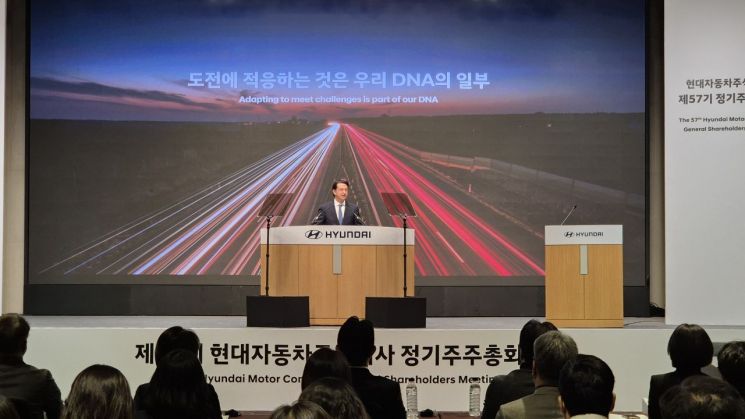 Hyundai Motor Company CEO Jose Munoz is explaining this year's business strategy at the regular shareholders' meeting on the 20th. Photo by Suyeon Woo
To expand EV leadership in the U.S. market, Hyundai is also focusing on improving charging infrastructure. In addition to applying the charging system using the North American Charging Standard (NACS), which is Tesla’s exclusive connection method, Hyundai plans to expand the use of the 'IONNA' charging method, developed through a separate alliance with BMW, Mercedes-Benz, GM, and others. IONNA, a super-fast charging service brand, plans to install about 30,000 charging stations across the U.S. over the next five years.
In Europe, another major market, Hyundai plans to respond to increasingly stringent carbon emission regulations by equipping customized engines, and in the Middle East, it announced plans to build a CKD (completely knocked down) plant in Saudi Arabia with an annual capacity of 50,000 units to meet local demand. In China, where local EV companies are gaining market share and Hyundai is struggling, the company plans to launch a locally tailored strategic electric vehicle in the near future.
CEO Munoz emphasized expanding strategic collaboration with global partners. Hyundai intends to continue cooperation not only with affiliates such as Boston Dynamics, Supernal, Motional, and Forty Two Dot but also with global companies like GM and Google Waymo. Hyundai is planning various collaborations with GM, including vehicle development and joint parts procurement, and will apply Waymo’s 6th generation fully autonomous driving technology to the Hyundai Ioniq 5 and deploy it in the autonomous driving service 'Waymo One.'
At the shareholders' meeting, Hyundai added 'hydrogen business and other related businesses' to the corporate purpose in its articles of incorporation. Hyundai stated that it amended the articles considering the potential for expansion into various hydrogen-related businesses. This year, Hyundai will launch a successor model to the hydrogen fuel cell vehicle Nexo and an improved model of the hydrogen fuel cell heavy-duty truck Xcient. Lee In-ah, Executive Director of the Energy and Hydrogen Business Division, said, "Although there are uncertainties such as possible changes in U.S. policy direction, we intend to take this as an opportunity to strengthen our conviction in hydrogen," adding, "We plan to expand the application of hydrogen fuel cells beyond mobility to various fields such as heavy equipment, broadening the scope of hydrogen utilization."
A proposal to restructure the board of directors mainly with ICT and semiconductor experts was also approved as originally planned. Chairman Chung Eui-sun was reappointed as an inside director, and Jin Eun-sook, Vice President of Hyundai Motor’s ICT division, was newly appointed. Vice President Jin is Hyundai Motor’s first female inside director. Newly appointed outside directors include Kim Soo-yi, former global private equity head at the Canada Pension Plan Investment Board (CPPIB), Do Jin-myung, former Vice President of Qualcomm Asia, and Benjamin Tan, former Asia portfolio manager at the Government of Singapore Investment Corporation (GIC).
© The Asia Business Daily(www.asiae.co.kr). All rights reserved.

















