Basic and Detailed Design for Comprehensive Renovation of Sejongno Park
Symbolic Space to Be Created First... Principle of Expressing 'Identity'
New Symbolic Space for Citizens Progressing Smoothly
Design Fee for Park and Symbolic Space Set at 2.6 Billion Won
Seoul City has begun detailed design work for the 'Garden of Gratitude' being created in Gwanghwamun Square. The project, newly initiated after ideological disputes over installing a large-scale Taegeukgi flagpole, has a construction budget of 50 billion won.
According to the maintenance industry on the 20th, the city recently launched basic and detailed design services to renovate Gwanghwamun Sejongno Park and create a symbolic space.
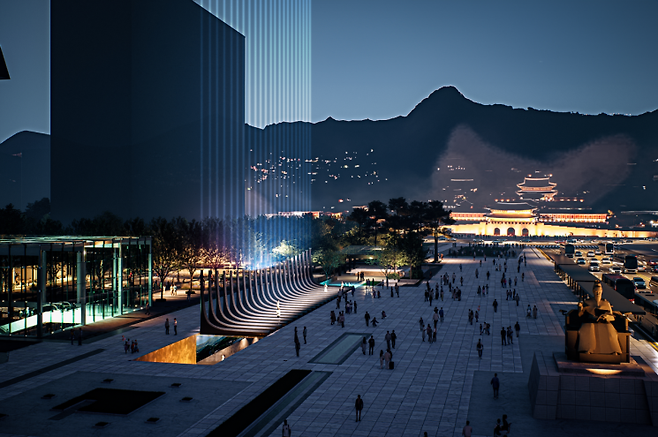 Above-ground part of the 'Garden of Gratitude' to be created at Gwanghwamun Square by the Seoul Metropolitan Government. Provided by Seoul Metropolitan Government
In February, Seoul City announced the 'Garden of Gratitude' plan, which involves creating a light pillar sculpture made from stone sent by 22 countries that participated in the Korean War, and installing a media wall underground to enable real-time communication with the allied countries.
Originally, this site was where Mayor Oh Se-hoon of Seoul had announced the construction of a giant Taegeukgi flagpole, which sparked controversy. Later, through a public opinion gathering process, Seoul City shifted the plan to create a symbolic space expressing gratitude to allied countries.
This service contract will cover both basic and detailed design phases. It will review the specific scale and layout of the facilities, as well as the construction period and costs. The construction budget allocates 40.8 billion won for the comprehensive renovation of Sejongno Park and 8.8 billion won for the creation of the symbolic space. The design fee is set at 2.6 billion won. Although this is less than the initially announced budget of 62.8 billion won, there is a possibility of increase due to variables in the design process and timeline.
The detailed concept was also revealed. The principle is to first create the symbolic space, while Sejongno Park will be partially developed with a focus on reorganizing scattered sculptures and monuments on the surface. The locations of the Hanmalgeul Protection Monument, Hangul Letter Square, and Seoul's Hymn Monument may be changed. Most importantly, since underground space up to six floors deep is secured, a three-dimensional connected space will be configured. There is also a possibility of linked development with the adjacent Sejong Center for the Performing Arts site.
The symbolic space is based on the principle of creating a facility that can express the content of South Korea's identity: liberal democracy, market economy, freedom, and peace. It will consist of an above-ground section featuring 22 black granite stone pillars connected by glass bridges symbolizing the nation, and an underground section serving as a space of gratitude with real-time communication with the allied countries.
In particular, the above-ground area will feature 22 sculptures called 'Light of Gratitude 22,' each 5.7 to 7 meters tall, visualizing gratitude to the 22 Korean War allied countries. Stones mined from these 22 countries will be brought in to create the sculptures, and on the sides, poems, literary works, and inscriptions in the native languages of the allied countries will be engraved to honor the sacrifices of the veterans. Underground, a symbolic space enabling real-time communication with allied countries will be established. Along with a media wall displaying videos and images of the 22 countries, the space will be equipped to broadcast the Taegeukgi and allied countries' flags. Visitors can enter Sejongno Park by walking on the glass bridge between the above-ground sculptures. The glass bridge will have built-in smart glass that functions as a large media screen when viewed from underground. The city also plans to build a system using media technology to enable real-time communication with the 22 allied countries. If real-time communication is difficult due to time differences, recorded videos considering the time zones will be shown. The intention is to make the space of gratitude not just a memorial but a living place of exchange.
However, concerns continue regarding the process of receiving the stones. The target completion is September, but time is tight, and there may be issues with the specific donation methods or transportation. Mayor Oh previously explained at a briefing, "Although there may be concerns about whether stones from the 22 countries can arrive by September, it is definitely possible. It may be difficult for all 22 countries to coordinate perfectly, and there may be a shortage of stones, but technically, it is possible to use markers or some of the stones."
© The Asia Business Daily(www.asiae.co.kr). All rights reserved.