K-Cloud Technology Development Project Budget Slashed from 940.5 Billion KRW to 403.1 Billion KRW
Applying NPU and PIM to Data Centers to Improve Performance and Efficiency
Preliminary Feasibility Report: "No Plan to Secure Learning-Use AI Semiconductors"
The government project budget, which started with the purpose of "replacing South Korea's artificial intelligence (AI) computing infrastructure from NVIDIA's graphics processing units (GPUs) to domestically produced neural processing units (NPUs)," has been halved. This is due to the domestic NPU's performance and utility falling short of expectations. NPUs refer to semiconductors specialized for AI learning and inference. In South Korea, AI semiconductor startups such as Rebellions and FuriosaAI are developing them.
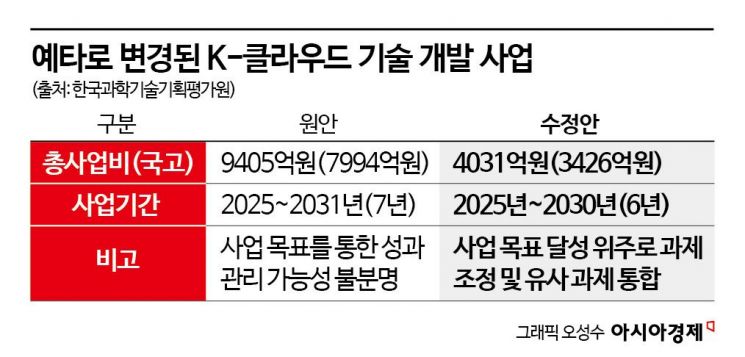
According to the government on the 21st, the Ministry of Science and ICT has been promoting the "K-Cloud Technology Development Project Using AI Semiconductors" since this year. The core goal is to build data centers equipped with low-power, high-performance domestic AI semiconductors. The Ministry of Science and ICT set targets to ▲reduce energy consumption to one-tenth compared to GPU-based data centers ▲improve learning performance efficiency by more than twice compared to GPU-based data centers ▲achieve over 20% localization rate of domestic data centers. Initially, the Ministry proposed a project budget of 940.5 billion KRW, but during last year's preliminary feasibility study, the budget shrank to 403.1 billion KRW. The cause was the forced push of the project without properly verifying the performance of domestic NPUs.
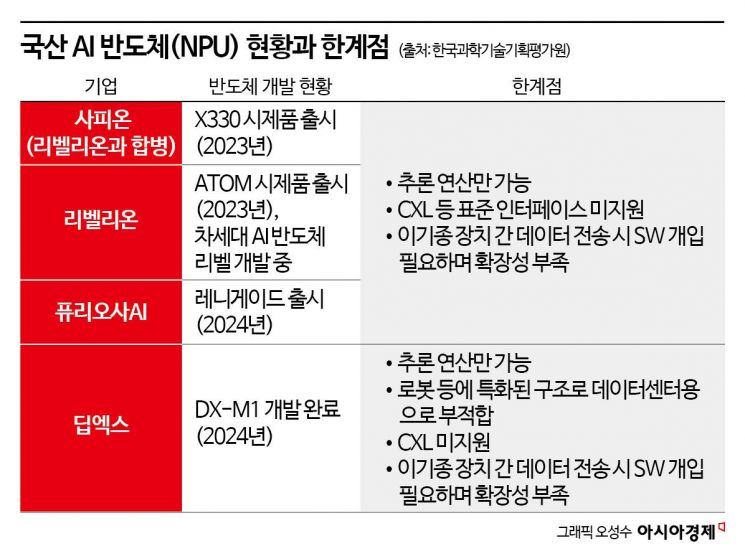
The problem with domestic NPUs revealed through the preliminary feasibility report by the Korea Institute of S&T Planning and Evaluation (KISTEP) is that they are "half-baked," limited only to "inference use." NPUs are divided into "learning use," which acquires large amounts of data, and "inference use," which is used when providing services like AI agents. Both sides must be equipped to achieve full performance. The report pointed out, "The Ministry of Science and ICT, the main department in charge of this project, has not presented a plan to secure learning-use AI semiconductors," and "It is difficult to find evidence that semiconductors such as 'Rebel' developed by Rebellions and 'Renegade' developed by FuriosaAI are sufficiently usable for learning."
Next-generation AI semiconductors similar to NPUs, called PIMs, also face uncertain smooth supply. Although Samsung Electronics and SK Hynix are producing them, they are still in the testing phase. PIM refers to semiconductors that perform computations in memory where data was temporarily stored. As a result, KISTEP judged that while overcoming the GPU-centered cloud server ecosystem led by NVIDIA is necessary, pushing forward a data center project using domestic NPUs costing over 900 billion KRW is currently a waste of budget.
Initially, the Ministry of Science and ICT planned that out of the 940.5 billion KRW project budget, 799.4 billion KRW would be borne by the government and the remaining 141.1 billion KRW by the private sector, but it was revealed that the private sector's willingness to bear the financial burden was not properly confirmed during the project promotion. The report stated, "Although 63 companies submitted letters of intent to participate, no investment intention letters confirming the private sector's concrete financial burden were shown," reducing the private sector's contribution to a total of 60.4 billion KRW.
Professor Cho Sung-bae of Yonsei University's Department of Computer Science said, "South Korea, as a latecomer, is betting on semiconductors specialized for inference, but it is realistically difficult to build a competitive data center solely with domestic AI semiconductors," adding, "The government's role is to ease regulations and lay the groundwork so that AI semiconductor startups can also develop learning-use NPUs." An industry insider from the NPU sector said, "Currently, inference types have a winning chance, so domestic startups are focusing there, but eventually both learning and inference NPUs must be developed," and "The process of developing and mass-producing learning-use NPUs involves many difficulties such as cost consumption, so government support is necessary."
© The Asia Business Daily(www.asiae.co.kr). All rights reserved.


















