Sequential Rollout by State Starting in 2026
The U.S. Bar Examination will be administered in a new format starting July 2026 in nine jurisdictions, including six states: Connecticut, Idaho, Maryland, Missouri, Oregon, and Washington. The revamped exam, called the NextGen Bar Exam (NGBE), significantly strengthens practical skills assessment compared to the existing Uniform Bar Examination (UBE). While UBE and NGBE may coexist for a time, NGBE is expected to become the primary bar exam format around 2028.
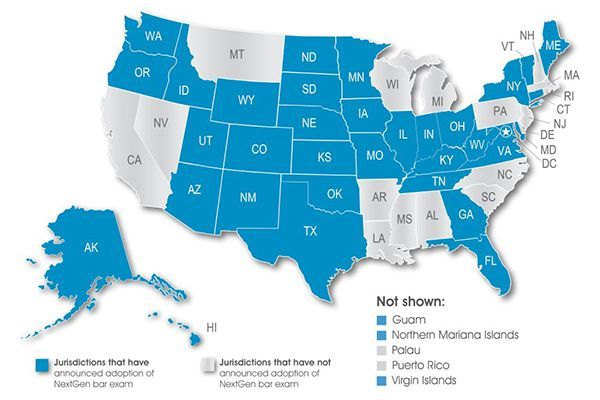 Map of states introducing the NGBE released by the National Conference of Bar Examiners (NCBE). National Conference of Bar Examiners (NCBE)
"Critical Use of AI Information Will Be Required"
Beginning July 2026, the NGBE will assess both legal concepts and practical skills. The tested subjects include Business Associations, Civil Procedure, Constitutional Law, Contract Law, Criminal Law, Evidence, Real Property, and Torts. From July 2026 to February 2028, Family Law and Trusts and Estates will be tested within practical tasks and integrated question sets. Starting July 2028, Family Law and Trusts and Estates will be formally included as Foundational Concepts and Principles. The exam will closely evaluate lawyer skills directly related to practice, such as legal research, document drafting, investigation and evaluation, client counseling, negotiation, and dispute resolution.
Jang Suhoon, a Washington DC attorney, said, "The NGBE focuses more on practical skills assessment than the existing exam, so the ability to utilize materials rather than rote memorization will be emphasized. English reading comprehension and writing skills will become even more important in the exam."
California attorney Jang Soyoung also stated, "The new exam has been restructured to evaluate whether candidates can perform as practicing lawyers, moving away from simple memorization of legal knowledge. Since AI technology is being used in the legal market, the ability to critically review and utilize information provided by AI will also be required."
Exam Schedule Reduced from 2 Days to 1.5 Days
The exam schedule will also change. The existing exam was conducted over two days, with multiple-choice questions on the first day and essay-type subjective questions on the second day.
The NGBE shortens the exam to one and a half days, consisting of three sessions of three hours each.
The types of exam questions are expected to diversify. New York attorney Kang Byungjin said, "Currently, the exam format provides four answer choices with one correct answer for multiple-choice questions, but in the NGBE, there may be more than four choices and possibly more than one correct answer. The question types are likely to be more complex than before."
NGBE to Become Mainstream Around 2028
The NGBE will be introduced in phases. Starting July 2026, it will be administered in Connecticut, Guam, Idaho, Maryland, Missouri, Northern Mariana Islands, Oregon, U.S. Virgin Islands, and Washington. In July 2027, it will expand to Arizona, Iowa, Kentucky, Minnesota, Nebraska, New Mexico, North Dakota, Oklahoma, South Dakota, Tennessee, Vermont, West Virginia, and Wyoming. In February 2028, it will be implemented in Washington DC, and from July 2028, Alaska, Colorado, Florida, Georgia, Hawaii, Indiana, Kansas, Maine, New York, Ohio, Texas, Utah, and Virginia will also adopt it. Illinois plans to implement it sometime in 2028. Some states, including California, Michigan, Massachusetts, and Pennsylvania, currently have no plans to adopt the NGBE.
Score Transferability Likely with NGBE
In the U.S., lawyer licensure is generally required on a state-by-state basis. The UBE allows score transferability, enabling some states to recognize bar qualifications obtained in other states. The NGBE is also likely to maintain score mobility similar to the UBE. If certain criteria are met, it will be possible to obtain bar admission in another state.
However, not all states permit score transfer, so it is necessary to check additional requirements for each state. Some states require passing the Multistate Professional Responsibility Examination (MPRE), completing specific legal education, or gaining a certain period of practical experience. Therefore, it is important to verify the score transfer policies and additional requirements of the state where one wishes to practice law on the respective state bar association websites in advance.
Lee Jinyoung, Legal Times Reporter
※This article is based on content supplied by Law Times.
© The Asia Business Daily(www.asiae.co.kr). All rights reserved.

















