Expansion of Credit Recognition Scope for Cooperative Classes Utilizing Infrastructure Owned by Government-Funded Research Institutes
Support for Researcher and Research Team Exchanges: Up to 1.7 Million KRW per Person per Month, Up to 9 Million KRW per Team per Month
Industry-Led Talent Development, Providing Work Experience Opportunities for Youth, and Supporting Worker Capacity Building Training
Students will be able to gain global-level education and research experience by utilizing high-quality facilities and research equipment owned by government-funded research institutes. Additionally, the establishment and operation of joint research institute companies, where academia and research institutes contribute technology and each holding company invests funds, will also be supported.
In response to the New Space era, the 'Talent Development Plan for Advancing to the Top 5 Space Powers (STAR)' for nurturing space talents will also be promoted.
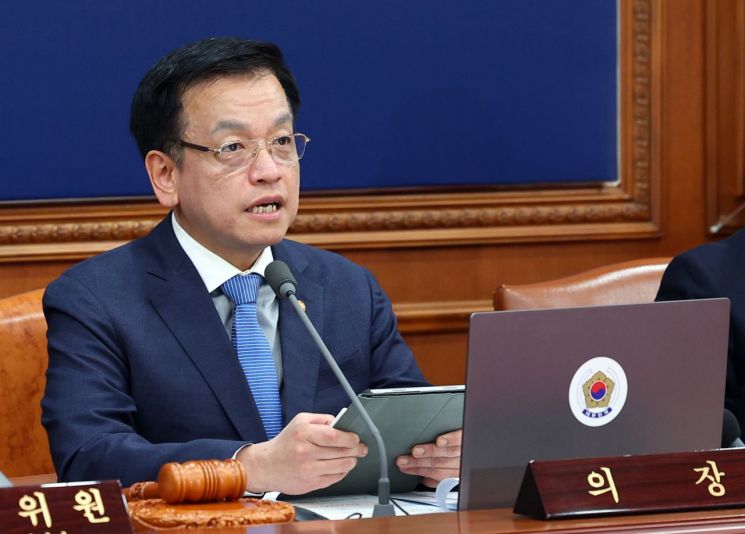 Prime Minister and Acting President Choi Sang-mok, also Minister of Economy and Finance, is speaking. Photo by Yonhap News.
On the 19th, the government held the '4th Talent Development Strategy Meeting' at Korea University, chaired by Choi Sang-mok, Acting Prime Minister and Minister of Economy and Finance, and announced this talent development plan.
First, the government plans to revise the 'Regulations on University Establishment and Operation (Presidential Decree),' which currently allows only university-owned land and buildings to be used as university campuses and facilities, so that land and buildings owned by government-funded research institutes can also be utilized as university campuses and facilities.
By applying regulatory exemptions, the scope of credit recognition for cooperative classes utilizing infrastructure owned by government-funded research institutes will be expanded, enabling students to use the high-quality facilities and research equipment of these institutes for education and research.
Expansion of Credit Recognition Scope for Cooperative Classes Utilizing Infrastructure Owned by Government-Funded Research Institutes
Support will be provided for the establishment and operation of joint research institute companies where academia and research institutes contribute technology and each holding company invests funds, and regulations on shareholding ratios applied to technology holding companies operating research institute companies and subsidiaries will be relaxed to activate investment attraction.
Through projects such as the Ministry of Science and ICT's 'Open Lab Project,' linked with regional industries, support will be given to utilize the demonstration infrastructure of government-funded research institutes for the technology commercialization of basic and foundational research achievements held by universities, and package-type technology transfers of patented technologies will be promoted through joint technology transfer centers between academia and research institutes.
To this end, a comprehensive technology commercialization company with expertise in both technology and investment will be fostered to strengthen the creation, utilization, and dissemination of outcomes from public research and development (R&D). Incentives through technology commercialization activities will be provided so that researchers can focus solely on research without facing economic difficulties.
In the rapidly changing science and technology and industrial ecosystem and the intensifying global technology hegemony competition, it is urgent to break down the barriers between universities and government-funded research institutes, the two main pillars of national R&D activities, and various measures to this end will be promoted.
To remove personnel and physical barriers between universities and government-funded research institutes, a special system such as open recruitment for major university positions will be piloted, and excellent faculty and researchers will be treated exceptionally to prevent the outflow of top talent. Regulations on hiring procedures and retirement age will also be improved to allow universities to employ outstanding retired researchers as faculty members.
Support for Researcher and Research Team Exchanges: Up to 1.7 Million KRW per Person per Month, Up to 9 Million KRW per Team per Month
Financial support will be provided for researcher and research team exchange projects to promote personnel exchanges between universities and government-funded research institutes. Up to 1.7 million KRW per person per month will be newly supported for 'researcher exchange' projects, and up to 9 million KRW per team per month for 'research team exchange' projects. Exceptional treatment such as exemption from salary caps will be allowed to attract excellent external personnel.
A legal basis has also been established to allow government-funded research institutes to freely secure outstanding personnel both internally and externally with exceptional support, and plans are in place to actively promote the recruitment and improved treatment of excellent researchers at these institutes.
Other models such as 'joint research labs,' where university faculty and government-funded research institute researchers jointly conduct research projects, and 'joint research institutes,' sustainable cooperation hubs operated through joint committees for affiliated research institutes or research centers of academia and research institutes, will also be applied.
The Talent Development Plan (STAR) for advancing to the world's top 5 space powers will also be promoted. The Space Agency will actively implement the 'Student' policy to expand the space culture base among youth, future space talents, by providing experiential opportunities such as 'Space Camp' and 'Cube Satellite Competition.'
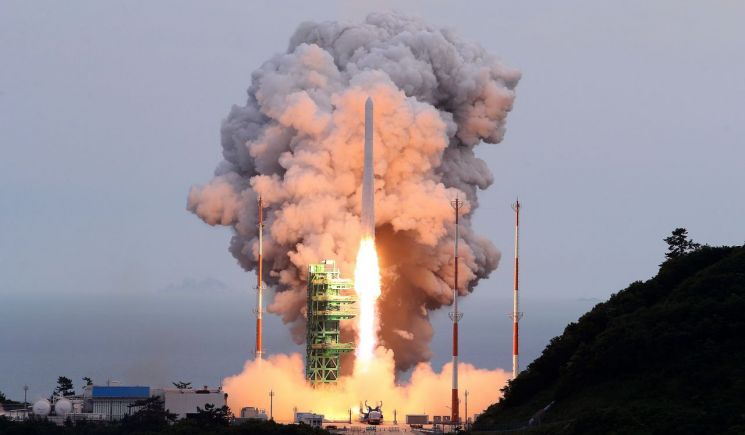 The Korean-type launch vehicle Nuriho (3rd flight), developed with domestic proprietary technology, is being launched. Photo by Yonhap News Agency
For 'Technology,' the cultivation of convergent technology experts, a strategic technology-based mission center will be operated, and advanced personnel training will be promoted through the expansion of convergent aerospace R&D, including education utilizing satellite information. To this end, cooperation systems with regional universities will be strengthened, and policies supporting regionally tailored specialized majors will be promoted to reinforce regionally settled talent development.
Industry-Led Talent Development, Providing Work Experience Opportunities for Youth, and Supporting Worker Capacity Building Training
The 'Ability' project to strengthen job competencies led by industry will also be carried out. Competency enhancement academies reflecting on-site corporate demands will be operated, and support will be provided for talent development initiatives led proactively by industry. Work experience opportunities will be offered to youth interested in the aerospace field, and training necessary for capacity building will be supported for workers engaged in related fields.
To strategically nurture aerospace talents and revitalize industry-academia cooperation hubs in connection with government policies, the operation of a Talent Strategy Development Center will also be promoted.
To strengthen 'Relations' domestically and internationally, a system for joint use of research and experimental facilities of schools and research institutes will be established to enhance the research capabilities of startups and other companies. Furthermore, projects linked with global space agencies will be conducted, advanced technology cooperation will be expanded, and a global leadership program to cultivate global talents will be developed.
An official from the Space Agency stated, "In the New Space era, it is necessary to create a space industry ecosystem, and it is time to establish a core strategy for space talent development to promote national space policies," adding, "We plan to establish a virtuous cycle talent development system covering the entire cycle, including expanding the youth base through bold investment, mission-centered talent development, and regionally settled practical workforce training."
Acting Prime Minister Choi Sang-mok said, "In the era of global technology hegemony competition, we will actively promote securing world-class research and education capabilities and creating an innovation ecosystem, and through a virtuous cycle talent development system for advancing to the top 5 space powers, we will actively support building a progressive future for the Republic of Korea."
© The Asia Business Daily(www.asiae.co.kr). All rights reserved.


















