"Uncertainties in Trade Policy and More" Highlighted
Governor Ueda to Hold Press Conference in the Afternoon
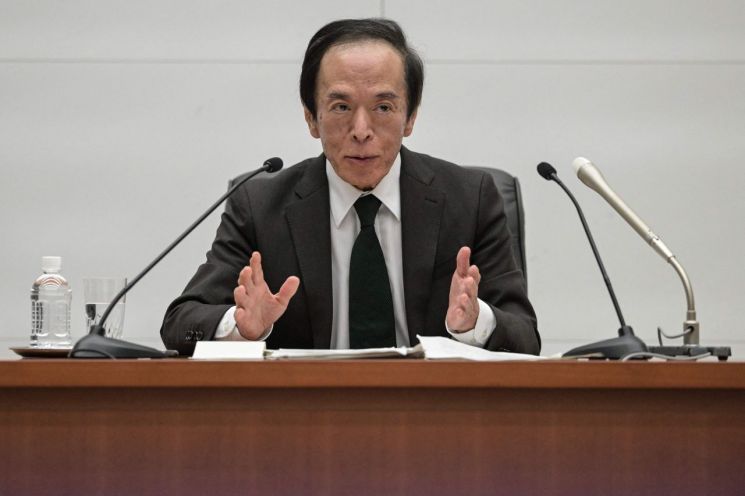 Kazuo Ueda, Governor of the Bank of Japan (BOJ), is explaining the interest rate hike at a press conference held on March 20 last year. As expected by the market, the BOJ kept the benchmark interest rate at around 0.5% on the 19th. / AFP News Agency · Yonhap News Agency
Japan's central bank, the Bank of Japan (BOJ), on the 19th, as expected by the market, kept the benchmark interest rate at "around 0.5%," according to public broadcaster NHK and Nihon Keizai Shimbun (Nikkei).
The BOJ decided to maintain the benchmark interest rate at its two-day Monetary Policy Meeting held on the 18th and 19th. In a statement released after the meeting, the BOJ pointed out that "uncertainties surrounding the Japanese economy and prices remain high due to movements in trade policies of various countries, the overseas economy affected by these, and trends in prices of goods and resources."
This decision aligns with market expectations. The financial market had anticipated that the BOJ would hold rates steady this time to assess the impact of the January rate hike and the economic policies of the U.S. Donald Trump administration. The BOJ raised the rate from "around 0.25%" to "around 0.5%" in late January.
The market is focusing on the timing of the next rate hike. Since the BOJ has repeatedly expressed its intention to implement additional rate increases if the economy and prices move within expected ranges, there is a growing view that further rate hikes are likely in the future. The sharp rise in rice prices and other signs of accelerating inflation are also analyzed as factors supporting expectations of a rate increase.
In March last year, the BOJ raised rates for the first time in 17 years at the Monetary Policy Meeting, ending its negative interest rate policy, and again raised rates in July last year, attempting to move away from large-scale monetary easing. The large-scale monetary easing, a hallmark of former Prime Minister Shinzo Abe's economic policy "Abenomics," was a policy to recover the Japanese economy, which had fallen into deflation (price declines amid economic stagnation), by keeping interest rates at very low levels and increasing the money supply.
BOJ Governor Kazuo Ueda is scheduled to hold a press conference in the afternoon to explain the results of the meeting.
© The Asia Business Daily(www.asiae.co.kr). All rights reserved.

















