Minister of Agriculture Visits Pocheon Wangjin Bus Site
This Year Adds Osteoporosis, Dementia Screenings, and Physical Therapy
Pilot Program for Home Visit Medical Services Also Launched
Song Miryeong, Minister of Agriculture, Food and Rural Affairs, announced on the 18th, "This year, we will provide visiting medical services to 150,000 people, an increase of 60,000 from last year, through the Wangjin Bus."
Minister Song visited the 'Rural Wangjin Bus' medical site held at Gasan Sports and Culture Center in Pocheon-si, Gyeonggi Province, and said, "This year, the Wangjin Bus plans to reach more people with a wider variety of services."
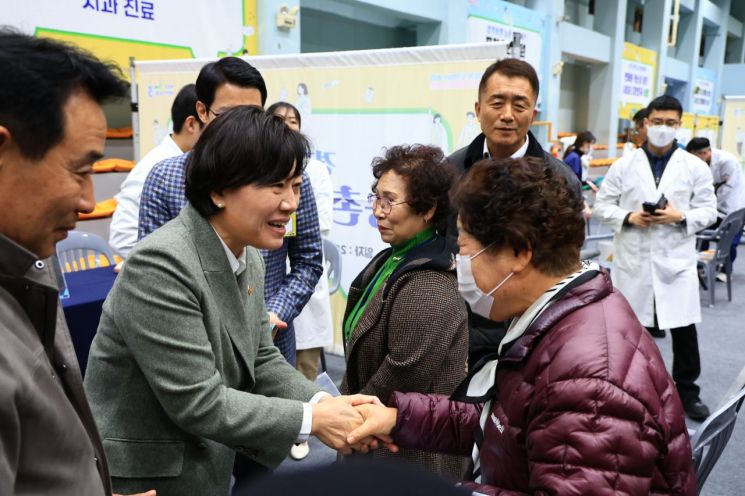 Song Miryeong, Minister of Agriculture, Food and Rural Affairs, is inspecting the 'Rural House Call Bus' medical site held at Gasan Sports and Culture Center in Pocheon-si, Gyeonggi Province on the 18th, greeting local residents who visited the house call bus.
Minister Song explained, "Rural areas, which are aging and have a high prevalence of diseases, have a high demand for medical services, but due to a lack of medical facilities or low accessibility, rural residents find it difficult to receive timely necessary medical care. The Ministry of Agriculture, Food and Rural Affairs introduced the Rural Wangjin Bus last year to address these inconveniences by providing medical services directly in rural areas."
The Wangjin Bus, which started in March last year, is a project that provides visiting medical services directly to rural residents who are vulnerable in terms of health and medical care. Since 2013, it has expanded the 'Farmer Happiness Bus' project in cooperation with the NongHyup, offering services such as commemorative photos, eye exams and magnifiers, and both Western and Korean medicine. It provides medical services including Western and Korean medicine treatment, dentistry, and eye exams, as well as beauty services and legal consultations.
Han Insu (74), who visited the Wangjin Bus that day, said, "I came to take the bus sent to the village for dental checkups and vision tests, and if time permits, I plan to receive physical therapy for my wrist and shoulder. I am satisfied because I can receive the desired treatments all at one place at once."
In the second year of the project, the budget has been increased to expand the target group. The budget increased from 7.5 billion KRW last year to 9.3 billion KRW this year, and the number of beneficiaries increased from 91,000 last year to 150,000 this year. Minister Song said, "Especially from this year, we have added medical services necessary for rural elderly, such as musculoskeletal disease management and dementia diagnosis. Also, starting from Gasan-myeon, Pocheon, we plan to pilot home visit medical services for elderly people with mobility difficulties."
The Ministry of Agriculture, Food and Rural Affairs plans to link and expand health, medical, and living services specialized for rural areas in addition to the Wangjin Bus. It also plans to expand special health checkups to prevent various diseases among women farmers.
Minister Song said, "Rural residents should not experience inconvenience in their daily lives regardless of where they live. We will continue to expand life-oriented public policies that are close to daily life, such as mobile markets that load and sell daily necessities from vehicles, rural transportation models, and childcare support, to improve the quality of life in rural areas."
© The Asia Business Daily(www.asiae.co.kr). All rights reserved.

















