For the construction industry to continue developing sustainably, it is argued that unfair practices must be improved and a major transformation of the related industrial system is necessary.
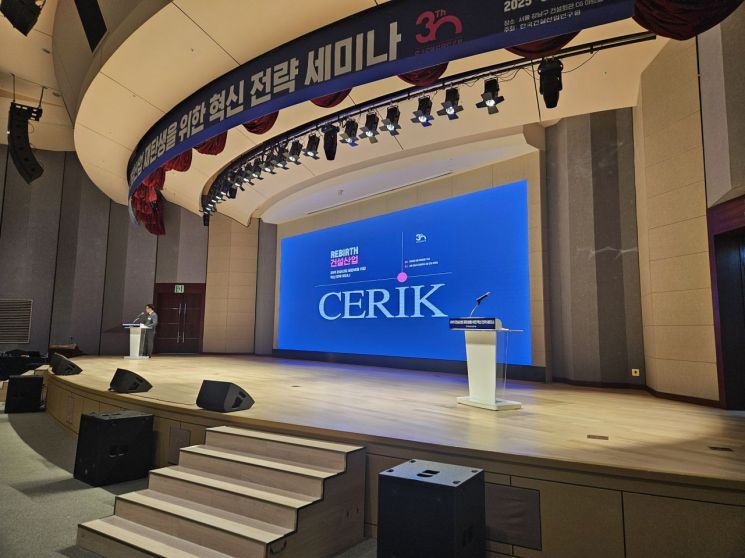
The Korea Construction Industry Research Institute (KCON) held the "2025 Rebirth Seminar for Innovation in the Construction Industry" on the 18th at the Construction Hall in Gangnam-gu, Seoul, commemorating its 30th anniversary. At the seminar, KCON suggested that three major transformations are needed, including the industry's core values, industrial system, and the construction market and products.
Lee Chung-jae, president of KCON, emphasized that for a "major transformation of the industry's core values," all parties must redefine their roles as responsible actors rather than as dominant parties. He stated, “To restore trust across the industry, a new paradigm centered on the values of fairness and cooperation must be established,” and added, “It is necessary to establish an organic linkage and cooperation base across the entire industry beyond individual companies.”
KCON also proposed improvements to address construction labor shortages and various unfair practices through a "major transformation of the industrial system" strategy. To this end, contract terms, construction periods, and construction costs need to be made more realistic. They argued that, unlike the existing standard contracts led by government authorities, private organizations should take the lead in creating and distributing standard contracts, as is done overseas. They also called for the establishment of legal procedures allowing permitting agencies to review and examine each stage of private construction projects.
Furthermore, regarding regulations, they proposed creating a "regulation map" grouped by types to eliminate unnecessary regulations. They also argued that detailed construction industry categories under the current Construction Industry Basic Act should be governed by separate individual laws, and the Construction Industry Basic Act should be revised as a fundamental law encompassing the entire construction industry.
In addition, the Ministry of Land, Infrastructure and Transport, which oversees the construction industry, was requested to be elevated from ministerial to deputy prime ministerial level and to establish a "public-private joint policy consultation committee" involving both private companies and public institutions.
Finally, concerning the "major transformation of the construction market and products," pilot projects related to housing and redevelopment were proposed.
They advocated for pilot initiatives such as construction finance projects led by the private sector, redevelopment projects involving public participation in unprofitable redevelopment, and complex urban development projects led by the private sector with public support.
President Lee stated, "The challenges and crises facing the construction industry are complex and fundamental, so sustainable growth cannot be guaranteed by existing methods alone," emphasizing, "For the construction industry to create a sustainable future, short-term measures on systems and markets must be accompanied by a fundamental and structural major transformation leading to the industry's rebirth."
© The Asia Business Daily(www.asiae.co.kr). All rights reserved.

















