"Energy 3 Acts" Pass Cabinet Meeting
Including the High-Level Radioactive Waste Disposal Facility Act
The so-called "Energy 3 Acts"?the "High-Level Radioactive Waste Disposal Facility Act," the "Power Grid Expansion Act," and the "Offshore Wind Power Special Act"?were passed at the Cabinet meeting on the 18th. This establishes the legal foundation for energy policies such as the construction of permanent disposal sites for spent nuclear fuel, expansion of the national power grid, and activation of the offshore wind power industry.
The government held a Cabinet meeting on the same day to review and approve the Energy 3 Acts, which were passed by the National Assembly on the 27th of last month. The Power Grid Special Act and the High-Level Radioactive Waste Special Act will be enforced six months after promulgation, while the Offshore Wind Power Special Act will be enforced one year after promulgation. The Ministry of Trade, Industry and Energy will begin drafting subordinate legislation, including procedures for public consultation and specific measures to expand compensation and support, in line with the enforcement of the laws. It will also actively prepare for implementation by organizing committees and promoting communication and publicity with local governments and communities.
First, the "High-Level Radioactive Waste Disposal Facility Act (Special Act on the Management of High-Level Radioactive Waste)" serves as the legal basis for constructing facilities to process spent nuclear fuel generated from nuclear power plants, enabling the transition from the current temporary storage method to intermediate storage and permanent disposal facilities.
Currently, temporary storage facilities for spent nuclear fuel at domestic nuclear power plants are expected to reach capacity starting with Hanbit Nuclear Power Plant in 2030, followed by Hanul in 2031, and Kori in 2032. The storage periods for Wolseong (2037), Shin-Wolseong (2042), and Saeul (2066) nuclear power plants are also limited, making it inevitable to halt nuclear power plant operations if permanent disposal facilities are not established.
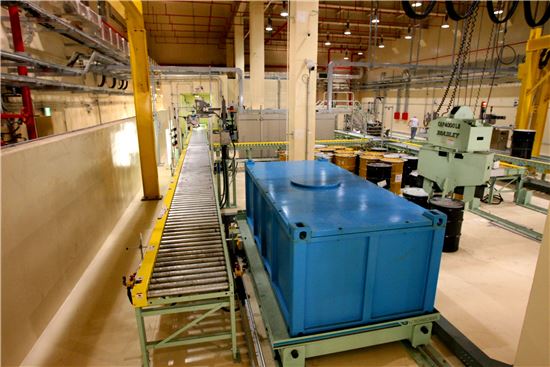 ▲At the Gyeongju Radioactive Waste Disposal Facility's interim storage facility, inspections such as dose measurement and radionuclide analysis are conducted on the waste.
The special act sets target dates to secure intermediate storage facilities by 2050 and disposal facilities by 2060. For site selection, basic local governments (cities, counties, districts) can apply, followed by a two-stage site suitability investigation (basic and in-depth surveys) and a resident referendum. It also includes provisions to ensure broad support, including special subsidies, for the hosting regions and their surrounding areas.
When installing spent nuclear fuel storage facilities within nuclear power plant sites, procedures for gathering opinions from surrounding areas and support measures are required. The scale is limited to the predicted amount generated during the reactor's design life, and it is stipulated that spent nuclear fuel stored on-site must be transferred to the intermediate storage facility immediately upon its completion.
The "Power Grid Expansion Act (Special Act on the Expansion of the National Power Grid)" involves the government leading the expansion of the national power grid to support the growth of industries requiring large-scale power, such as artificial intelligence (AI) and data centers.
Under this law, the government will establish the "National Power Grid Expansion Committee" under the Prime Minister, comprising government-wide, local government, and expert participants, to mediate conflicts related to national power grid construction. The scope of permits subject to review will be expanded (from the existing 18 to 35), and measures to prevent delays in permits related to ancillary projects (such as access roads and work sites) will be introduced. It also includes provisions allowing regions that produce electricity to have priority in using it.
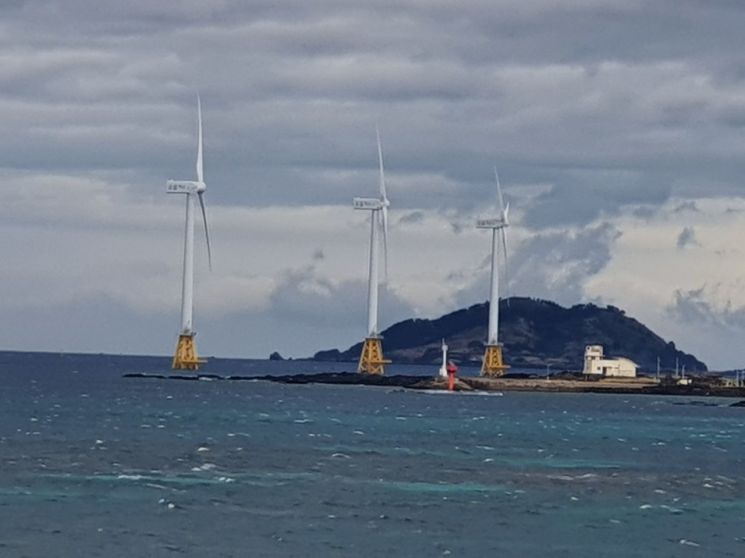
The Offshore Wind Power Special Act (Special Act on the Promotion of Offshore Wind Power Distribution and Industry Development) aims to introduce a government-led "planned site system" that allows offshore wind power projects in locations where economic feasibility, environmental impact, and acceptability have been pre-verified for systematic and orderly offshore wind power distribution. It also includes measures to strengthen support for fisheries to harmonize offshore wind power projects with existing shared water surface users such as fishermen.
Accordingly, the government will establish the "Offshore Wind Power Development Committee" under the Prime Minister and the "Offshore Wind Power Development Promotion Team," a joint task force of related ministries. The Ministry of Trade, Industry and Energy and the Ministry of Oceans and Fisheries will build an "Offshore Wind Power Site Information Network" and designate preliminary zones considering wind conditions, fishing activities, ship navigation, and environmental factors through the committee's review and resolution.
Subsequently, the Ministry of Trade, Industry and Energy will designate development zones after consultations with local governments' public-private councils and marine environmental impact surveys, and select offshore wind power project operators within the development zones through bidding. Once the selected operators submit and receive approval for their implementation plans, related permits will be processed by exemption.
The passage of the "Energy 3 Acts" is evaluated as reflecting the will of the government and the National Assembly to pursue nuclear power and renewable energy policies in a balanced manner. Accordingly, Korea's energy transition policy to respond to the large-scale power demand of future advanced industries such as AI and semiconductors is expected to be fully activated.
© The Asia Business Daily(www.asiae.co.kr). All rights reserved.

















