Trump: "Previous Presidents Were Foolish... We Will Reclaim Our Benefits"
Global economic growth rate falls due to Mexico-Canada bilateral tariffs
OECD warns of slowing global growth, but Trump remains unfazed
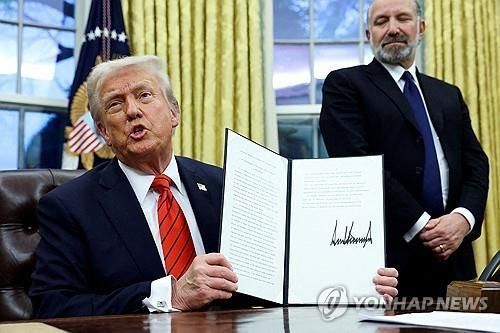 Donald Trump, President of the United States, is holding up an executive order after signing it in the White House Oval Office.
U.S. President Donald Trump reaffirmed his original plan on April 2 to impose reciprocal tariffs worldwide. Despite the Organization for Economic Cooperation and Development (OECD) lowering its global economic growth forecast by as much as 0.2 percentage points this year, citing serious damage from the bilateral tariffs the U.S. imposed on Mexico and Canada, Trump remains unfazed.
Trump: "Previous Presidents Were Foolish... We Will Reclaim Our Benefits"
According to U.S. political media outlet The Hill and others on the 17th (local time), President Trump told reporters on the evening of the 16th aboard Air Force One that he plans to impose reciprocal tariffs as scheduled on April 2, calling that day "Liberation Day." This statement was made on the presidential plane traveling from Mar-a-Lago estate in Palm Beach, Florida, to the White House in Washington D.C.
He told reporters that day, "Foolish presidents, who did not even properly understand, handed over our economic benefits to other countries," adding, "We will reclaim them." When asked if there was a possibility of easing tariff policies amid market instability, he firmly said, "No."
Household consumer sentiment in the U.S. has weakened due to soaring egg prices and the trade war potentially triggered by U.S. tariffs. Despite concerns about tariff imposition both inside and outside the U.S., President Trump maintains that there is no problem. He said, "Egg prices have dropped by as much as 35% in a short period," and "Oil and energy prices are also falling, with oil prices dropping from $82 to $65 per barrel." He also mentioned that food prices are decreasing and that "now is the right time." However, U.S. media such as CNN have pointed out that Trump's claim about the egg price drop is not accurate.
Kevin Hassett, Chairman of the U.S. White House National Economic Council (NEC), also aligned with President Trump in an interview with CNBC that day, stating that there will be some economic uncertainty until the reciprocal tariffs are announced, but that uncertainty will be resolved afterward. He explained, "Clearly, there will be some uncertainty from now until April 2, but by April, the market will realize that reciprocal trade policies are very reasonable."
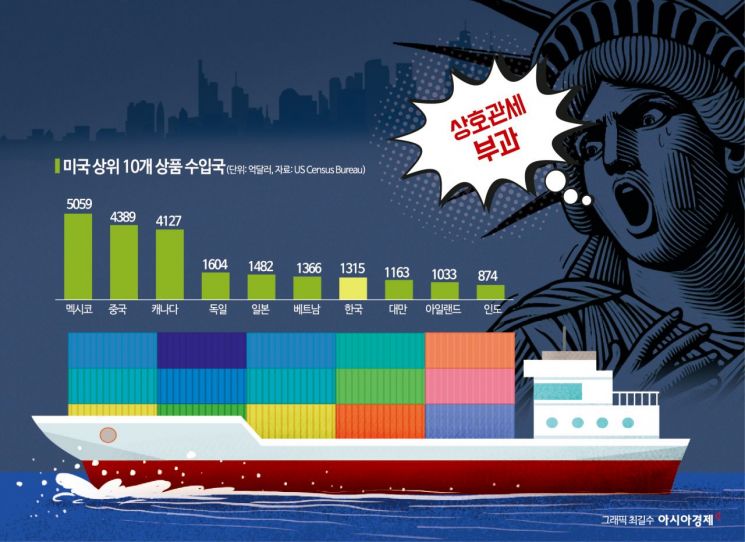
Global Economic Growth Rate Declines Due to Mexico-Canada Bilateral Tariffs Alone
Contrary to the wishes of President Trump and his second-term administration, economic organizations have expressed deep concerns about reciprocal tariffs. While the current Trump-style tariff policies have been limited to targeted tariffs on specific countries such as China, Canada, and Mexico, or specific sectors like steel and aluminum, the reciprocal tariffs set to take effect on April 2 will apply globally and across all products, thus expected to have a much greater impact.
The global economic outlook is already bleak due to the tariffs the U.S. has imposed on Canada and Mexico. In its recently published "Interim Economic Outlook" report, the OECD lowered its global economic growth forecast for this year from 3.3% to 3.1%, a 0.2 percentage point drop. The growth forecast for next year was also adjusted downward from 3.3% to 3.0%, a 0.3 percentage point decrease. The report noted, "Global GDP growth is expected to gradually slow until next year," and "Increased trade barriers among some major Group of Twenty (G20) economies, along with rising geopolitical and policy uncertainties, will weigh on investment and household spending."
There are also analyses suggesting that the U.S. is shooting itself in the foot. Looking at the country-specific forecasts, the U.S., under the Donald Trump administration, is expected to see economic growth of 2.2% this year, 0.2 percentage points lower than the previous forecast, and a further decline to 1.6% next year, down by 0.5 percentage points, due to the trade war's impact. Canada is also forecasted to grow only 0.7% this year and next, down from 1.5% growth last year. Mexico's situation is even worse, with growth expected to contract by -1.3% this year and -0.6% next year, indicating an economic recession.
Furthermore, the trade war is expected to accelerate inflation worldwide. The annual consumer price inflation rate for the G20 was also forecasted gloomily compared to the report from three months ago. The OECD had previously projected inflation at 3.5% this year and 2.9% next year, but the latest report raised these estimates to 3.8% and 3.2%, respectively.
© The Asia Business Daily(www.asiae.co.kr). All rights reserved.


















