Special Mobility Support Brigade of Ground Operations Command
to Become a UGF Specialized Unit by Year-End
The Army announced on the 17th that the Ground Operations Command/Ground Component Command is conducting the “ROK-US Combined Underground Facility (UGF) Response Training” over four days until the 20th at the urban area operation training ground in Paju, Gyeonggi Province.
This training, part of the 2025 Freedom Shield (FS) exercise, involved about 370 ROK and US soldiers, centered on the Ground Operations Command Special Mobility Support Brigade, along with the Drone-Bot Combat Unit, Capital Mechanized Infantry Division, 30th Armored Brigade, 5th Corps Chemical, Biological, Radiological, and Nuclear (CBRN) Battalion, and the US 2nd Infantry Division/ROK-US Combined Division 23rd Engineer Battalion.
The training was designed to concretize combat execution methods such as operations and combat techniques in various UGFs and environments. In particular, it focused on reinforcing the unit structure, organization, and equipment modernization plans of the Ground Operations Command Special Mobility Support Brigade, which is scheduled to be reorganized into a UGF response specialized unit by the end of this year.
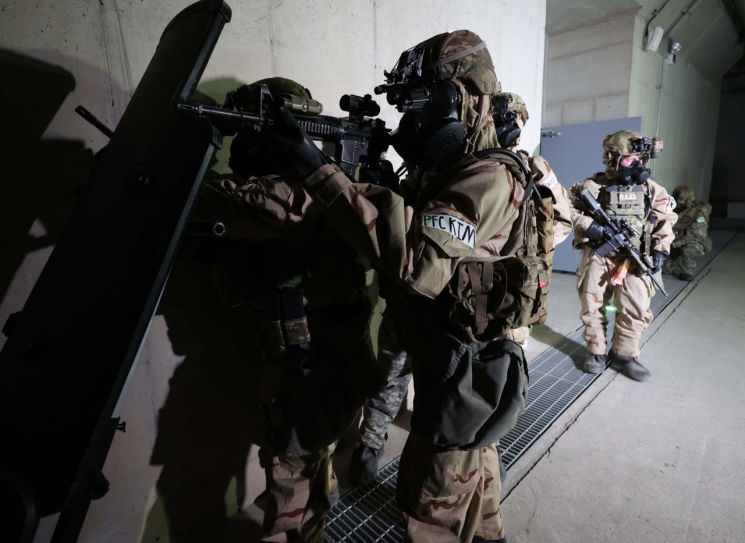
It is estimated that North Korea currently has thousands of UGFs used as important bases and hideouts. To counter this threat, the Army established the Special Mobility Support Brigade in 2019 and is developing it into a UGF response specialized unit that includes various functions such as engineering, mobility, intelligence, logistics, CBRN, and medical support.
The full-scale training began with the Drone-Bot Combat Unit’s SWID drone conducting reconnaissance near the UGF. Based on the detailed locations and specifications of the opposing forces identified by the drone, the ROK mechanized units annihilated the enemy and established a ground foothold to assault the UGF.
Once the foothold was secured, soldiers from the Special Mobility Support Brigade’s battalion deployed multi-legged walking robots to explore the UGF entrances. They sealed all entrances except the ones to be used by friendly forces using remote demolition devices and welding equipment, and isolated the enemy by demolishing water supply, ventilation, and power facilities.
Next, the Special Mobility Support Brigade’s pioneer squad forcibly opened the entrance using cutters and explosives. After the CBRN unit confirmed there was no chemical or biological contamination inside the UGF, the ROK-US maneuver units began to enter the UGF. The US side’s miniature drones, Black Hornet and Talon, identified enemy positions and removed IEDs and booby traps, allowing the maneuver units to completely eliminate enemy forces ambushed in various compartments, concluding the training.
Colonel Hwang Hyun-jo, commander of the Special Mobility Support Brigade’s engineer battalion, said, “ROK and US soldiers were able to work as one team and exchange methods for conducting underground facility combat,” adding, “It was a valuable opportunity to accumulate diverse experiences in underground facility combat and derive areas for improvement.”
Sergeant Major Murr Mark, squad leader of the Combined Division Engineer Battalion, stated, “It was a meaningful time to develop and exchange various combat techniques to respond to enemy underground facility threats,” and added, “I am confident this training served as a testament to the strong alliance between the ROK and the US.”
© The Asia Business Daily(www.asiae.co.kr). All rights reserved.
![Clutching a Stolen Dior Bag, Saying "I Hate Being Poor but Real"... The Grotesque Con of a "Human Knockoff" [Slate]](https://cwcontent.asiae.co.kr/asiaresize/183/2026021902243444107_1771435474.jpg)
















