Aimed at Promoting National Unity
Yoon's Side: "Premature to Respond, Assumes One-Sided Decision"
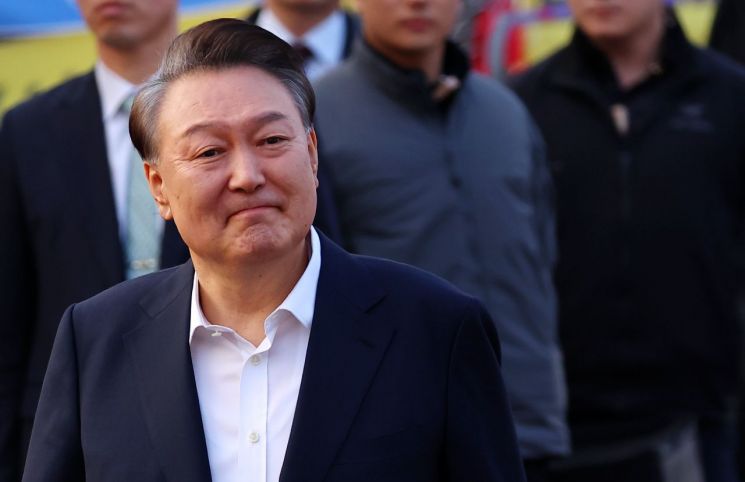 President Yoon Seok-yeol, who was released, is seen on the 8th in front of Seoul Detention Center in Uiwang-si, Gyeonggi-do, getting out of a security vehicle and greeting supporters as he leaves the detention center. Photo by Yonhap News
As the Constitutional Court's ruling on the impeachment trial of President Yoon Seok-yeol approaches, political circles are intensifying disputes over the sincerity of acceptance messages following the court's decision. President Yoon and the Blue House have shown subtle differences in stance, refraining from making official statements.
A Blue House official stated on the 17th that regarding People Power Party leader Kwon Seong-dong's announcement that the party would accept the Constitutional Court's judgment, "There is no official acceptance message from the Blue House," adding, "There are no plans to make a separate statement ahead of the court's ruling, and we will wait for the court's result carefully and calmly." Leader Kwon reaffirmed at a press briefing the previous day, "Our party's official position is to accept the Constitutional Court's judgment." This drew attention to whether there was prior coordination with the Blue House.
President Yoon's legal team expressed discomfort over the ruling party's repeated calls for President Yoon to issue an acceptance message. Yoon's lawyer Yoon Gap-geun told Asia Economy that morning, "Since there is neither a ruling date nor a Constitutional Court decision, asking about acceptance presumes one side's decision and is not a situation to respond to." This was interpreted as indirectly conveying that the repeated demands for acceptance messages ahead of the court's decision effectively amount to coercion to accept, presuming the ruling will be in favor.
The Blue House is exercising maximum restraint in making statements. One aide said, "If the Constitutional Court makes a correct ruling, why wouldn't we accept it?" and added, "There is no reason not to accept it, assuming the ruling is correct." A key ruling party official explained the subtle difference in tone, saying, "The party may have to prepare for an early presidential election depending on the impeachment trial result, so some differences in acceptance messages between Yongsan and the party are inevitable."
Park Chan-dae, floor leader of the Democratic Party of Korea, said, "Respecting the Constitutional Court's judgment is something politicians with a will to uphold the constitution in a rule-of-law country must naturally do." Both ruling and opposition parties have conveyed acceptance positions but have not yet concretized them into actions.
Professor Shin Yul of Myongji University's Department of Political Science and Diplomacy said, "Doubting the sincerity of acceptance messages from the opposing camp diminishes the effect of the acceptance messages issued by each side," adding, "If it is awkward to meet each other (to heal national division), they can issue a joint statement."
Professor Ha Sang-eung of Sogang University's Department of Political Science and Diplomacy said, "More important than the ruling and opposition parties is President Yoon's acceptance message," and added, "If he does not speak directly, his supporters will not believe the political acceptance messages."
© The Asia Business Daily(www.asiae.co.kr). All rights reserved.

















