Dollar Index Drops from 110 to 103 Range
Meanwhile, Euro Rises 5 Percent This Year
Trump Administration Favors Weak Dollar
Since last year’s U.S. presidential election, the value of the dollar, which had been strong, has recently continued to weaken. This is due to the combination of President Donald Trump’s unpredictable economic and foreign policies and concerns about an economic recession. On the other hand, the euro, which had been weak against the dollar, has recently shown strength, displaying a movement opposite to that of the dollar.
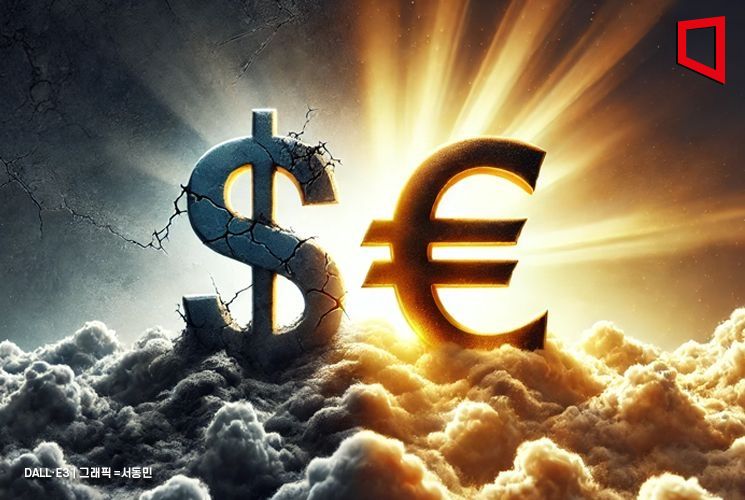
According to the U.S. Wall Street Journal (WSJ) on the 16th (local time), the U.S. Dollar Index, which represents the relative value of the dollar against six major currencies including the euro and yen, fell from around 110 in early January to the 103 range, dropping 4.41% so far this year. The WSJ Dollar Index, which shows the dollar’s value against 16 currencies including emerging markets, also dropped to 99.26 at around 8:37 p.m. Eastern Standard Time on the same day, returning to the level before the U.S. presidential election on November 5 last year.
WSJ interpreted, “President Trump has initiated an unprecedented challenge to the geopolitical order that has lasted for decades,” and one of the potential victims of this is the ‘U.S. dollar.’
The British Economist wrote, “While President Trump’s antagonism toward U.S. allies and neighbors may appeal to the Make America Great Again (MAGA) base, unfortunately investors do not think so,” adding, “Confidence in the U.S. economic outlook has weakened, and financial markets are sinking.”
The background to the dollar’s weakness is attributed to President Trump’s tariff policies. The tariff war initiated by Trump has increased uncertainty about trade, raising concerns that U.S. economic growth will slow down, and this uncertainty has led to rapid capital outflows from the New York stock market.
While the dollar’s strength has weakened, the euro’s value has risen. This is because, after President Trump declared that he would step back from the role of global security guardian for allies, major European countries announced plans to increase military spending. The fiscal expansion raises expectations for European economic growth and enhances investment attractiveness, driving the euro’s strength. On this day, the euro was valued at $1.08. The euro has risen 5.11% so far this year.
Sonu Bhages, global market strategist at Carson Group, said, “This euro strength is different from the one-off stimulus during the COVID-19 period,” and judged, “It is likely to be a sustained trend.”
While investors who put money into dollar-denominated assets are feeling the strain, there is an interpretation that the Trump administration is welcoming the recent dollar weakness. President Trump believes that a weaker dollar is advantageous for securing price competitiveness in exports to revitalize U.S. manufacturing. This is why some interpret the series of measures pursued since Trump took office as a long-term strategy aimed at weakening the dollar. In fact, President Trump has often argued that the dollar should be weak, and last year he claimed that a strong dollar was a “disaster for our manufacturers.”
However, Wall Street expresses concerns that prolonged dollar weakness could cause various economic side effects. For example, a weak dollar can raise import prices, increasing inflationary pressures and potentially limiting the Federal Reserve’s room to cut interest rates. Additionally, capital outflows from U.S. assets could lead to stock price declines and rising government bond yields.
Nevertheless, there are also opinions that the possibility of global investment funds moving to regions outside the U.S. will be limited. Former U.S. Treasury Secretary Robert Rubin questioned, “All of this creates uncertainty, but on the other hand, where else can foreign companies and investors go besides the U.S.?”
WSJ also noted, “Of course, very few people believe the dollar will fall dramatically. One reason is that U.S. interest rates are higher than anywhere else in the developed world, making continued foreign investment likely.”
© The Asia Business Daily(www.asiae.co.kr). All rights reserved.
![Clutching a Stolen Dior Bag, Saying "I Hate Being Poor but Real"... The Grotesque Con of a "Human Knockoff" [Slate]](https://cwcontent.asiae.co.kr/asiaresize/183/2026021902243444107_1771435474.jpg)
















