KAIST has succeeded in shortening the charging time of electric vehicle lithium batteries through innovative electrolyte technology.
On the 17th, KAIST announced that a research team led by Professor Namsoon Choi from the Department of Bio and Chemical Engineering and Professor Seungbeom Hong from the Department of Materials Science and Engineering developed a new electrolyte solvent called ‘isobutyronitrile (isoBN)’ and, by maximizing lithium-ion movement within the battery, developed a technology that can charge electric vehicle batteries at room temperature within 15 minutes.
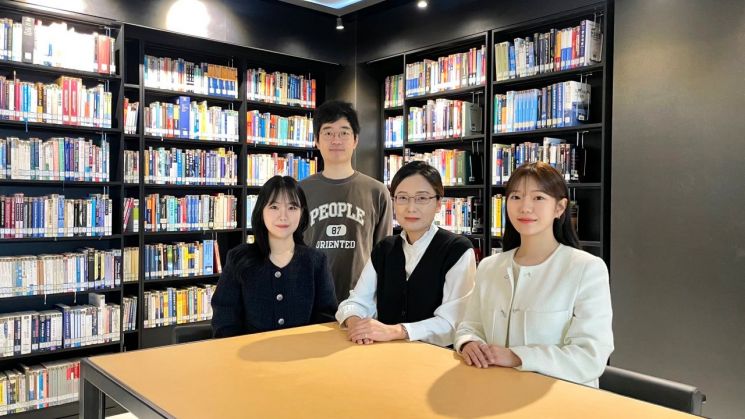 (From left) Song Chae-eun, PhD candidate; Choi Young-woo, integrated MS-PhD program; Choi Nam-soon, professor; Han Seung-hee, PhD candidate. Provided by KAIST
First, the joint research team developed a strategy to control the solvation structure in the electrolyte. This optimizes the formation of the anode interfacial layer (Solid Electrolyte Interphase, SEI), a key component of the battery, facilitating lithium-ion movement and solving problems such as lithium plating and battery lifespan reduction that occur during fast charging, thereby laying the foundation for improving lithium-ion battery charging speed.
The ethylene carbonate (EC) electrolyte used in conventional lithium-ion battery electrolytes has high viscosity (3.38 cP) and strong solvation, forming an anode interfacial layer composed of large crystal grains, which hinders smooth lithium-ion movement and entry into the graphite anode layered structure during fast charging.
Additionally, metallic lithium deposits on the anode interfacial layer or the upper part of the anode plate (the part in contact with the separator). Such deposited lithium is irreversible lithium that cannot participate in charging and discharging, leading to battery lifespan reduction and increased risk of fire due to short circuits.
To address these issues, the joint research team introduced ‘isobutyronitrile,’ a new electrolyte solvent that can completely replace EC, into the battery electrolyte. This lowers the lithium-ion desolvation energy and reduces the crystal grain size of the anode interfacial layer, presenting a battery electrolyte technology that enables fast charging at low and room temperatures.
Moreover, by introducing the isobutyronitrile solvent, they developed a high-ion-conductivity electrolyte system with 55% lower viscosity (1.52 cP) and 54% higher ionic conductivity (12.80 S/cm) compared to EC electrolyte.
The isobutyronitrile electrolyte significantly reduces the lithium-ion desolvation energy, enabling fast charging within 15 minutes and maintaining 94.2% capacity without irreversible lithium plating on the upper part of the anode even after 300 cycles.
In particular, the joint research team utilized Electrochemical Strain Microscopy, a mode of atomic force microscopy, to visualize for the first time in the world how lithium-ion conductivity varies depending on electrolyte composition and how lithium ions move in the anode interfacial layer. They also revealed that electrolyte composition affects the crystal grain size of the anode interfacial layer.
This study is significant in that it identified the crystal grain size and arrangement state of the anode interfacial layer and the solvation structure of the electrolyte as key factors influencing the fast charging time of lithium-ion batteries.
By replacing the highly crystalline EC solvent, which prevents rapid lithium-ion movement at low temperatures, with the low-crystallinity, ultra-low viscosity isobutyronitrile solvent, fast charging is enabled even at room temperature and minus 10 degrees Celsius. This technology is evaluated as a breakthrough that can drastically reduce the biggest obstacle to electric vehicle batteries: charging time.
The joint research team expects this technology to contribute to the practical application of fast charging technology for lithium-ion batteries in various fields such as energy storage systems (ESS), drones, and aerospace industries.
Professor Namsoon Choi of KAIST said, “The joint research team proposed an anode interfacial layer technology and electrolyte system that drastically reduces the charging time of lithium-ion batteries,” adding, “This research overcomes the limitations of the conventional cyclic carbonate electrolyte material (EC) with nitrile-based electrolyte technology (isoBN), contributing to accelerating the popularization of electric vehicles through shortened charging times.”
Meanwhile, this research was conducted with support from the Korea Institute for Advancement of Technology’s development project for high-output electric vehicle batteries and charging systems and the National Research Foundation of Korea’s nano and materials technology development project.
The study, co-first authored by Professor Namsoon Choi, researchers Chaeun Song and Seunghui Han from the Department of Bio and Chemical Engineering, and Professor Seungbeom Hong and researcher Youngwoo Choi from the Department of Materials Science and Engineering at KAIST, was also introduced on the 11th in the international journal Advanced Materials.
© The Asia Business Daily(www.asiae.co.kr). All rights reserved.
![Clutching a Stolen Dior Bag, Saying "I Hate Being Poor but Real"... The Grotesque Con of a "Human Knockoff" [Slate]](https://cwcontent.asiae.co.kr/asiaresize/183/2026021902243444107_1771435474.jpg)
















