Wall Street Sees Rate Hold as Certain This Month
Concerns Grow Over 'S Fear' Amid Indiscriminate Tariffs
Will Rate Cut Forecasts Drop to One or Rise to Three?
Bloomberg Expert Survey Expects "Two Cuts Maintained"
As the U.S. Federal Reserve (Fed) prepares for this week's monetary policy meeting, Wall Street's attention is focused on the dot plot and economic forecasts that indicate this year's interest rate outlook. With growing concerns that U.S. President Donald Trump's indiscriminate tariff war against the world could trigger a recession, the market is closely watching the scale of interest rate cuts expected this year.
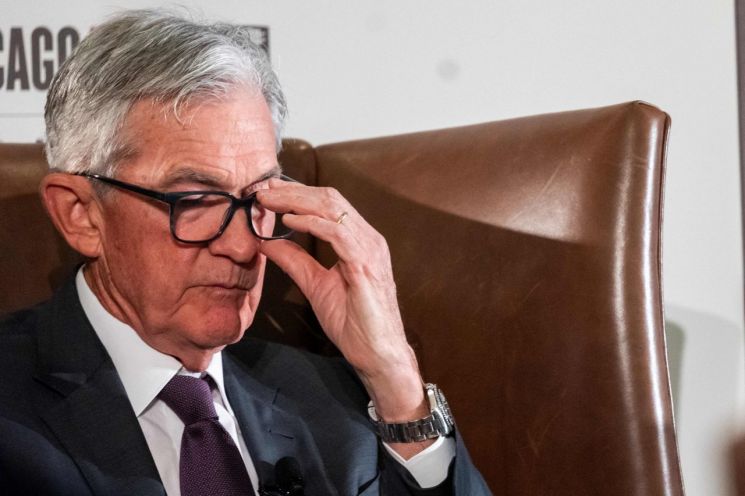
According to the Fed on the 16th (local time), the Federal Open Market Committee (FOMC) will hold its regular meeting on the 18th and 19th to decide the benchmark interest rate. The market has largely priced in a rate hold. According to the Chicago Mercantile Exchange (CME) FedWatch, Wall Street expects the Fed to keep rates unchanged this month with a 98% probability.
The key point is the dot plot showing Fed officials' interest rate projections. Previously, in December last year, the Fed significantly reduced its forecast for the number of rate cuts by 2025 from four times (total 1.0 percentage point) at 0.25 percentage points each to two times (total 0.5 percentage points). Amid growing fears of stagflation (rising prices alongside economic slowdown) triggered by President Trump's indiscriminate tariff attacks since his inauguration on January 20, the market is expected to seek clarity on whether the Fed is placing more weight on the risks of inflation rebound or growth slowdown. If the Fed adopts a hawkish stance (favoring monetary tightening) and reduces the forecast for rate cuts to one this year, it can be interpreted as emphasizing inflation risks; conversely, if it takes a dovish stance (favoring monetary easing) and raises the forecast to three cuts, it signals concerns over economic downturn.
Attention is also on the Summary of Economic Projections (SEP), which includes the Fed's forecasts for growth, inflation, and unemployment, as well as remarks from Fed Chair Jerome Powell during the press conference immediately following the rate decision.
Currently, the market is caught between inflation concerns and recession fears. Although the February Consumer Price Index (CPI) inflation rate slowed to 2.8% from 3.0% in the previous month, the full impact of tariffs is expected to lead to higher import prices and an inflation rebound. This is a factor that could prompt the Fed to hold or raise rates. At the same time, growing recession fears have increased pressure for monetary easing. Market sentiment has already turned cold. Due to tariff-driven recession fears, the three major indices on the New York Stock Exchange have fallen more than 5% just this month. The University of Michigan Consumer Sentiment Index, a key U.S. economic indicator, also dropped from 64.7 in February to 57.9 in March, marking its lowest level in two years and four months since November 2022. Dominique Constam, Head of Macro Strategy at Mizuho Securities, said, "Powell needs to send some kind of signal that they are watching the recent stock market decline closely."
Experts expect the Fed to maintain its forecast of two rate cuts this year. According to a recent Bloomberg survey of economists, the Fed is expected to cut rates by 0.25 percentage points twice this year, in September and December, totaling 0.5 percentage points. Meanwhile, the interest rate futures market reflects an 82.7% probability of at least two rate cuts this year and a 52.3% probability of three or more cuts, indicating expectations for three cuts.
Scott Anderson, Chief U.S. Economist at BMO Capital Markets, said, "Core inflation significantly exceeds the medium-term target, and stagflation risks are growing, putting the Fed in a very difficult position right now. The uncertainty surrounding the scale, duration, and targets of future tariffs is making the monetary policy outlook even more complicated. This could potentially unsettle expectations for monetary policy and financial markets."
Key indicators reflecting the U.S. economic situation will also be released this week. On the 17th, February retail sales, which support two-thirds of the U.S. economy, will be announced, and on the 20th, weekly initial jobless claims, which indicate labor market conditions, will be released. Central banks of major countries such as Japan, the United Kingdom, and Sweden will also hold monetary policy meetings this week to decide their benchmark interest rates.
© The Asia Business Daily(www.asiae.co.kr). All rights reserved.

















