Conscription Revival Gains Momentum in Europe
Young Generations Reluctant, Alternatives Like Reservist Training Considered
Amid concerns over the weakening of the U.S. security umbrella, Europe is exploring measures to increase troop numbers, including the revival of conscription.
According to the Stockholm International Peace Research Institute (SIPRI) on the 16th (local time), the number of active-duty soldiers across Europe was approximately 1.47 million as of last year.
Currently, European military operations are centered around the NATO Allied Command Operations (SACRE), led by a U.S. general. Although the number of active-duty soldiers across Europe is not small, there have been consistent criticisms that efficiency is reduced due to the absence of an integrated command.
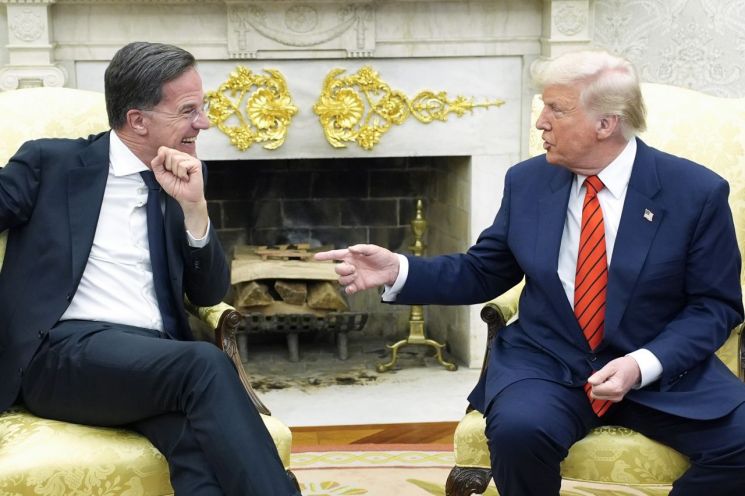 Donald Trump, President of the United States, is meeting with NATO Secretary General Mark Rutte at the White House office in Washington D.C. on the 13th (local time). Photo by UPI Yonhap News
European think tanks Bruegel and the Kiel Institute for the World Economy released a report titled "Defending Europe Without the U.S." last month, stating, "To complement the fragmented characteristics of each country's military, it is necessary to either significantly increase troop numbers by more than 300,000 or find ways to rapidly strengthen military cooperation."
The easiest way to increase troop numbers in the short term is conscription. Alexander Burilkov, a researcher at the Heidelberg University Institute of Political Science and co-author of the report, argued that "conscription can play a role in mobilizing a large number of new troops." Among NATO's 32 member countries, nine have conscription systems in place: Greece, T?rkiye, Finland, Sweden, Norway, Denmark, Estonia, Latvia, and Lithuania. Including NATO non-member countries Cyprus, Switzerland, and Austria, there are 12 countries in total across Europe.
The problem is the trend among younger generations to avoid military service. A recent survey by YouGov showed that 58% of Germans support the reintroduction of conscription. However, support among those aged 18 to 29 was only about one-third. Germany abolished conscription in 2011.
Some countries are leaning toward training reservists as an alternative. Poland, which abolished conscription in 2008, recently announced plans to provide military training annually to 100,000 civilians starting in 2027. The system will allow participants to choose whether to participate voluntarily and will offer incentives to those who take part.
French President Emmanuel Macron said in a press conference the day before that reintroducing conscription is realistically difficult but promised to announce "ways to mobilize citizens within a few weeks." The Italian Ministry of Defense also holds a positive stance toward training reservists.
© The Asia Business Daily(www.asiae.co.kr). All rights reserved.

















