Waste That Cannot Be Repackaged Is Decomposed and Recycled
A company in China has been caught repackaging discarded sanitary pads and diapers from famous brands as new products, sparking a major controversy.
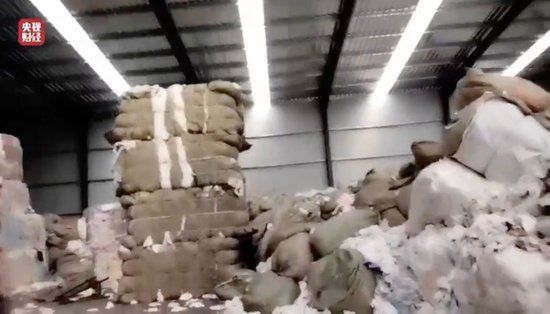 Sanitary pad and diaper waste is piled up in the factory warehouse of "Liangshan Xixi Paper Products Co., Ltd." in Jining City, Shandong Province, China. Photo by China Central Television (CCTV)
The representative consumer complaint program "3·15 Wan Hui" of China's state broadcaster CCTV infiltrated "Liangshan Xixi Paper Products Co., Ltd." in Jining City, Shandong Province, on the 15th to expose how defective products or waste rejected during the production process of well-known companies were handled. At the warehouse floor of the company visited by the CCTV crew, hundreds of tons of sanitary pad and diaper waste were scattered. The company sorted out relatively intact diapers and sanitary pads without severe damage or stains from the industrial waste that arrived in tons. Brands such as "Ziyoudian," a top 10 sanitary pad company in China, and "Maikuku," a famous baby product company, were also caught on camera. The waste moved from the floor to tables was individually patted by employees to restore a soft state, then filled into new packaging and sealed. There was no hygiene or sterilization equipment used during this process.
The repackaged sanitary pads and diapers were sold to general consumers through online shopping malls. The waste was purchased at 260 to 1,400 yuan per ton (approximately 52,000 to 280,000 KRW) and repackaged to be sold at 7,000 to 8,000 yuan per ton (approximately 1.4 million to 1.6 million KRW). This means the company made about 30 times the profit by selling trash. CCTV reported, "The sales volume of the two products found on online shopping malls was 57,000 and 21,000 units, respectively." It was also reported that the company processed about 20,000 tons of waste annually.
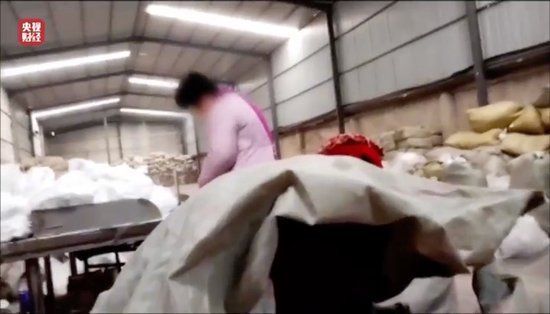 An employee at the factory of "Liangshan Xixi Paper Products Co., Ltd." in Jining City, Shandong Province, China, is repackaging discarded "Grade 2" sanitary pads and diapers as new products. Photo by China Central Television (CCTV)
Following the report, the entire country of China was thrown into an uproar. On Chinese social networking services (SNS), the term "refurbished sanitary pads" has become a hot issue keyword at the top. Female consumers, in particular, are greatly anxious. On the Chinese SNS Weibo, one netizen attached a photo of cloth sanitary pads made by layering multiple pieces of fabric and remarked, "It seems much safer to use cloth sanitary pads instead." Another netizen, a 40-year-old woman with a daughter, expressed on Baidu, "My daughter and I are both anxious," and lamented, "Ordinary people cannot distinguish good from bad, so why are such unqualified products allowed to circulate?"
The famous sanitary pad and diaper companies mentioned in the broadcast immediately issued statements. "Ziyoudian" emphasized, "We will thoroughly investigate the illegal recycling of defective raw materials and strictly regulate the disposal process to ensure waste is destroyed according to industry standards." "Sophie" and "Chuanmiansidai" each drew a clear line, stating, "The company in question has no cooperative relationship with us and has never been authorized or supplied by us."
Waste that could not even be made into "refurbished sanitary pads" or "refurbished diapers" was decomposed and turned into recycled raw materials. Sanitary pad and diaper waste mixed with various trash such as cigarette packs and masks underwent decomposition to produce wood pulp and superabsorbent resin. According to Chinese regulations, using recycled raw materials in disposable hygiene products is prohibited, but the company representative stated, "Recycled materials are very popular with customers."
After the broadcast, the Jining City Party Committee and city government formed a joint team composed of market supervision, health officials, and public security to launch an investigation. Authorities estimate that those involved in the act could face life imprisonment depending on the actual sales amount.
© The Asia Business Daily(www.asiae.co.kr). All rights reserved.


















