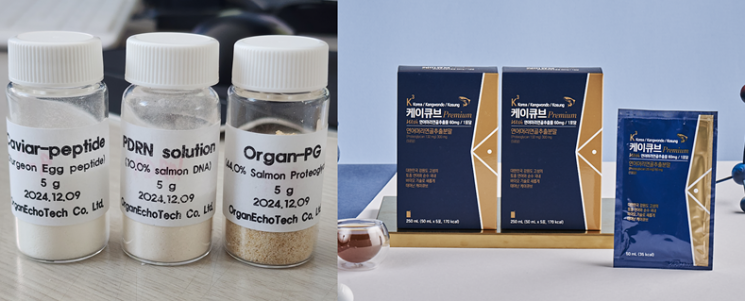
On the 16th, the Ministry of Oceans and Fisheries announced that it has commercialized biopharmaceuticals and functional cosmetics using fishery by-products and signed supply contracts with over 50 domestic department stores. Additionally, it secured an export contract worth $500,000.
Since 2022, the Ministry has been conducting the "Marine Fishery By-product Bio-material Technology Development" project to secure core technologies for high value-added commercialization of fishery by-products (such as pharmaceutical and food raw materials, cosmetic ingredients) including fish heads and seaweed roots, and to industrialize these technologies.
Recently, a research team led by Dr. Oh Cheol-hong at the Korea Institute of Ocean Science and Technology, in collaboration with the Korea Food Research Institute (KFRI) and Ogeon Ecotech, developed a domestically produced technology to effectively produce "polydioxyribonucleotide (PDRN)" and "proteoglycan" using salmon by-products (male reproductive organs and heads) through this project.
PDRN, a fragment of DNA mainly extracted from salmon testes, is effective for cell regeneration, wound healing, keratin removal, wrinkle improvement, whitening, hair growth, and prevention of hair loss. Proteoglycan is a compound formed by chondroitin sulfate and protein, components found in joint cartilage, which helps regenerate knee joint cartilage and has strong skin moisturizing effects.
Although PDRN and proteoglycan are important materials used in various industries such as biopharmaceuticals, functional cosmetics, health functional foods, and quasi-drugs, over 90% of them are imported. Therefore, developing domestic technologies has been recognized as a priority task to revitalize sustainable blue food and bio industries.
The newly developed process applies a patented eco-friendly method instead of the conventional ethanol extraction process, eliminating the need for ethanol extraction facilities subject to hazardous materials control, fire safety, and building regulations. This is expected to offer advantages in industrialization not only in productivity but also in price competitiveness.
Ogeon Ecotech registered patents related to the extraction of PDRN and proteoglycan domestically and internationally last year, and signed supply contracts with 50 department store outlets nationwide for commercialized products such as cosmetics (multi-balm), shampoo, and cartilage regeneration health functional foods. Recently, it also signed an export contract worth $500,000 (powder raw materials) with a Brazilian company and is conducting additional discussions on applications of PDRN and proteoglycan raw materials.
The research team has also started developing standard production processes and new materials to enhance industrial productivity and stabilize supply prices of this domestic technology.
Kang Do-hyung, Minister of Oceans and Fisheries, stated, "As Korea is a country with high seafood consumption, a huge amount of fishery by-products is generated. It is necessary to utilize these by-products not as simple waste but as high value-added resources." He added, "We will continue to expand research converting fishery by-products into high value-added raw materials to minimize environmental pollution and lead efforts to increase industrialization potential."
© The Asia Business Daily(www.asiae.co.kr). All rights reserved.

















