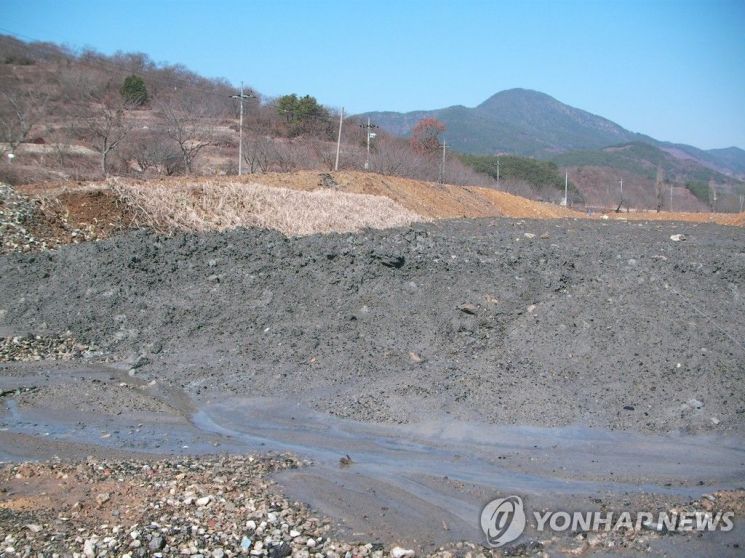
Regulations will be eased to allow public power companies to use coal ash landfills that have been closed as sites for energy transition facilities. Public power companies are expected to save 370 billion KRW in costs and advance the construction start date by about one year.
On the 16th, the Ministry of Environment announced that it will implement the "Regulatory Rationalization Plan for the Utilization of Power Company Landfill Sites" within this month. This plan is a follow-up measure to the "Advanced Management System for Waste Landfill Facilities" announced at the National Policy Issues Ministerial Meeting and Economic Ministers' Meeting on January 22.
According to the current Waste Management Act, when burying waste in the ground, a "final cover" process requiring at least 60cm of soil coverage is necessary. However, coal ash landfills at power plants have low pollution concerns, but large costs are incurred due to soil covering requirements under the regulations. In some cases, even though they are not subject to post-management, unclear regulations have led to them being managed post-closure.
Accordingly, the Ministry of Environment plans to exempt the final cover obligation for power company landfills by the end of this year. It also intends to exclude landfills that have no environmental pollution during operation from post-management targets.
The five major domestic public power companies?Dongseo Power, Seobu Power, Namdong Power, Nambu Power, and Jungbu Power?plan to replace coal ash landfills with liquefied natural gas (LNG) power generation. Exempting the final cover will enable these five power companies to save approximately 370 billion KRW in costs. Omitting post-management procedures is estimated to shorten the LNG construction start time by up to 24 months.
Kim Go-eung, Director of the Resource Circulation Bureau at the Ministry of Environment, emphasized, “Securing industrial sites is a difficult issue in our narrow land of Korea. Through regulatory rationalization, it will be possible to quickly secure industrial sites without additional environmental damage, and it is expected to contribute to accelerating the energy transition speed of domestic power companies.”
© The Asia Business Daily(www.asiae.co.kr). All rights reserved.

















