First Korea-U.S. Trade Talks Since Trump Took Office
U.S. Raises Issues Including Rerouting of Chinese Steel Exports
Jung In-kyo, the Chief Negotiator of the Ministry of Trade, Industry and Energy of South Korea, who is visiting the United States, stated on the 14th (local time) that he requested "tariff exemptions for Korea or at least non-discriminatory treatment compared to major countries" regarding the 'reciprocal tariffs' that President Donald Trump plans to implement starting April 2.
Jung said this during a press briefing held at the South Korean Embassy in Washington DC, mentioning that he had a meeting with Katherine Tai, the U.S. Trade Representative (USTR), during his visit to the U.S.
He explained, "Through the Free Trade Agreement (FTA), not only tariffs but also non-tariff measures raised by the U.S. side have been largely resolved or managed, and I actively explained that trade between the two countries has expanded both quantitatively and qualitatively."
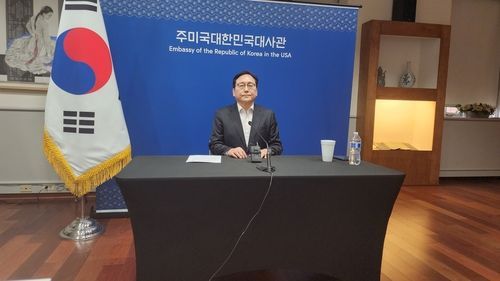 Jung In-kyo, Director General for Trade Negotiations at the Ministry of Trade, Industry and Energy, who is visiting the United States, is holding a press briefing with correspondents at the Washington DC Embassy. Photo by Yonhap News.
This is the first direct meeting between the heads of the trade authorities of the two countries since the start of President Trump's second term administration. The meeting between Chief Jung and Representative Tai reportedly lasted about an hour and a half that morning.
Regarding President Trump's mention in his joint session speech to Congress that "Korea imposes tariffs four times higher than the U.S.," Chief Jung stated, "To correct the difference in perception between the two countries, I accurately explained the facts and emphasized that reciprocal tariffs should not be considered based on this."
He added, "The U.S. side also recognized that tariffs on both sides are close to zero under the Korea-U.S. FTA," and "We agreed to continue working-level consultations on tariff measures and seek reasonable and mutually beneficial progress, acknowledging the usefulness of the Korea-U.S. FTA as a comprehensive economic cooperation framework."
Regarding the background of President Trump's 'four times tariff' remark, a senior government official explained, "About three weeks ago, data showing Korea's average tariff rate as 12% and the U.S. as 3% began circulating on the internet, and we immediately requested correction, but it is possible that President Trump made his remarks based on this data."
The 12% tariff rate for Korea is an average tariff rate applied to all global trading partners, not a specific country, but it is possible that President Trump misunderstood this and perceived that Korea imposes tariffs four times higher than the U.S.
Chief Jung specifically mentioned the 25% tariffs imposed on steel and aluminum products starting from the 12th, stating, "I conveyed the necessity of tariff exemption for Korean steel." He explained, "Korean steel does not threaten U.S. industrial security but rather supplies items lacking in the U.S., contributing to supply chain stabilization and strengthening downstream industrial competitiveness." He also explained that "the trade imbalance concerns raised by the U.S. side could be gradually alleviated through increased Korean investment in the U.S. and increased energy imports."
Chief Jung said, "This meeting was the first encounter between the trade authorities of the two countries since the inauguration of the new U.S. administration," and added, "It is evaluated as a meaningful starting point to build trust going forward, providing an opportunity to fully explain our position on U.S. trade policy and prepare for upcoming bilateral consultations."
The U.S. side raised issues such as Korea's sanitary and phytosanitary (SPS) regulations, digital trade barriers, trade balance deficits, and the rerouting of Chinese products through Korea for export to the U.S., including steel products, and reportedly requested an expansion of U.S. energy imports.
In response, the Korean side sufficiently explained the U.S. concerns and clearly stated that the concern about Chinese steel being rerouted through Korea to the U.S. is not true, according to a government official. Although there was no direct mention of U.S. beef in relation to SPS regulations, opinions were expressed that Korea has many areas to improve, and due to limited meeting time, agricultural sector consultations were not deeply discussed.
The government official explained that reducing the trade deficit is the issue of greatest interest to the U.S., and Korea presented what efforts it would make to address this during the consultation. He also said, "If this consultation was the first round, we felt that there are many areas to pay more attention to in the next round."
The official also said, "I felt that Representative Tai generally positively evaluated the value and importance of the Korea-U.S. FTA," and "In the remaining 20 days until April 2, working-level officials will visit Washington as opportunities arise to continuously explain our position and strive for good results."
The government official added, "Representative Tai said that ultimately President Trump makes all decisions, so if countries bring meaningful proposals or measures, she can report well to the President," and "This means we have a considerable amount of homework to do."
During his visit to the U.S., Chief Jung also met with Andy Kim (Democrat, New Jersey), the first Korean-American federal senator, experts from the Hudson Institute and U.S. law firms, and held a meeting with representatives of the Korean steel industry operating in the U.S.
© The Asia Business Daily(www.asiae.co.kr). All rights reserved.