Supporting New Drug Development for Fatty Liver Treatment
Measurement and Analysis of Specific Tissue Areas Now Possible
Domestic researchers have developed a disease model organoid and non-destructive hardness analysis technology that can be used to evaluate the efficacy of new drugs for fatty liver treatment.
On the 16th, the Korea Research Institute of Chemical Technology announced that the research team led by Dr. Kim Hyun-woo and Dr. Bae Myung-ae developed an organoid mimicking non-alcoholic fatty liver disease and a nano-probe-based analysis technology that can quantitatively measure the stiffness of specific tissue areas while minimizing cell damage.
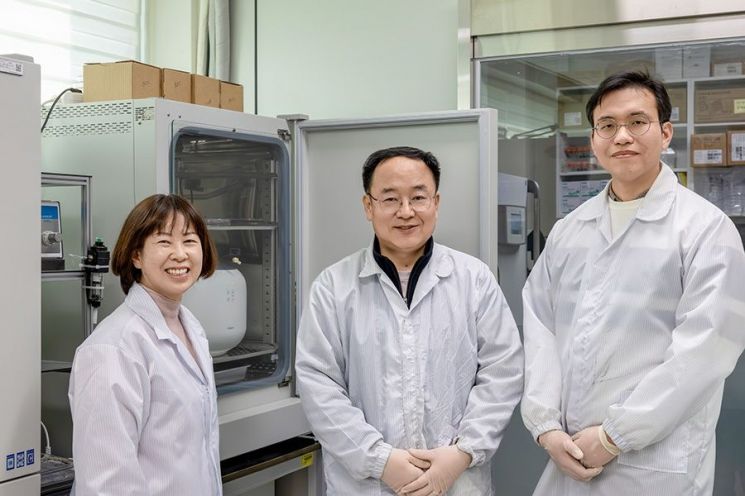 From the left, Myeongae Bae, Principal Researcher at the Korea Research Institute of Chemical Technology (Corresponding Author), Daeseop Shin, Researcher (First Author), Hyunwoo Kim, Principal Researcher (Corresponding Author). Provided by the Korea Research Institute of Chemical Technology
Non-alcoholic fatty liver disease begins when fat accumulates in liver cells due to excessive eating or lack of exercise, even without alcohol consumption, causing the liver to become soft. Excessive production of fibrous substances like collagen leads to liver cirrhosis, which can progress to life-threatening diseases such as liver cancer.
In new drug development for liver diseases, candidate drugs are repeatedly administered to disease model organoids, and their responses are measured and analyzed. Existing testing methods measured the hardness of liver tissue by pressing the entire area of the disease model organoid until it was destroyed. Therefore, continuous measurement in a living state was impossible, and hardness information at specific locations could not be obtained.
The research team developed a technology that allows measurement of 'liver organoids' created to mimic fatty liver disease in a living state. They developed a calculation formula that analyzes measurement values by selectively pressing narrow areas with nano-scale fine pressure, enabling quantitative measurement of hardness by location without destroying the organoid.
First, the research team stained the organoid with fluorescent dye to make areas with fat accumulation emit strong light and locate them. Then, using a method where a 'very small rod (nano-probe)' applies fine pressure, they measured the degree of bending of the nano-probe when pressing the organoid. The measurement results were analyzed using a mathematical formula developed by the team, allowing quantitative measurement of hardness changes due to fat accumulation as Young’s modulus.
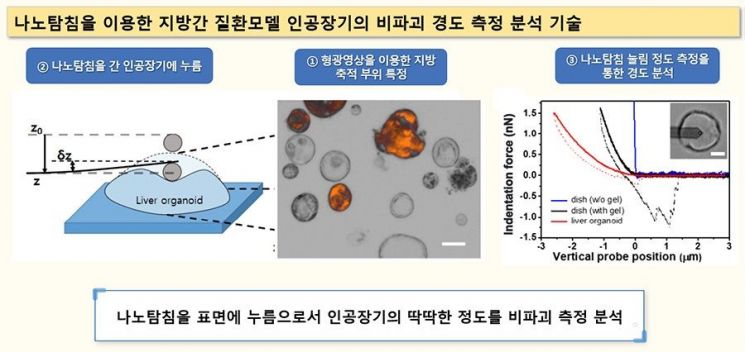 Non-destructive hardness measurement analysis technology for fatty liver disease model artificial organs using nano-probes. Provided by Korea Research Institute of Chemical Technology
While previous methods required fixing the organoid by chemical treatment that killed it, the new nano-probe technology can be applied in culture media that maintain the organoid alive. Also, by pressing only to a shallow depth of about 5 μm (micrometers), it causes no damage to the liver tissue.
When the research team applied the 'nano-probe hardness measurement technology' to a non-alcoholic fatty liver model organoid, the hardness of the fluorescently strong fat accumulation areas was about 35% softer based on Young’s modulus compared to areas with weak fluorescence. In other words, they accurately identified the desired locations.
By locating measurement points through fluorescent fat accumulation imaging, the total measurement time was reduced by more than half compared to random measurement methods, and cell viability after measurement was maintained at over 97%, minimizing damage.
Lee Young-guk, President of the Korea Research Institute of Chemical Technology, said, "This technology allows easy analysis of changes in disease models during fatty liver drug development," and added, "It is expected to be widely applied not only to liver diseases but also to the drug development process for other diseases."
The research results were published in December last year in the international journal ACS Biomaterials Science and Engineering (IF: 5.5). Dr. Kim Hyun-woo and Dr. Bae Myung-ae of the Korea Research Institute of Chemical Technology served as corresponding authors, and researcher Shin Dae-seop participated as the first author. (Paper title: Local stiffness Measurement of Hepatic Steatosis Model Liver Organoid by Fluorescence Imaging-Assisted Probe Indentation)
© The Asia Business Daily(www.asiae.co.kr). All rights reserved.


















