Government Exercises Veto on 'Myeong Taegyun Special Prosecutor Act'
Cites Concerns Over Excessive Investigation and Human Rights Violations
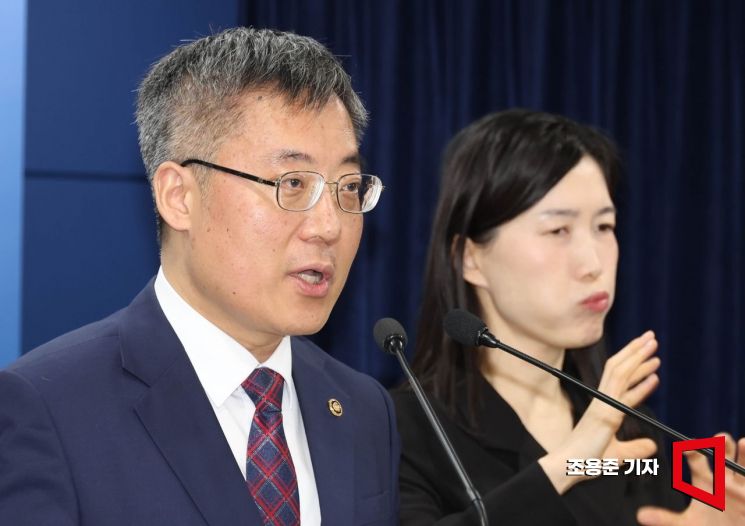 Kim Seok-woo, Acting Minister of Justice and Vice Minister of Justice, is giving a briefing on the re-request authority related to the 'Myeong Tae-gyun Special Prosecutor Act' following the Cabinet meeting results at the Government Seoul Office in Jongno-gu, Seoul on March 14, 2025. Photo by Jo Yong-jun
Acting President Choi Sang-mok exercised his right to request reconsideration (veto power) on the ‘Myeong Tae-gyun Special Prosecutor Act’ on the 14th, citing excessive investigation and human rights violations. Kim Seok-woo, Acting Minister of Justice, held an unusual press briefing that day and explained the government's reason for vetoing the bill, stating, “The investigation targets and scope are unclear and extensive, making the purpose of introducing the special prosecutor system ambiguous.”
The Myeong Tae-gyun Special Prosecutor Act mandates a special prosecutor to investigate allegations that Mr. Myeong used his personal connections with President Yoon Seok-yeol and his spouse from 2021 to 2024 to engage in nomination trading and opinion polling. The investigation covers a total of about 10 elections, including local elections, National Assembly elections, by-elections, and the presidential election held since 2021. The total number of elected officials from these elections is 4,518. The special prosecutor law allows for investigation of all cases recognized within this scope.
The government expressed concerns about ‘excessive investigation.’ Acting Minister Kim said, “Allowing investigations into all recent elections and important policy decision processes contradicts the purpose of introducing the special prosecutor system.” He also stated, “The broad scope of investigation combined with the provisions for ex officio investigations raises a high possibility of human rights violations due to excessive investigation.” The provision that suspends the statute of limitations during the special prosecutor period was also criticized. A Ministry of Justice official said, “There is no precedent for granting the authority to maintain prosecution in ongoing trials,” adding, “This is inconsistent with the purpose of the special prosecutor system.”
Regarding the clause that the Chief Justice of the Supreme Court recommends two candidates for the special prosecutor and if the president does not appoint one within three days, the elder candidate is automatically appointed, the official said, “This unprecedented provision infringes on the president’s appointment authority and may violate the principle of separation of powers.”
Furthermore, since Mr. Myeong has already been indicted and is on trial due to investigations by the prosecution that have continued since last year, launching the ‘Myeong Tae-gyun Special Prosecutor Act’ again contradicts the principles of exceptionality and subsidiarity, which are the essence of the special prosecutor system.
The opposition party reacted strongly. Park Chan-dae, floor leader of the Democratic Party, criticized at the Supreme Council meeting held in Gwanghwamun, Seoul, in the morning, saying, “The Myeong Tae-gyun Special Prosecutor Act is a bill to investigate the ‘Myeong Tae-gyun Gate’ that caused the insurrection, and rejecting it explicitly acknowledges that Choi Sang-mok himself is an accomplice to the insurrection.” On the other hand, Kwon Seong-dong, floor leader of the People Power Party, stated, “The exercise of veto power is natural because the bill is full of unconstitutional and illegal elements.”
With the exercise of veto power on this day, Acting President Choi has exercised veto power on eight bills in just over two months since assuming the acting presidency. It was reported that prior to the Cabinet meeting on the 11th, Acting President Choi held a meeting with cabinet members to hear their views on the Myeong Tae-gyun Special Prosecutor Act.
© The Asia Business Daily(www.asiae.co.kr). All rights reserved.

















