Pilot Project to Verify 'Korean-style PQC' by 2028
National Cryptographic System to Transition to 'PQC' by 2035

The government announced the 'PQC Master Plan' in July 2023 to transition the national cryptographic system to post-quantum cryptography (PQC) by 2035. Accordingly, in January, the lattice-based algorithm from Cryptolab was selected through the 'Korean-style Post-Quantum Cryptography Contest (KpqC Contest)' organized by the PQC Research Group under the National Intelligence Service.
Cryptolab received high evaluations by proposing the 'SMAUG-T algorithm,' jointly developed with the Military Counterintelligence Command in the public key cryptography category, and the independently developed 'HAETAE algorithm' in the digital signature category.
The Ministry of Science and ICT, together with the Korea Internet & Security Agency (KISA), has begun full-scale transition work according to the PQC Master Plan. The PQC pilot transition support project, which started last month, aims to verify the applicability of Korean-style PQC algorithms across various industries over four years until 2028.
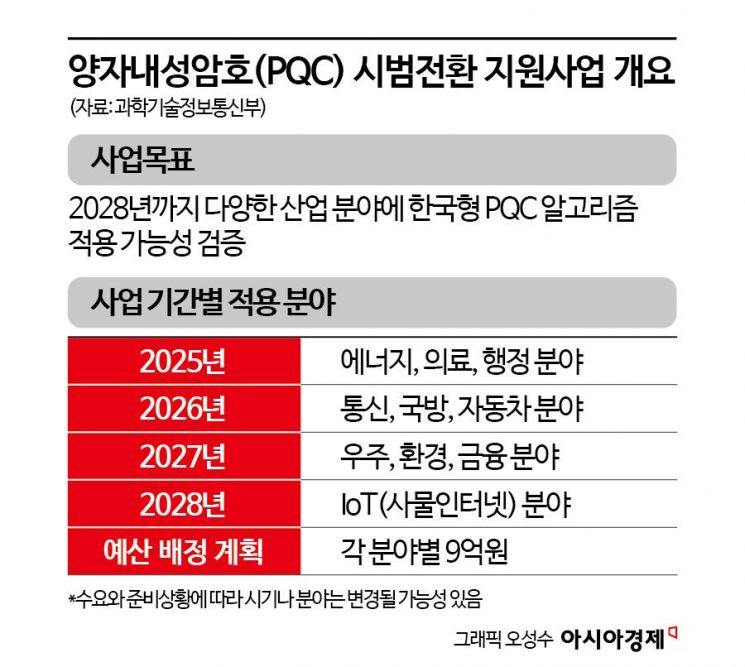
This year, PQC will be introduced in the energy, medical, and administrative sectors. Son Gijong, head of KISA's Next-Generation Cryptography Technology Team, stated, "We selected the sectors where security is most urgent," adding, "We plan to gradually expand the scope of application through the pilot project."
The government plans to expand pilot applications to the telecommunications, defense, and automotive sectors in 2026; space, environment, and finance sectors in 2027; and the IoT (Internet of Things) sector in 2028. Although pilot sectors may be flexible and subject to change depending on demand and readiness, a budget of 900 million KRW is allocated for each sector.
The government intends to discover PQC transition cases through the project and establish specific procedures and guidelines. Team leader Son emphasized, "The core goal is to ensure the safety of national secrets, research and development data, corporate secrets, and sensitive personal information that must be absolutely protected from hacking."
The PQC transition is expected to be a gradual process involving coexistence with existing cryptographic systems rather than a simple software replacement. Kim Kwangjo, Professor Emeritus at KAIST, explained, "It will be a process of running the currently used cryptographic systems alongside PQC and gradually transitioning to the new method," adding, "Step-by-step review and preparation are necessary to minimize user inconvenience, and the target year 2035 was set considering this transition process."
© The Asia Business Daily(www.asiae.co.kr). All rights reserved.
![Clutching a Stolen Dior Bag, Saying "I Hate Being Poor but Real"... The Grotesque Con of a "Human Knockoff" [Slate]](https://cwcontent.asiae.co.kr/asiaresize/183/2026021902243444107_1771435474.jpg)

















