OECD Countries Show Gap in Effective Tax Rates Based on Having Children
Korea's Effective Tax Rate Gap Is Only 1.7 Percentage Points
"Need to Reduce Child-Rearing Costs Through Fiscal Support"
Multiple Studies Find Positive Effects of Paternity Leave for Men
A claim has emerged that the effect of income tax-based fiscal policies introduced by the government to overcome low birth rates may be limited. This is due to the fact that the effective tax rate is not high under the domestic income tax system, and the effective tax rate for the policy target group of people in their 20s and 30s is already lower than that of other generations. While there is an evaluation that fiscal policies supporting child-rearing, such as paternity leave for men, can help improve birth rates, there are concerns about adverse effects caused by cash-type support.
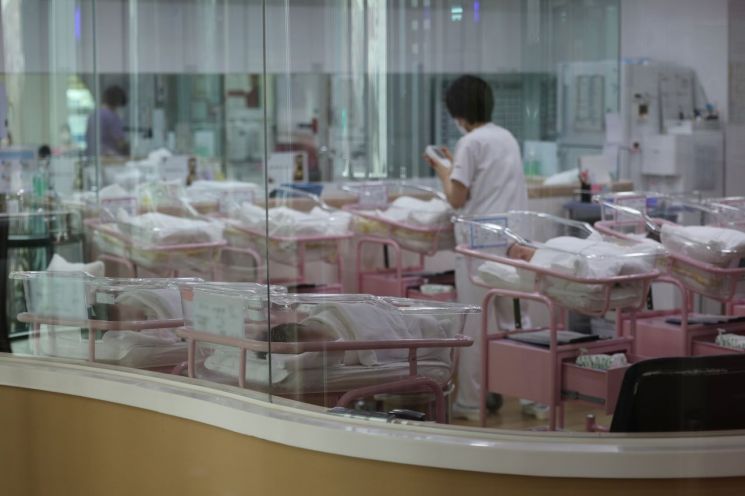 An employee is taking care of a newborn in the nursery of a postpartum care center in Seoul. Photo by Yonhap News.
OECD Countries Have Lower Effective Tax Rates for Families with Children... Korea Shows Only a 1.7%p Difference
According to the 'Current Status and Amendment Trends of Tax Support Related to Marriage, Childbirth, and Childcare' included in NABO Focus No. 96 by the National Assembly Budget Office on the 14th, OECD countries including Korea are introducing income tax-centered tax support measures to respond to low birth rates.
In Korea, there are tax exemptions for childcare allowances and childbirth allowances, income deductions such as dependent child personal deductions, and tax credits for education and medical expenses. Last year, through the tax law amendment, a marriage tax credit (KRW 500,000 per person) was introduced, and the child tax credit amount was increased by KRW 100,000 per child.
On the 11th, the government also announced that it would finalize a tax law amendment in the second half of the year to supplement the non-taxable limit for corporate childcare support funds and implement it early next year. The amendment rationalizes the non-taxable limit of earned income tax on childcare support funds given by companies to employees with children under six years old to KRW 200,000 per child.
The report analyzed that the effect of income tax-based fiscal support in Korea may be lower compared to OECD countries. While most OECD countries reduce the effective income tax rate for households with children compared to those without children through various deductions and exemptions, the gap is small in Korea.
The average effective income tax rate in OECD countries as of 2023 was 15.4% for single households without children and 10.4% for single-earner households with two children, a gap of 5.0 percentage points. The decline rate in effective tax rates by household type, considering the level of effective income tax rates in each country, was 32.7%.
In contrast, in Korea, under the same criteria, the effective income tax rate was 6.8% for single households without children and 5.2% for single-earner households with two children, with a decrease of only 1.7 percentage points. The decline rate in effective tax rates by household type, considering the level of effective income tax rates, was also lower at 24.3%.
The characteristics of people in their 20s and 30s also reduce the effect of tax policies. The effective earned income tax rates for people in their 20s and 30s were 2.2% and 4.8% respectively as of 2023, lower than those in their 40s (7.0%) and 50s (8.4%). The proportion of income tax-exempt individuals was also higher for those in their 20s (49.1%) and 30s (28.7%) compared to those in their 40s (26.0%) and 50s (26.6%).
 Children are observing the wetland at Pyeongdume Wetland in Hwaam-dong, Buk-gu, Gwangju. Photo by Yonhap News
Kang Min-ji, an analyst at the National Assembly Budget Office and author of the report, evaluated, "Since tax support related to low birth rates is centered on income tax, and given the characteristics of Korea’s income tax system where the effective tax rate is not high, the additional capacity for income tax support to respond to low birth rates will be limited."
She added, "In the short term, it is necessary to consider measures that practically reduce the burden of child-rearing costs through fiscal support rather than tax support," and "In the medium to long term, comprehensive efforts should be made in parallel to solve social, economic, cultural, and value-related issues that affect marriage and childbirth."
Paternity Leave for Men Effective in Increasing Birth Rates
A research report by the National Assembly Budget Office released in January this year, titled 'A Study on Overseas Cases of Tax Policies to Respond to Low Birth Rates,' also analyzed that fiscal policies rather than tax policies can have a direct impact on birth rates. It included recommendations that both tax and fiscal policies should be combined.
The report explained that while tax policies to respond to low birth rates in countries including Korea, France, Germany, Japan, and the Netherlands indirectly affect birth rate increases, there is significant variation in policy effectiveness and efficiency depending on the country and policy type, preventing a uniform conclusion.
Fiscal policies responding to low birth rates also showed varying results depending on the implementing country, but the report stated that "they can directly support household income and asset formation, influencing household decisions on childbirth." It particularly included findings from numerous studies showing that paternity leave positively affects birth rates.
Hong Woo-hyung, professor of economics at Dongguk University and lead researcher, explained in the report, "Fiscal policies supporting child-rearing, such as parental leave and child allowances, can have a significant impact on household childbirth decisions when they lead to increased female labor participation and reduced household burdens."
However, cash-type support that does not presuppose income-generating activities is a concern as it may lead to a decrease in women's labor supply. The Korea Institute of Public Finance revealed in the 'Fiscal Forum December 2024 issue' that research results showed cash-type support could reduce women's economic activity participation and working hours.
© The Asia Business Daily(www.asiae.co.kr). All rights reserved.
![Clutching a Stolen Dior Bag, Saying "I Hate Being Poor but Real"... The Grotesque Con of a "Human Knockoff" [Slate]](https://cwcontent.asiae.co.kr/asiaresize/183/2026021902243444107_1771435474.jpg)


















