Population and Agricultural Demand Decline Not Reflected
Local Financial Burden Must Also Be Considered
Environmental groups in Gwangju have called on the government to withdraw its plan to construct new climate response dams. They argue that the Ministry of Environment is exaggerating the issue of water shortages to push for dam construction, while failing to adequately explain the damages that local communities would have to bear.
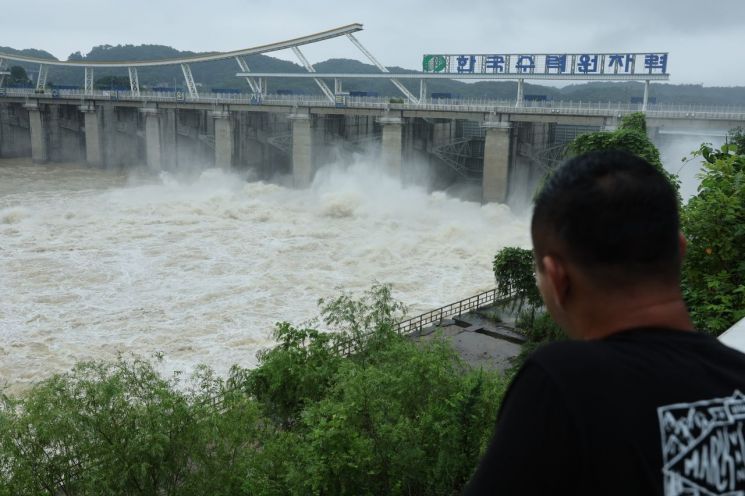
On the 13th, the Gwangju Environmental Movement Association issued a statement saying, "The Ministry of Environment must scrap its plan to build climate response dams," and added, "The government's withdrawal of five new dam projects under the pretext of water shortages means that our country no longer needs additional dams. Even the dams proposed by local communities should be entirely canceled, considering financial issues."
The previous day, at the National Water Resources Management Committee held at the Seoul Government Complex, the Ministry of Environment decided to proceed with 9 out of 14 candidate sites for climate response dams, excluding 5. The Dongbokcheon Dam (Hwasun, Jeonnam) and Jicheon Dam (Cheongyang and Buyeo, Chungnam) will be further discussed through consultative bodies with local governments, while the Suipcheon Dam (Yanggu, Gangwon), Danyangcheon Dam (Danyang, Chungbuk), and Okcheon Dam (Suncheon, Jeonnam) have been put on hold.
The Gwangju Environmental Movement Association claimed, "The water shortage projections announced by the Ministry of Environment through its management plan are merely a pretext to push water resource supply projects," and continued, "The projected future water shortage of 740 million tons per year is an exaggerated figure that fails to properly reflect population decline and reduced agricultural demand."
They added, "The National Water Management Basic Plan (2020-2030) also forecast that there is little likelihood of a national water shortage by 2030, considering population decline and industrial demand," and pointed out, "The Ministry of Environment's claim that the contract rate for water supply from existing dams exceeds 90% is also far from actual usage. More than half of the contracted water is not being used."
Referring to the recently canceled Okcheon Dam project in Suncheon, they also raised the issue that local governments cannot bear the financial burden of dam construction. Suncheon City abandoned the project due to the heavy burden on its local budget, and other local governments such as Gangjin County (7.61%), Uiryeong County (7.72%), Cheongdo County (8.23%), Gimcheon City (11.97%), and Samcheok City (13.48%) are also struggling to cover dam construction costs due to low financial independence.
The Gwangju Environmental Movement Association emphasized, "The Ministry of Environment is only highlighting the expected benefits, without explaining the actual costs and damages," and added, "The five sites classified as on hold have yet to undergo basic planning and feasibility studies, making their construction unlikely. We will also work with local residents to ensure that the remaining nine sites are canceled as well."
© The Asia Business Daily(www.asiae.co.kr). All rights reserved.

















