"Clear Definition of Legal Provisions Needed... Predictability Must Be Enhanced"
AI Policy Directions of Major Countries Including the US, Japan, and EU Introduced
"Korea's AI Usage Rate at 55%... Higher Than Global Average"
"Economic Impact from AI Utilization Expected to Reach 236 Trillion KRW"
"Korea's Artificial Intelligence (AI) Basic Act emphasizes strengthening Korea's competitiveness in the AI market, but when looking into the actual content, it regulates the AI technology itself. Our position is that the focus should be on the outcomes rather than the AI technology itself."
At the 'AI Era, The Path Forward for Korea Press Briefing' held on the morning of the 13th at the Google Korea headquarters in Gangnam-gu, Seoul, Alice Friend, Head of Google AI and Emerging Technology Policy, commented on Korea's AI Basic Act. She argued that regulation should focus on the side effects arising from the use of AI rather than regulating the AI technology itself.
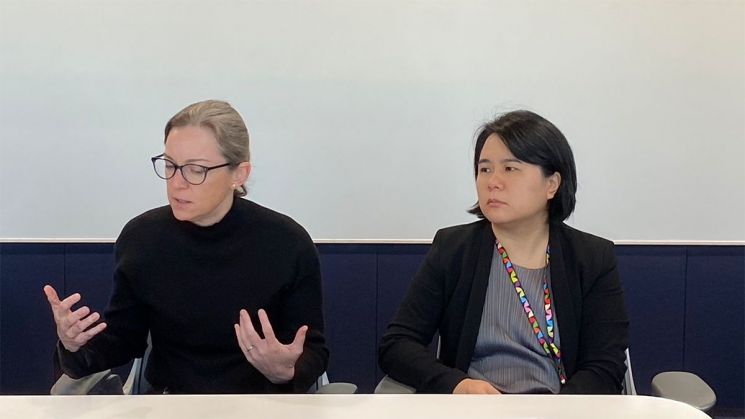 Alice Friend, Head of AI and Emerging Technology Policy (left), and Eunice Hwang, AI and Emerging Technology Policy Lead for the Asia-Pacific region, are speaking at a press briefing held on the morning of the 13th at the Google Korea office in Gangnam-gu, Seoul. Photo by Google Korea
Friend stated, "What we advocate is focusing on output rather than input." The intention is to prepare regulatory measures focusing on side effects such as deepfakes or misinformation created using AI.
The AI Basic Act was passed by the National Assembly plenary session at the end of last year. It consists of provisions for the systematic development of the AI industry and the prevention of risks that may arise from AI in advance. Currently, subordinate statutes are being prepared, but controversy arose as there is a clause granting authorities investigative powers even upon simple complaints or reports. This has led to dissatisfaction within the industry, claiming that the government's regulatory authority is excessive.
There were also criticisms that some technical terms or the scope of legal application defined in the AI Basic Act are ambiguous. The term "high-impact AI" defined in the AI Basic Act was presented as an example. Eunice Hwang, Google Asia-Pacific AI and Emerging Technology Policy Lead, said, "There needs to be a clear definition of what high-impact AI is and the extent of its scope," adding, "There are aspects that need clarification when looking at the actual regulatory content. If regulations are applied too broadly, they could suppress innovation."
Hwang suggested, "Regulations introduced by the government should be both predictable and understandable," emphasizing, "Only then can companies that develop innovative AI products and services operate effectively."
She also argued that when formulating AI-related policies, directions that can aid innovation should be prioritized. Hwang said, "I believe this is an area to be developed through dialogue with various stakeholders," but added, "Since AI is a rapidly evolving technological field, efforts are needed to ensure regulations are innovation-friendly."
The briefing also introduced AI regulatory cases from major countries. The United States, under the second Trump administration, reversed the AI executive orders announced by the Biden administration and is taking a deregulation approach. The European Union (EU) has also indicated easing AI-related regulations, and Singapore decided not to establish a separate AI law but to handle AI under existing laws. Neighboring Japan is promoting itself as an 'AI-friendly country' and is setting related regulations and policies focused on promotion.
Meanwhile, according to a survey conducted by Google and Ipsos, 55% of domestic users responded that they have used generative AI for work, which is higher than the global average of 48%. The economic impact of AI utilization is also expected to be significant. According to data from Access Partnership, the economic effect that can be obtained by using AI in Korea amounts to 236 trillion KRW.
At the press briefing, Friend, who leads the team responsible for global market governance and regulatory issues at Google, and Hwang, who supports AI policy and regulatory environment creation in cooperation with governments and stakeholders in the Asia-Pacific region, explained that their visit to Korea was to meet with key stakeholders of the AI Basic Act to discuss the law's content and implementation stages.
Google is deploying various AI services in Korea, including the generative AI service "Gemini." It is also collaborating with Samsung Electronics, with Gemini pre-installed on the latest Galaxy S25 series smartphones.
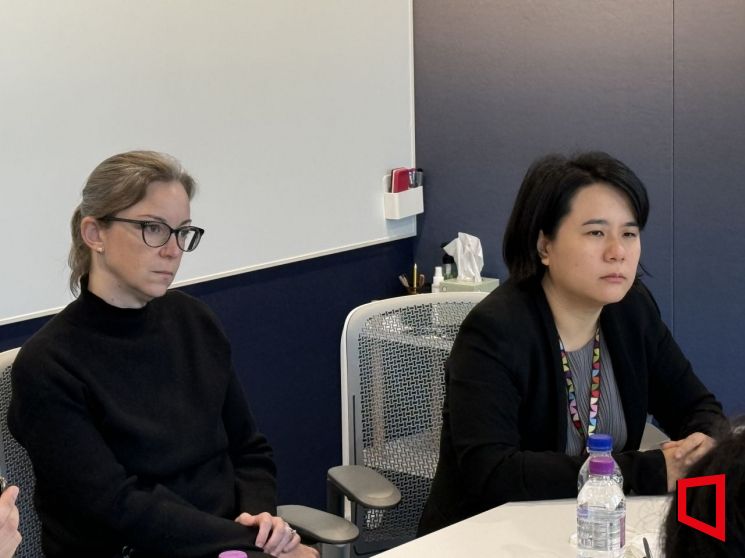 Alice Friend, Head of AI and Emerging Technology Policy (left), and Eunice Hwang, AI and Emerging Technology Policy Officer for the Asia-Pacific region, are speaking at a press briefing held on the morning of the 13th at the Google Korea building in Gangnam-gu, Seoul. Photo by Lee Myunghwan
© The Asia Business Daily(www.asiae.co.kr). All rights reserved.
![Clutching a Stolen Dior Bag, Saying "I Hate Being Poor but Real"... The Grotesque Con of a "Human Knockoff" [Slate]](https://cwcontent.asiae.co.kr/asiaresize/183/2026021902243444107_1771435474.jpg)

















