Woo Won-shik to Preside Over Morning Meeting of Floor Leaders from Both Parties
Opposition Pushes for Commercial Act Amendment to Expand Directors' Fiduciary Duty
Move Also Seen as Pressure Tactic for Appointment of Constitutional Court Nominee Ma Eun-hyuk
With the impeachment trial decision of President Yoon Seok-yeol imminent, the National Assembly plans to push for the submission of over 40 bills, including the Commercial Act amendment, at the plenary session on the afternoon of the 13th. However, amid the turbulent political situation, the ruling to swiftly designate key contentious bills such as the Semiconductor Special Act, initially announced by the opposition as fast-track bills, has been postponed for now.
Speaker Woo Won-shik of the National Assembly decided to preside over a meeting of floor leaders from both ruling and opposition parties in the morning to discuss the bill submissions ahead of the plenary session at 2 p.m. However, Park Chan-dae, the Democratic Party floor leader, announced plans to visit the Supreme Prosecutors' Office to protest President Yoon’s release decision, making the success of the meeting uncertain. The People Power Party is in a similar situation. Park Hyung-soo, the senior deputy floor leader of the People Power Party, said, "(The meeting) is undecided. Nothing has been decided yet."
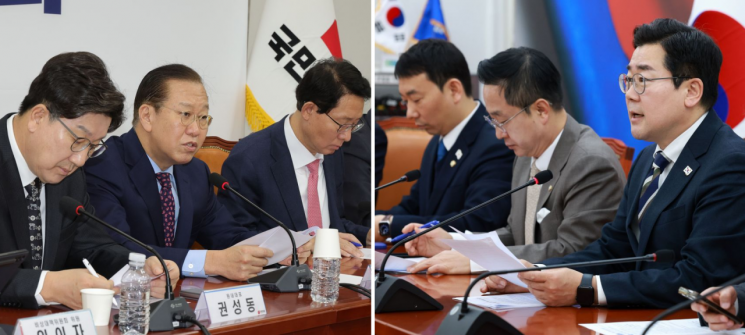 (Left) Kwon Young-se, Emergency Response Committee Chairman of the People Power Party, is speaking at the Emergency Response Committee meeting held at the National Assembly on the 13th. (Right) Park Chan-dae, Floor Leader of the Democratic Party of Korea, is speaking at the Policy Coordination Meeting held at the National Assembly on the same day. 2025.3.13 Photo by Kim Hyun-min
The Democratic Party is determined to ensure that at least the Commercial Act amendment is passed under opposition leadership at the plenary session. Jin Sung-jun, the Democratic Party Policy Committee chairman, stated at the party’s policy coordination meeting, "We will pass the Commercial Act amendment to expand directors’ fiduciary duties to improve corporate governance concentrated on major shareholders and enhance the rights of minority shareholders," emphasizing, "This will be the starting point to resolve the Korea discount, a chronic problem in our securities market."
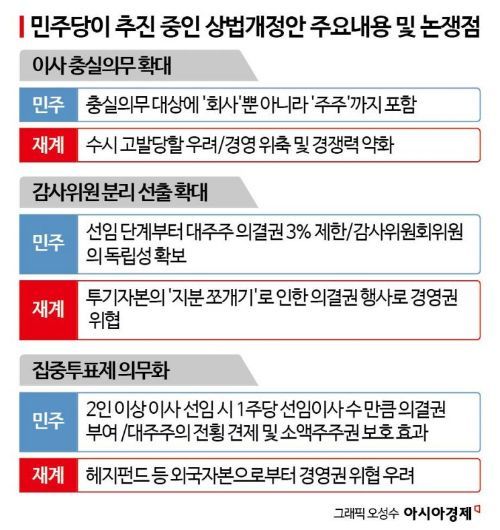
The core agenda of the Commercial Act amendment adopted as party policy by the Democratic Party currently includes four main points. First, the scope of the ‘directors’ fiduciary duty’ (Article 382-3 of the Commercial Act) will be expanded from the existing ‘company’ to ‘company and shareholders.’ Additionally, for listed companies with assets exceeding 2 trillion won, mandatory cumulative voting will be introduced, the separate election of audit committee members in large listed companies will be expanded, and provisions for electronic shareholders’ meetings will be established.
On the other hand, the ruling party opposes the opposition-led Commercial Act amendment, arguing that it infringes on corporate autonomy and could significantly dampen investment and other business activities. The People Power Party proposed maintaining the current ‘directors’ fiduciary duty’ clause but adding a separate phrase stating that ‘directors must protect the interests of the majority shareholders.’ There is also an opinion that since the Commercial Act applies not only to large corporations but also to unlisted companies, the expansion of directors’ duties should be linked with the Capital Markets Act.
There is also a view that the Democratic Party’s push to force the passage of the Commercial Act amendment amid the impeachment political turmoil is related to securing the final lead in the political battle. It is seen as a strategic move to gain the upper hand based on a hard-and-soft approach to political issues such as urging the appointment of Constitutional Court Justice Ma Eun-hyuk. The simultaneous adjustment of pace instead of an all-out offensive on all issues fits this context.
At the plenary session, the Democratic Party has decided to postpone the fast-track designation of other contentious bills such as the Semiconductor Special Act, the Banking Act, and the Franchise Business Act, aside from the Commercial Act amendment. Additionally, the formation of a special parliamentary committee to discuss National Pension reform remains open for consideration depending on the final positions of both ruling and opposition parties on the day.
© The Asia Business Daily(www.asiae.co.kr). All rights reserved.

![Clutching a Stolen Dior Bag, Saying "I Hate Being Poor but Real"... The Grotesque Con of a "Human Knockoff" [Slate]](https://cwcontent.asiae.co.kr/asiaresize/183/2026021902243444107_1771435474.jpg)















