Trump's Aides Explain Ceasefire Proposal to Russia
Putin in Military Uniform Orders "Liberation of Kursk Occupied by Ukraine"
Russian Think Tank Claims "Ceasefire Impossible Until 2026"
U.S. President Donald Trump urged Russian President Vladimir Putin to accept a 30-day ceasefire agreement with Ukraine. If President Putin accepts the '30-day ceasefire,' the war in Ukraine, which began with Russia's invasion in February 2022, would come to a halt after more than three years. However, some speculate that Russia will not easily accept the ceasefire despite pressure from the U.S.
On the 12th (local time), President Trump stated in a public remark before a summit with Prime Minister Michal Martin of Ireland at the White House, "We have achieved about half of the ceasefire, and if Russia can be stopped, a full ceasefire is possible."
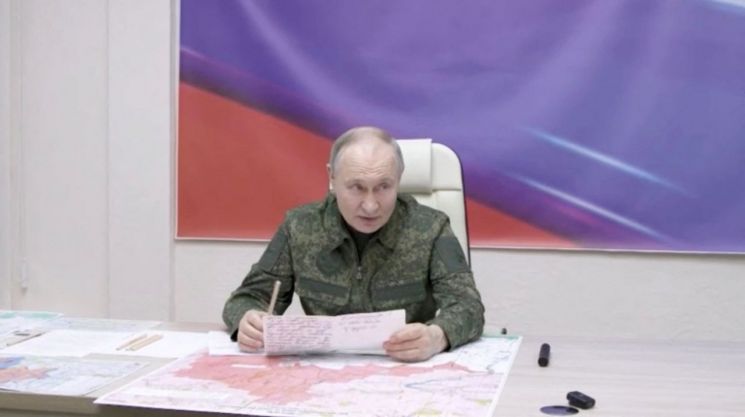 Russian President Vladimir Putin, dressed in military uniform, is delivering a speech to commanders during his visit to the Russian military command and control center in the border region of Kursk, where the Russia-Ukraine war is ongoing, on the 12th (local time). Photo by Reuters Yonhap News
He pressured President Putin to accept the ceasefire, saying, "Once the ceasefire is in place, I don't think the war will start again."
President Trump explained, "We have a complicated situation, but one side (Ukraine) has been largely resolved," adding, "We discussed territorial issues and others very concretely."
When asked if there was confidence that President Putin would keep his promise if he agreed to the ceasefire, Trump said, "We have received some positive messages," but added, "That is nothing considering the current serious situation." Regarding sanctions on Russia for the ceasefire agreement, he said, "We can do it," but added, "I don't want to because I want peace."
Earlier, the U.S. and Russia held a high-level meeting in Saudi Arabia the previous day and agreed to promote a 30-day ceasefire between Russia and Ukraine. White House National Security Advisor Mike Waltz spoke with the Russian side that day to explain the 30-day ceasefire plan and urged acceptance. Special Middle East envoy Steve Witkoff is also scheduled to visit Russia within this week.
However, some speculate that Russia will not easily accept the 30-day ceasefire plan. On the same day, President Putin held a meeting in military uniform in Kursk Oblast, a border region fighting against Ukrainian forces, and ordered the complete liberation of Kursk territory occupied by Ukraine. Inside Russia, there are claims that a ceasefire should not be made until Kursk is recaptured.
That day, The Washington Post (WP) analyzed and reported on a Russian think tank report obtained through European intelligence agencies. The report dismissed President Trump's plan to conclude a peace agreement within 100 days of his inauguration as "unrealistic" and claimed that "a peaceful resolution to the Ukraine crisis cannot be achieved before 2026."
The report was prepared by a Moscow-based think tank close to the Russian Federal Security Service (FSB) and submitted to the Kremlin ahead of the U.S.-Russia talks held in Saudi Arabia on the 18th of last month.
It rejected the European-led plan to dispatch a peacekeeping force to Ukraine and argued that Russia's sovereignty over the Ukrainian territories it occupies must be recognized. It demanded the creation of a buffer zone in northeastern Ukraine near the Russian border and a demilitarized zone in southern Ukraine near Crimea, which Russia occupied in 2014. It also claimed that the complete dismantling of the current Ukrainian government is necessary.
The report suggested that Russia could gain a favorable position in negotiations by worsening tensions between the U.S. and China, and the U.S. and the EU, and by proposing deals to the U.S. regarding rare earth elements buried in the Donbas region of Ukraine occupied by Russia. In fact, on the 24th of last month, President Putin announced readiness to attract foreign partners to develop rare earth elements within Russian territory, including occupied Ukrainian areas. It also proposed focusing on normalizing U.S.-Russia relations and appointing Aleksandr Darchiev as the Russian ambassador to the U.S. President Putin appointed Darchiev on the 6th.
The report argued that unless sovereignty over the occupied regions is officially recognized, there is a high likelihood that armed conflict will resume in the medium term, for example, after a change in the U.S. administration.
Kremlin spokesman Dmitry Peskov told WP, "We were not aware of such recommendations," adding, "We are working on more cautious options."
Experts pointed out that Russia has various means to delay negotiations and that the path to a long-term peace agreement remains distant. Thomas Graham, a fellow at the U.S. Council on Foreign Relations who handled Russia during the George W. Bush administration's National Security Council, said, "Russia is not interested in an early resolution of the Ukraine issue," adding, "They constantly talk about fundamental causes such as Ukrainian domestic politics and NATO's role. Russia has no interest in a simple ceasefire that does not consider these." He added, "President Trump seems not to understand this."
Dmitry Alferovich, head of the U.S. think tank Silverado Policy Accelerator, said on social media platform X (formerly Twitter), "From President Putin's perspective, the current stakes are more than just Ukraine," adding, "The bigger goals are normalization of U.S.-Russia diplomacy, lifting sanctions, and fomenting divisions within NATO."
© The Asia Business Daily(www.asiae.co.kr). All rights reserved.

















