Market Has Grown Rapidly, but Regulations Remain at 1998 Levels
Spring Water Regulations Not Enforced in the U.S., Yet Korea Clings to Them for Decades
Microplastics Reduction Measures Remain an Unresolved Challenge
Although the market in Korea has grown to the extent that one-third of the population drinks bottled water, regulations remain stuck decades behind. While major countries have already relaxed regulations based on scientific research showing that ‘general bacteria’ in nature are harmless to humans, Korea remains stagnant. Bottled water companies frequently face business suspensions even when producing safe products. Therefore, the core of this new policy is to ease unreasonable bottled water regulations to reduce the burden on companies. However, the issue of newly emerging problems such as microplastics remains unaddressed and is left as a task.
According to a comprehensive report by Asia Economy on the 13th, the Ministry of Environment will revise bottled water regulations this month through the ‘Advanced Strategy for Drinking Water Management.’ (Related article: [Exclusive] Bottled Water Consumed by 30% of the Population, Regulation Relaxed for the First Time in 27 Years)
Market Has Grown Rapidly... Regulations Remain at 1998 Level
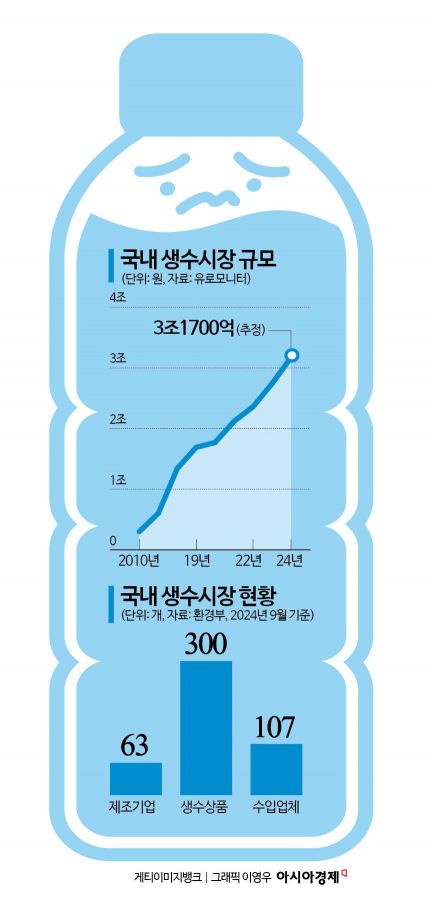
The background for the government’s decision to ease bottled water regulations after 27 years is the rapidly expanding market. Bottled water was first developed in Korea in 1975 to supply U.S. military bases, but selling it to Korean citizens was illegal for over 20 years. However, after the 1991 Nakdong River Phenol Spill incident, distrust in tap water grew and bottled water buyers began to increase. Eventually, in March 1994, the then Ministry of Health and Social Affairs (now Ministry of Health and Welfare) permitted the sale of bottled water. The following year, in 1995, the ‘Drinking Water Management Act’ was enacted to regulate bottled water.
Since then, the bottled water market has grown rapidly every year. According to global market research firm Euromonitor, the bottled water market size reached approximately 300 billion KRW in 2010. In 2018, it surpassed 1 trillion KRW for the first time, and in 2021?two years earlier than expected?it broke through the 2 trillion KRW mark. As of 2023, the domestic bottled water market size is estimated at 2.74 trillion KRW, with Euromonitor projecting it exceeded 3 trillion KRW last year.
Imports of bottled water from overseas have also increased significantly. The number of bottled water importers rose from 67 in 2013 to 107 over ten years, an increase of 40 companies (59.7%). During this period, the volume of imported bottled water distribution grew from 50,000 tons to 240,000 tons, an increase of 190,000 tons (380%). Currently, there are 63 bottled water manufacturers, producing about 300 bottled water products. According to the ‘Tap Water Drinking Survey Results’ announced by the Ministry of Environment in December last year, nearly 34.3% of households purchase bottled water directly.
Although bottled water has become commonplace, regulations have remained frozen for decades. In particular, the 1998 standards, which manage the quality of spring water used to make bottled water more strictly than the bottled water itself, are still in place. While bottled water consumed by customers allows up to 100 general bacteria colonies per 1 ml, the spring water used to produce bottled water must not exceed 5 to 20 general bacteria colonies. This leads to contradictory test results where the raw spring water is deemed unsafe despite producing safe bottled water.
As a result, bottled water companies face penalties even when producing safe products. In 2021, a bottled water company in Gyeonggi Province found 45 general bacteria colonies per 1 ml in water sampled from the intake site. This water is about twice as clean as the bottled water standard applied to consumers, but because it follows separate spring water safety standards, the company was notified of a violation exceeding the standard by 2.2 times. Although the bottled water made from this spring water met safety standards and was sold, the company was severely penalized with a one-month suspension of water intake.
Although the market has grown to the extent that one-third of the population drinks bottled water, regulations remain stuck decades behind. While major countries have already relaxed regulations based on scientific research showing that ‘general bacteria’ in nature are harmless to humans, Korea remains stagnant. Bottled water companies frequently face business suspensions even when producing safe products. Therefore, the core of this new policy is to ease unreasonable bottled water regulations to reduce the burden on companies. However, the issue of newly emerging problems such as microplastics remains unaddressed and is left as a task.
Spring Water Regulations That Even the U.S. Does Not Enforce, Korea Clings to for Decades
The regulations are also far from international standards. Since December 2009, the U.S. Food and Drug Administration has inspected bacteria in bottled water contained in PET bottles. However, it only tests for coliform bacteria and does not specifically regulate general bacteria as Korea does. Public institutions or organizations supplying public drinking water are regulated but allow up to 500 general bacteria colonies per 1 ml. Simply comparing regulatory levels, the U.S. allows at least five times broader standards than Korea.
Canada also holds the position that the presence of bacteria in spring water is not problematic. The Canadian Bottled Water Association (CBWA) states in its guidelines that ‘spring water is a natural product containing some bacteria’ and that ‘these bacteria are found in many everyday food and beverage products and do not threaten health.’ Bottled water products are not regulated for general bacteria counts but focus on sterilizing harmful coliform bacteria, Giardia, and Cryptosporidium.
In fact, Wales and Northern Ireland prohibit artificial disinfection of general bacteria in spring water. The use of chemicals or ultraviolet (UV) treatment without chemicals is also not allowed. Efforts to eliminate naturally occurring general bacteria are considered environmentally unfriendly actions that damage spring water and artificially alter ecosystems.
The leniency toward general bacteria is thanks to science. In 2002, the World Health Organization (WHO) released a spring water report concluding that “as long as there is no fecal contamination, there is no direct relationship between general bacteria in ingested water and human health.” Most countries that managed spring water until the 1990s gradually relaxed regulations after this announcement, but some countries, including Korea, still maintain strict regulations on spring water.
While this new policy is expected to resolve many difficulties faced by bottled water companies, challenges remain. One is the issue of microplastics larger than 20 μm (micrometers, 0.001 mm) in bottled water. According to the National Institute of Environmental Research, an average of 0.9 microplastic particles per liter were detected in 30 types of bottled water distributed in the market. The microplastic issue was also raised during the Advanced Drinking Water Management Forum hosted by the Ministry of Environment at the Government Sejong Convention Center last November, but it was excluded from this policy.
The government’s stance is that microplastic reduction measures can only be implemented after international standards are established. A Ministry of Environment official said, “Basically, international standards for measuring microplastics have not been finalized, and there are many disagreements regarding existing data on risks. Therefore, this policy does not focus on the issue.”
© The Asia Business Daily(www.asiae.co.kr). All rights reserved.
![Clutching a Stolen Dior Bag, Saying "I Hate Being Poor but Real"... The Grotesque Con of a "Human Knockoff" [Slate]](https://cwcontent.asiae.co.kr/asiaresize/183/2026021902243444107_1771435474.jpg)

















