Personal Information Protection Commission Approves Preliminary Adequacy Assessment for Kakao AI "Kanana"
Security Measures Implemented, Including Encryption During Model Training
Conversation Data Stored Only on Kakao's Separate Servers... Not Saved by OpenAI
Data Sent to OpenAI Models Has Personal Information Redacted
Kakao AI service "Kanana," which aims to be an artificial intelligence (AI) assistant, is establishing safety measures to protect personal information. It has taken steps to prevent personal information leakage during the AI model training process and to ensure that OpenAI, partnered with Kanana, cannot use Kanana data for training. The Personal Information Protection Commission announced on the 13th that it reviewed and approved the preliminary adequacy assessment results concerning "Kanana," which include these measures.
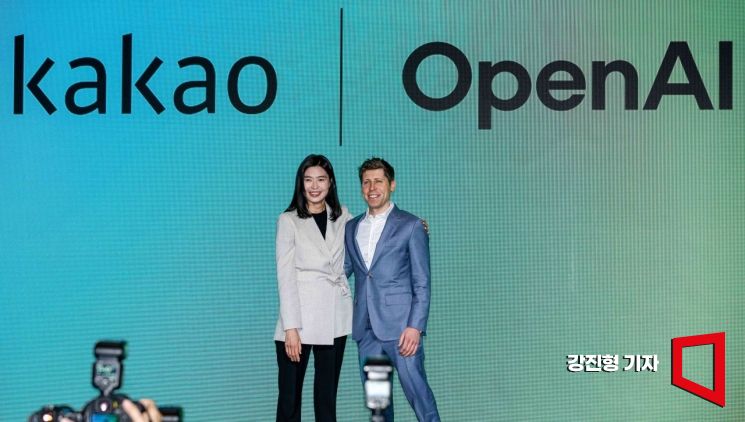 Sam Altman, CEO of OpenAI, the developer of ChatGPT, and Jeong Sin-ah, CEO of Kakao, are attending the 'Kakao Media Day' held at the Plaza Hotel in Jung-gu, Seoul on the 4th and posing for a photo. Photo by Kang Jin-hyung
In December last year, Kakao applied to the Personal Information Protection Commission for a preliminary adequacy assessment of Kanana. This was to ensure that Kanana complies with the Personal Information Protection Act while protecting individual privacy during its design and operation. Kanana, scheduled to be launched in the first half of this year, will be introduced as a separate application. Its feature is to remember key information from previous conversations within the context when users ask questions and provide optimized answers.
Kakao emphasized that an AI model serving as a safety device will be installed in Kanana. If a user attempts to extract another person's personal information through leading questions, the system will block the response or automatically review answers generated by the AI model to prevent exposure of others' phone numbers, emails, and similar information.
Kanana will primarily utilize Kakao's self-developed large language model (LLM), but OpenAI's models will also be used complementarily. However, OpenAI will not store data from Kanana chat rooms. If conversation data includes personally identifiable information or sensitive personal information such as account or card numbers, it will be processed by Kakao's own LLM. When using OpenAI's models to process conversation data containing personal information, the personal information parts will be encrypted.
When learning from conversation data with users using Kakao's own model, an "opt-out" condition will also be implemented, requiring separate consent from users. Opt-out means that users refuse to allow their input information to be used for generative AI training. Therefore, users who do not want their data to be used for Kanana model training can choose not to consent.
Internal management systems will also be strengthened. Kakao's Chief Privacy Officer (CPO) will establish and operate a Kanana personal information risk management system. Risk management plans and execution details will be regularly reported to the board of directors. The Personal Information Protection Commission plans to inspect whether Kakao is actually implementing the preliminary adequacy assessment measures once the Kanana service is officially launched.
© The Asia Business Daily(www.asiae.co.kr). All rights reserved.

















