Canada Imposes 25% Tariff on $21 Billion Worth of U.S. Products
Retaliatory Move Against U.S. 25% Tariffs on Steel and Aluminum
February CPI Growth Slows to 2.8%... Tariff Uncertainty Remains
The three major indices of the U.S. New York Stock Exchange showed mixed trends in early trading on the 12th (local time). Although concerns about entrenched high inflation were somewhat alleviated by the slowdown in the February Consumer Price Index (CPI), the market gave up its initial gains shortly after opening due to fears of a trade war triggered by retaliatory measures following the U.S. imposition of tariffs on steel and aluminum.
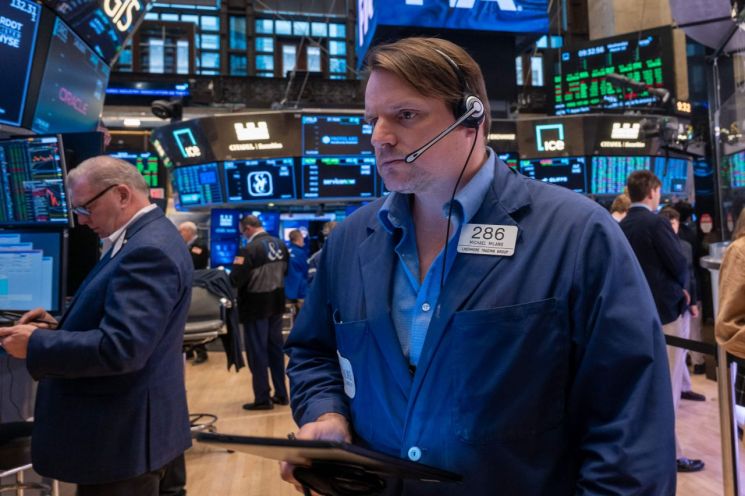
As of 11:29 a.m. in the New York stock market, the blue-chip-focused Dow Jones Industrial Average (Dow) was down 229.27 points (0.55%) from the previous trading day, standing at 41,204.21. The large-cap-focused S&P 500 index rose 5.35 points (0.1%) to 5,577.41, while the tech-heavy Nasdaq index increased by 114.97 points (0.66%) to 17,551.07.
By individual stocks, technology shares, which had recently experienced significant declines, showed a rebound. AI leader Nvidia surged 5.38%. U.S. electric vehicle maker Tesla rose 6.41%, and Meta, the parent company of Facebook, increased by 1.51%.
Last month's CPI data unexpectedly slowed, spreading relief in the market early in the session, but concerns about a trade war revived and weighed on investor sentiment. Canada announced that in response to the U.S. 25% tariffs on steel and aluminum, it would impose retaliatory tariffs of 25% on $21 billion (approximately 31 trillion won) worth of U.S. products starting from the 13th. These tariffs apply to U.S. steel, aluminum, computers, sports equipment, and cast iron products. Earlier, the European Union (EU) also announced it would impose retaliatory tariffs on $28 billion (approximately 41 trillion won) worth of U.S. imports starting in April in response to the U.S. steel and aluminum tariffs. The escalation of this tariff war has raised concerns that it could lead to stagflation (rising prices amid economic slowdown) or a recession, shaking investor confidence.
Prior to Canada's retaliatory tariff measures, the CPI report released before the market opened somewhat eased market concerns about entrenched inflation. The U.S. Department of Labor reported that the February CPI rose 2.8% year-over-year, below the market forecast of 2.9%, and slower than January's 3.0% increase. The core CPI, which excludes volatile energy and food prices, rose 0.2% month-over-month and 3.1% year-over-year, both below the previous month's 0.4% and 3.3% and the forecasted 0.3% and 3.2%, respectively.
The Federal Reserve (Fed), which is expected to keep the benchmark interest rate unchanged for the time being, is analyzed to have more flexibility in monetary policy operations due to this CPI slowdown. The market had previously anticipated that the Fed would delay resuming rate cuts due to rising inflation.
Dave Greksak, Investment Strategy and Research Managing Director at Espirient Wealth Management, said, "This data slightly dilutes stagflation discussions and allows the Fed to regain some policy flexibility. If inflation figures had been higher, concerns would have grown that the Fed might not respond even if the economy continued to slow."
The Fed is expected to hold the benchmark interest rate steady at the current 4.25?4.5% during the Federal Open Market Committee (FOMC) regular meeting scheduled for the 18th?19th. According to the Chicago Mercantile Exchange (CME) FedWatch tool, the federal funds futures market currently prices in a 97% probability of the Fed maintaining rates this month.
However, it is still too early to be reassured, as the full impact of U.S. President Donald Trump's tariffs may lead to future price increases.
U.S. Treasury yields showed slight gains. The 10-year U.S. Treasury yield, a global bond yield benchmark, rose 1 basis point (1 bp = 0.01 percentage points) to 4.3%, while the 2-year Treasury yield, sensitive to monetary policy, increased 2 basis points to 3.96%.
© The Asia Business Daily(www.asiae.co.kr). All rights reserved.

















