Government's '2024 Youth Life Survey'
Most Subjective Income Class Perceptions Worsen
Mental Health Indicators Such as Depression Also Deteriorate
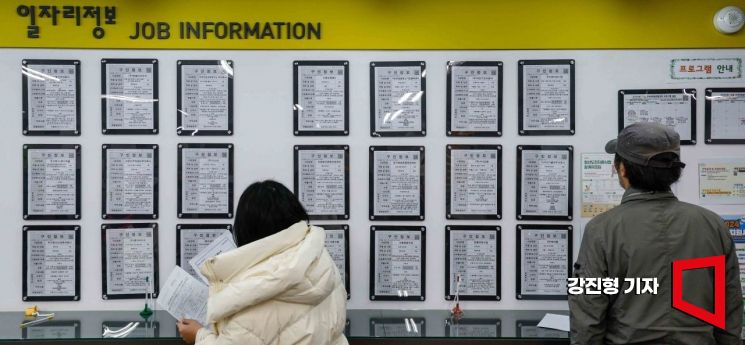 A job seeker visiting a Seoul Employment Center is looking at the job posting board. Photo by Kang Jin-hyung
The proportion of young people without spouses who answered that they have marriage plans has dropped by more than 10% over the past two years. The proportion of those who said they have plans to have children also decreased significantly. As uncertainties regarding jobs, income, and assets increase and life becomes more difficult, perceptions about marriage and childbirth appear to have changed.
According to the results of the "2024 Youth Life Survey" announced by the Office for Government Policy Coordination on the 12th, the proportion of unmarried youth who answered that they have marriage plans was 63.1%, down 12.2 percentage points from the initial survey result two years ago (75.3%). The decrease was similar for both men (79.8→67.8%) and women (69.7→57.5%).
The proportion of those who said they have plans to have children also decreased by 4 percentage points during the same period, from 63.3% to 59.3%. Both men (70.5→65.1%) and women (55.3→52.8%) showed declines. However, men showed higher intentions for marriage (67.8% > 57.5%) and childbirth (65.1% > 52.8%) compared to women.
Evaluations of current life mostly declined. Over two years, life satisfaction dropped slightly from 6.72 points to 6.71 points, happiness in life decreased from 6.89 points to 6.80 points, and freedom of choice fell from 6.93 points to 6.92 points. On the other hand, trust in society rose from 5.20 points to 5.23 points.
The average annual income of young individuals was 26.25 million KRW, an increase of 4.63 million KRW, but the average personal debt also rose by 4.65 million KRW to 16.37 million KRW over two years. The average personal assets of young people were recorded at 50.12 million KRW.
Regarding desired life elements, jobs were the most desired at 95.9%, followed by human relationships (94.7%), income and assets (93%), dating (78.3%), and marriage (74.4%).
Subjective perception of income class showed that the "middle class" was the most common at 52.9%, followed by lower-middle class (30.9%) and upper-middle class (9.5%). The proportions of those who answered middle class, upper-middle class, and upper class decreased compared to two years ago, while the proportions of those who answered lower-middle class and lower class increased.
Mental health indicators also worsened. The proportion of respondents reporting depressive symptoms was 8.8%, and those who experienced suicidal thoughts were 2.9%, increases of 1.7 and 0.5 percentage points respectively compared to two years ago. The proportion of reclusive youth (hikikomori) was 5.2%, more than doubling over two years.
In the past year, 6.3% experienced mental health problems that required professional counseling but did not receive it, with cost burden being the most common reason at 38.6%.
Meanwhile, this survey was conducted from June to August last year targeting over 15,000 households nationwide with youth household members aged 19 to 34.
© The Asia Business Daily(www.asiae.co.kr). All rights reserved.

















